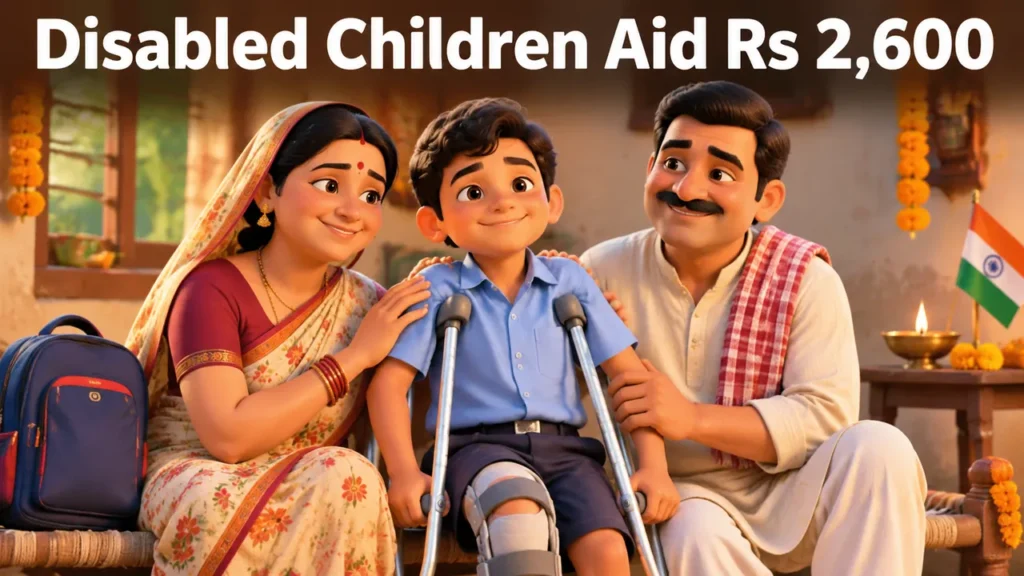
The Haryana Government pays Rs 2,600 every month to the family of a disabled child who cannot go to school — this is the “Financial Assistance To Non-School Going Disabled Children Scheme”, a state scheme of the Social Justice & Empowerment Department, running since 2008-09. Its most important feature is that it is paid for every such child in the family — there is no cap on the number of children — and it is meant for children who cannot attend formal education or training because of their disability. Note — myScheme still shows the old rate of Rs 2,150 a month (from April 2023); the department’s own website shows the current rate of Rs 2,600 a month (from November 2025), so this guide treats Rs 2,600 as today’s rate — do confirm the current rate in writing at your District Social Welfare Officer (DSWO) before applying.
The biggest confusion is mistaking this assistance for the Destitute Children assistance (FADC, guide 5983, Rs 2,300 a month). They are entirely different: FADC is for children deprived of parental care (death, long absence, imprisonment or incapacity of a parent), up to 2 children, up to age 21, and the parents’ annual income must not exceed Rs 2 lakh — while this scheme is for children who cannot go to school because of disability, with no cap on the number of children, and the income condition is “income less than the Minimum Wages”. The second confusion is with the Divyang Scholarship for school-going disabled children (40%+ disability, Rs 400–700 a month by class); that is for children who DO go to school, while this is for children who CANNOT. And the third confusion is with the Divyang Pension (Rs 3,200 a month) for adults; that is a pension for persons aged 18 and above, while this is assistance for children aged 0–18 — it stops when the child turns 18, and the child then becomes eligible for the Divyang Pension.
Scheme at a glance
| Point | Detail |
|---|---|
| Scheme name | Financial Assistance To Non-School Going Disabled Children Scheme (FANSGDCS); myScheme Haryana list entry #22 (pages 1–5) |
| Whose scheme | Haryana Government — Social Justice & Empowerment Department (Directorate); apply and get paid through the District Social Welfare Officer (DSWO) |
| Benefit | Rs 2,600 per child per month (from November 2025); paid for every eligible child in the family — no cap on the number of children |
| Who gets it | A child aged 0–18 years who cannot attend formal education/training because of disability; a resident of Haryana (living there for 3 years) |
| Disability | Mental retardation (IQ not exceeding 50) or 70%+ disability; cerebral palsy; autism; multiple disabilities totalling 70%+; orthopaedic disability of 100% permanent |
| Income condition | Income of parents/close relatives/the child’s own income from all sources is less than the income prescribed under the Minimum Wages (income proof verified by the competent authority) |
| How long | Until the child turns 18; after 18 the child becomes eligible for the Divyang Pension (Rs 3,200 a month) |
| How to apply | Online — on the Antyodaya SARAL portal (saralharyana.gov.in); also on paper by submitting the form at the DSWO office |
| Last date | No annual last date — apply year-round; RTS time limit 60 days |
| Fee | No government fee; CSC/Kendra service charges Rs 30 (Atal Seva Kendra also Rs 30) |
How much will you get? — Full rate table
Every eligible child gets a fixed monthly amount under this scheme — and remember, the amount has been raised several times; the full history is given below so that an old rate causes no confusion.
| From when | Rate (per child, per month) | Source |
|---|---|---|
| 1 December 2008 (scheme in force) | Starting rate not verified | 2009 Gazette (Notification 2351-SW-4-2008) |
| From 01.04.2021 | Rs 1,900 | SARAL service page |
| From April 2023 | Rs 2,150 | myScheme detail (now old) |
| From 1 January 2024 | Rs 2,400 | Aggregator report; The Tribune called Rs 2,400 the previous rate |
| From November 2025 (today’s rate) | Rs 2,600 | Department’s website + The Tribune (February 2026) |
| Example — 1 child | Rs 2,600 a month (Rs 31,200 a year) | — |
| Example — 2 children | Rs 5,200 a month (Rs 62,400 a year) | — |
| Example — 3 children | Rs 7,800 a month (Rs 93,600 a year) | No upper limit — every child gets it |
Know the rate history too — the scheme began in 2008-09 and the rate has been raised several times since. Today’s rate is Rs 2,600 a month, in force from November 2025 — confirmed by both the department’s own website and The Tribune’s February 2026 report. myScheme still shows Rs 2,150 a month (from April 2023) — that is the old rate, not today’s. There was also a Rs 2,400 rate in between (from 1 January 2024, as per an aggregator’s report; The Tribune also called Rs 2,400 the rate immediately before Rs 2,600, though its date could not be verified independently). And understand one thing clearly — this assistance is paid separately for every child; unlike the Destitute Children scheme (FADC), there is no 2-child cap here — however many children in a family are eligible, each gets Rs 2,600 a month. It is a monthly assistance, not a one-time grant — it will keep coming every month until the child turns 18.
The biggest confusion — this assistance vs other schemes
Haryana has several schemes for disabled children and adults, and their conditions differ — the most common confusion is about which scheme applies to whom. The table below makes the difference clear — and remember, this scheme’s definition says “cannot go to school”, which is the biggest dividing line.
| Scheme | For whom | Amount | Key condition |
|---|---|---|---|
| This scheme — Non-School Going Disabled Children (SJ&E) | A child aged 0–18 who cannot go to school because of disability | Rs 2,600 a month per child | Every child gets it; income below Minimum Wages; up to age 18 |
| Divyang Pension (guide haryana-divyang-pension-3200) | Disabled persons aged 18 and above | Rs 3,200 a month (from 01.11.2025) | Age 18+; 60%+ disability (as per the district page) |
| Destitute Children Assistance — FADC (guide 5983) | A child up to 21 deprived of parental care | Rs 2,300 a month per child | Maximum 2 children; annual income not above Rs 2 lakh |
| Divyang Scholarship (school-going children) | Disabled children studying in a recognised school | Rs 400–700 a month (by class) | 40%+ disability; passed the previous class; no other government aid |
| Disabled Children of Construction Workers (BOCW) | Disabled children of registered construction workers | Rs 2,000 a month | 50%+ disability; worker registered for at least 1 year |
| School Uniform, Books and Notebooks Assistance — HLWB (guide 7716) | Children of workers, Classes 1–8 | Rs 2,000 (Classes 1–4) / Rs 3,000 (Classes 5–8) | Worker’s 2 years of service; monthly wage up to Rs 20,000 |
| Rare Diseases Financial Assistance (guide 7416) | Persons suffering from listed rare diseases | Rs 3,200 a month (from 01.11.2025) | Listed rare disease; a separate scheme |
Who is eligible?
Every condition below must be met — these conditions are from the myScheme detail (slug fansgdcs), the SARAL service page and the 2009 notification; wherever information could not be verified, the guide says so clearly.
| Condition | Detail |
|---|---|
| Age | The child must be aged 0–18 years — the assistance stops when the child turns 18 |
| Cannot go to school | The child cannot attend formal education, training, etc. because of the disability — that is the definition of this scheme |
| Haryana residence | A domicile of Haryana State, residing in Haryana for the last three years at the time of submission of the application |
| Disability (Civil Surgeon certificate) | Mental retardation — IQ not exceeding 50, or disability of 70% and above; cerebral palsy; autism; multiple disabilities totalling 70%+ permanent; orthopaedic disability of 100% permanent (myopathy, paraplegic, quadriplegia) |
| Income condition | Income of parents, close relatives or the child’s own income from all sources is less than the income prescribed under the Minimum Wages; income proof verified by the competent authority must be submitted |
| Family situation | The parents/close relatives are not in a financial position to support the child; the child is totally dependent on parents and relatives and needs constant supervision and care from the family |
| Applicant | The child’s parents or guardian will apply — the child himself/herself is not the applicant |
| No other assistance | The child must not already be receiving assistance under the Scholarship, Unemployment Allowance or Handicapped Pension schemes run by the Social Justice & Empowerment Department |
Who is NOT eligible?
In any of the situations below, this assistance will not be paid — check yourself against this list before applying.
- The child has turned 18 — the assistance stops when the child turns 18; after that the Divyang Pension (Rs 3,200 a month) applies.
- The child goes to school — a child who can attend formal education is not covered by this scheme; see the Divyang Scholarship (for school-going children) instead.
- The disability is outside the list — for example, only 40% or 50% disability does not qualify under this scheme; for mental retardation the IQ must not exceed 50, or the disability must be 70% or more.
- Not residing in Haryana for 3 years — without a domicile certificate, or without three years of residence in Haryana, the application will not go through.
- Income above the Minimum Wages — the income of parents/relatives/the child from all sources must be less than the income prescribed under the Minimum Wages; higher income means no eligibility.
- Already getting a scholarship, unemployment allowance or handicapped pension — if the child is already receiving assistance under any of these three department schemes, this assistance will not be given.
The age condition — 18 years, and what happens after
The most important feature of this scheme is the age limit — the benefit is linked to a child aged 0–18. As soon as the child turns 18, this assistance stops. But that does not mean help ends completely — both the SARAL service page and myScheme say that “after attaining the age of 18 years, the beneficiary should automatically become eligible for a handicapped pension”. Today the Divyang Pension is Rs 3,200 a month (from 01.11.2025). But do not take the word “automatically” literally — the Divyang Pension has its own conditions (age 18+, Haryana domicile and 3 years of residence, a disability from the RPwD Act 2016 list; 60%+ disability as per the district page) and a separate application must be made for it. So prepare the Divyang Pension application before the child turns 18, so that no month goes without assistance. And one more thing — even before 18, if the child’s situation changes (for example, the child starts going to school), the DSWO must be informed, because then this scheme’s eligibility ends.
Documents required
The list below is taken from the SARAL service page and the application form — myScheme gives no document list for this scheme, so if even one paper is missing, the case will get stuck; confirm the exact list at your District Social Welfare Officer (DSWO) as well before applying.
| No. | Document | Note |
|---|---|---|
| 1 | Age proof (any one) | Birth certificate (from the Registrar of Births & Deaths) / affidavit attested by a First Class Magistrate / a certificate from any Gazetted Officer of the State/Central Government |
| 2 | Residential proof (any one, self-attested, issued prior to 5 years) | Ration card (Food & Supplies Department, Haryana) / voter card of the parents/guardian / the name of the applicant in the voters’ list showing the photograph of the parents/guardian / if none of these is available, a self-declaration document with any other documentary proof, to be verified by the DSWO |
| 3 | Disability certificate from the Civil Surgeon | Mental retardation (IQ not exceeding 50) or 70%+ disability; cerebral palsy; autism; multiple disabilities 70%+; orthopaedic disability of 100% permanent — as per the form, the certificate must not be more than 3 years old |
| 4 | Guardian certificate for mentally retarded children | Guardian certificate issued by the local-level committee — asked in the form; not mentioned in the myScheme/SARAL lists |
| 5 | Aadhaar card | Conflict: the SARAL page calls it “Optional”, but the application form marks the Aadhaar number as “mandatory” — carry your Aadhaar when filling the form |
| 6 | Bank account details | Saving bank account details with a photocopy of the passbook; the form also asks for the bank/post office/BC name, branch, IFSC code and account number |
| 7 | Parivar Pehchan Patra (PPP) | The Family ID is required for the SARAL application |
| 8 | Income proof + BPL/SECC details | Proof of annual income from all sources (verified by the competent authority); the form also asks for the BPL list number / Socio-Economic Caste Census number and category (SC/BC/General) |
| 9 | Affidavit and verification | Affidavit with the form — wrong information means the assistance can be stopped and recovered with 12% interest; verification by Sarpanch/Numberdar/Ward Councillor/Gazetted Officer; certification by BDPO/Municipal Corporation Secretary/CSC |
How to apply?
This assistance is applied for online — on the Antyodaya SARAL portal, and also on paper at the DSWO office. Follow the steps below, as given in myScheme and the SARAL service page — both routes are given below.
| Step | What to do |
|---|---|
| 1 | Check eligibility — the child is aged 0–18, cannot go to school because of disability, has lived in Haryana for the last 3 years, and income is below the Minimum Wages |
| 2 | Gather documents — birth certificate, residential proof, Civil Surgeon disability certificate (not more than 3 years old), Aadhaar, bank passbook, Parivar Pehchan Patra, income proof (see the list above) |
| 3 | Register on SARAL — register as a “New User” on saralharyana.gov.in; verify mobile and email with OTP and log in |
| 4 | Find the service — fill in your details under “Check Your Eligibility”; then select the department name “Social Justice And Empowerment” or search by the scheme name: “Financial Assistance to Non School Going Disabled Children less than 18 yrs. Scheme” |
| 5 | Fill and submit the form — click “Apply for Service/Scheme”, fill all mandatory details, upload documents, submit; paper route — collect the form from the DSWO office or download it from the department’s website, fill it, attach documents, get it verified and submit it at the DSWO office (you can also submit it at the BDPO/Municipal Corporation office after uploading it through a CSC) |
| 6 | Check the status — check the application’s status on the SARAL status portal with the application reference ID; you can also check by SMS — send “SARAL<Application ID>” from your registered mobile to 7738299899; you can also ask at the DSWO office |
Note — myScheme does not give the service’s serial number, so search for the scheme by name on the SARAL portal and confirm the service yourself. The SARAL portal did not load from here, so the steps above are taken from myScheme and the SARAL service page — check the service name and form on the portal yourself. If you face any difficulty in applying online, visit your District Social Welfare Officer (DSWO) office for help — the DSWO is the office that verifies your case.
Fee, timeline and status check
- Fee: There is no government fee (No Fee) — CSC/Kendra service charges of Rs 30 and Atal Seva Kendra charges of Rs 30 apply if you apply through a CSC.
- Timeline: There is no annual last date — you can apply year-round; the real deadline is the Right to Service (RTS) time limit of 60 days.
- Status check: Check on the SARAL status portal with the application reference ID; by SMS — send “SARAL<Application ID>” from the registered mobile to 7738299899; you can also ask at the DSWO office.
- RTS: The Right to Service (RTS) time limit for this service is 60 days (SARAL service page; the district page also says 60 days).
- Disposal time: A decision should come within the 60 days of RTS — but when the money will start after sanction is not stated in any official source — no number of days has been stated here.
How will the money come? — The payment route
After sanction, the assistance is paid every month — the route is as follows:
- Monthly payment — Rs 2,600 per child every month; under the 2009 notification the payment was made through the Panchayati Raj under the supervision of the Block Development and Panchayat Officer (BDPO) — today the route is the bank account (the form asks for full bank/post office/BC account details).
- Into the bank account — the money comes into the beneficiary’s saving bank account (a photocopy of the passbook is attached with the application); myScheme does not record this scheme as a DBT scheme (dbtScheme: null) — so no claim is made here that it comes “by DBT”.
- Separately for every child — however many children in a family are eligible, each gets Rs 2,600 a month; there is no upper limit.
- Affidavit condition — under the form’s affidavit, if the money is not withdrawn by biometric/debit voucher even once in 3 months, or the life certificate is not given, the department can stop the assistance and take back the money lying in the account — do not forget the 3-monthly withdrawal/life certificate.
- Recovery for wrong information — under the affidavit, if assistance was taken by giving wrong facts, the government has the right to stop the assistance and recover the amount taken with 12% interest.
When will the money come, and why is it delayed?
Under RTS, a decision should come within 60 days — but how many days after applying the money reaches your hand is not stated in any official source. One thing is certain — this assistance is monthly, so after sanction Rs 2,600 should come every month; the most common reasons for delay in sanction are incomplete documents (especially a Civil Surgeon disability certificate more than 3 years old, or no income proof), not finding the service name on SARAL, or residential proof not issued prior to 5 years. So stay in touch with your DSWO after applying, and keep checking your application’s status on the SARAL status portal with the reference ID. If no decision comes within 60 days, there is a complaint route under RTS — ask at the DSWO office.
Scheme budget and scale
This assistance runs on the Social Justice Department’s budget — the figures given on the department’s own website are as follows:
| Point | Detail |
|---|---|
| 2021-22 provision / beneficiaries / expenditure | Rs 2,700.00 lakh / 11,684 children / Rs 2,167.74 lakh |
| 2022-23 provision / beneficiaries / expenditure | Rs 2,200.00 lakh / 9,553 children / Rs 2,111.68 lakh |
| 2023-24 provision / beneficiaries / expenditure | Rs 2,500.00 lakh / 9,553 children / expenditure is blank on the department’s website — not verified |
| 2024-25 | Provision, expenditure and beneficiary counts not found — not verified |
| 2025-26 | Provision, expenditure and beneficiary counts not found — not verified; no figure has been invented in the guide |
Frequently asked questions (FAQ)
1. How much assistance will I get under this scheme?
Rs 2,600 a month per child (from November 2025) — for every eligible child in the family, with no cap on the number of children. myScheme still shows the old rate of Rs 2,150 a month (from April 2023) — that is now old; today’s rate is Rs 2,600, confirmed by the department’s website and The Tribune.
2. Who is the applicant — the child himself/herself, or the parents?
The parents or guardian. The child is aged 0–18, so the parents or guardian will apply; for mentally retarded children, a guardian certificate issued by the local-level committee is also asked in the form.
3. Which disabilities are eligible?
On the Civil Surgeon’s certificate: mental retardation — IQ not exceeding 50, or disability of 70% and above; cerebral palsy; autism; multiple disabilities totalling 70%+ permanent; orthopaedic disability of 100% permanent (myopathy, paraplegic, quadriplegia). Only 40% or 50% disability does not qualify under this scheme.
4. Is the IQ limit 50 or 35?
Today’s limit is IQ 50. The original 2009 notification said IQ not exceeding 35 — the limit was later raised to 50 (when and by which order could not be verified). Today myScheme, the SARAL service page and the department all say IQ 50.
5. What is the income condition — at what income is eligibility lost?
Income must be “less than the income prescribed under the Minimum Wages” — but it is not stated anywhere whether this is a monthly or an annual income, or which skill category’s wage applies. The 2009 notification quantified it as Rs 3,510 a month (as in 2008); today the unskilled minimum wage is Rs 15,220.71 a month (from 1 April 2026, Labour Department notification). Ask your DSWO in writing what income limit is being applied today.
6. What happens when the child turns 18?
This assistance stops — and the child becomes eligible for the Divyang Pension. The SARAL service page and myScheme say that on attaining 18 years the beneficiary “should automatically become eligible for a handicapped pension” — today the Divyang Pension is Rs 3,200 a month (from 01.11.2025). But do not take “automatically” literally — a separate application must be made for the Divyang Pension, and it has its own conditions.
7. Where do I apply — on SARAL or at the DSWO?
Both routes exist. Per myScheme, online on the Antyodaya SARAL portal — register, log in, fill “Check Your Eligibility”, select the department “Social Justice And Empowerment” or search by the scheme name (“Financial Assistance to Non School Going Disabled Children less than 18 yrs. Scheme”), fill the form under “Apply for Service/Scheme” and submit. On paper — collect the form from the DSWO office or download it from the department’s website, fill it, attach documents, get it verified and submit it at the DSWO office.
8. Is an Aadhaar card required or not?
The two sources say different things — so carry your Aadhaar. The SARAL service page calls Aadhaar “Optional”, but the application form marks the Aadhaar number as “mandatory”. Carrying your Aadhaar card when filling the form is the safe option.
9. How is this different from the Destitute Children assistance (FADC)?
They are two different schemes. FADC (guide 5983) is for children deprived of parental care — Rs 2,300 a month, maximum 2 children, up to age 21, annual income not above Rs 2 lakh. This scheme is for children who cannot go to school because of disability — Rs 2,600 a month, no cap on the number of children, up to age 18, with the income condition “less than the Minimum Wages”.
10. What is the fee, and how many days will a decision take?
There is no government fee — CSC/Kendra service charges of Rs 30 and Atal Seva Kendra charges of Rs 30 apply if you apply through a CSC. The RTS time limit is 60 days — a decision should come within 60 days.
Official links and contact
The links below are official sources. The 2021 notification PDF is a scanned image — its full text could not be read from here, so its link is given for information.
- myScheme — scheme detail: myscheme.gov.in/schemes/fansgdcs — “Financial Assistance To Non-School Going Disabled Children Scheme” (slug fansgdcs, short title FANSGDCS); the rate table, eligibility and SARAL process are taken from there
- Department’s scheme page: socialjusticehry.gov.in — Financial Assistance To Non-School Going Disabled Children — the current rate of Rs 2,600 a month (from November 2025) and the budget/beneficiary figures are taken from there
- Notification — 2009 Gazette: Haryana Gazette, 17 February 2009 — Notification 2351-SW-4-2008 — the original scheme, in force from 1 December 2008; the IQ limit of 35 and the income of Rs 3,510 a month (2008) are taken from there
- SARAL service page (PDF): Antyodaya-SARAL — Financial Assistance to Non School Going Disabled Children less than 18 yrs. Scheme — the document list, fees (no government fee; CSC Rs 30), RTS 60 days and helpline are taken from there
- Application form (PDF): Application form — Non-School Going Disabled Children — the form’s fields, affidavit and verification are taken from there
- Antyodaya SARAL portal: saralharyana.gov.in — online application; SARAL helpline 0172-3968400; email [email protected]
- Directorate of Social Justice and Empowerment: SCO 20-27, Jeevandeep Building, 3rd floor, Sector 17-A, Chandigarh; phone 0172-2715090; email [email protected]
- Related guide — Divyang Pension Rs 3,200: Divyang Pension Scheme | Destitute Children Assistance Rs 2,300: Destitute Children Assistance (FADC) | Haryana Widow Pension Rs 3,200: Widow Pension Scheme | Rare Diseases Assistance Rs 3,200: Rare Diseases Assistance | Silicosis Pension: Silicosis Rehabilitation Pension | Kinnar Bhatta Rs 3,200: Kinnar Bhatta | Acid Attack Victim Assistance: Acid Attack Victim Assistance | School Uniform Assistance — HLWB: School Uniform Assistance | Mukhyamantri Vivah Shagun: Vivah Shagun Scheme | DAYALU: DAYALU Scheme
Disclaimer
This guide was prepared on 9 November 2026 from the official sources available — the myScheme Haryana list (entry #22, pages 1–5) and the myScheme detail (slug fansgdcs, short title FANSGDCS; read via the myScheme API), the Haryana Social Justice & Empowerment Department’s scheme page (socialjusticehry.gov.in — the current rate of Rs 2,600 a month from November 2025, and the budget/beneficiary figures), the Haryana Gazette of 17 February 2009, Notification 2351-SW-4-2008 (the original scheme, in force from 1 December 2008), the Antyodaya-SARAL service page (document list, fees, RTS 60 days) and the application form (form fields, affidavit, verification), the Haryana Labour Department’s Minimum Wages notification (No. 2/25/26-2 Lab, 9 April 2026, effective 1 April 2026) and The Tribune’s February 2026 report (the rise from Rs 2,400 to Rs 2,600). The most important point: myScheme still shows the old rate of Rs 2,150 a month (from April 2023), while the department’s website shows the current rate of Rs 2,600 a month (from November 2025) — this guide treats Rs 2,600 as today’s rate, but do confirm the current rate in writing at your DSWO before applying; the income condition (“less than the Minimum Wages”) does not state clearly whether it is a monthly or an annual income, or which skill category’s wage applies — ask that too in writing at the DSWO. The amount, eligibility and process can change — before applying, do get the latest information in writing from your District Social Welfare Officer. Wherever sources differ or information could not be verified (especially today’s rate, the date of the Rs 2,400 rate, the order changing the IQ limit, what the income limit means, whether Aadhaar is required, and the 2024-25 and 2025-26 budget and beneficiary counts), the guide says so clearly. Viksit Haryana is not an official portal of any government department.

Leave a Reply