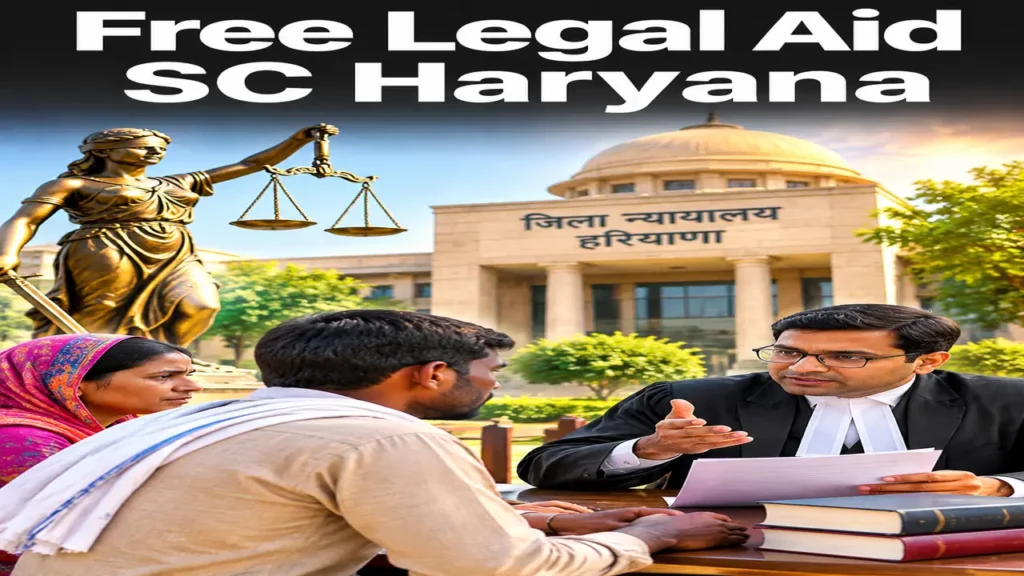
Fighting a case in court is expensive — the lawyer’s fee alone is beyond the reach of many families. That is why the Haryana government has run a special scheme since 1961: the Legal Aid to Scheduled Castes and Vimukat Jatis Scheme. Under it, a person belonging to a Scheduled Caste (SC) or a Vimukat Jati (denotified tribe) gets a free lawyer for certain specific types of cases — the government pays the lawyer’s fee, and the applicant pays nothing. The District Welfare Officer (DWO) can sanction an advocate’s fee of up to Rs 22,000; if the fee is higher, the Deputy Commissioner (DC) sanctions it. This is a 50:50 cost-sharing scheme of the Government of India and the State Government. This guide has the full details — which 11 types of cases are covered, who can apply, how to reach the Tehsil/District Welfare Officer, how to apply online on SARAL, and how this scheme differs from the DLSA’s free legal aid.
Understand one thing clearly: Rs 22,000 is NOT paid to the applicant in cash — it is the maximum limit of the advocate’s fee, which the government pays directly to the lawyer. Some websites describe it as “Rs 22,000 assistance” — that is not correct.
Scheme at a glance
| Point | Detail |
|---|---|
| Scheme name | Legal Aid to Scheduled Castes and Vimukat Jatis Scheme (50:50) |
| Started | 13 February 1961 — “Legal Aid to Scheduled Castes (Punjab) Rules, 1960” (Punjab Government Notification No. 13889-6WGI-60/3950); continued in Haryana after the state was formed |
| Type | Haryana state scheme — 50:50 cost-sharing between the Centre and the State Government |
| Department | Department of Social Justice, Empowerment, Welfare of SC & BC and Antyodaya (SEWA), Haryana |
| Benefit | Free lawyer — the government pays the advocate’s fee; the applicant pays nothing |
| Fee limit | DWO can sanction an advocate’s fee up to Rs 22,000; above that, the Deputy Commissioner (DC) sanctions it (raised from Rs 11,000 to Rs 22,000 by the amendment of 21 June 2021) |
| Who can apply | A Haryana resident belonging to a Scheduled Caste or a Vimukat Jati (proved by caste certificate) |
| Income limit | No income limit is given in the rules or on the department page — eligibility is caste-based |
| Where to apply | Tehsil Welfare Officer (TWO) or District Welfare Officer (DWO) office; online — Antyodaya Kendra or saralharyana.gov.in |
| Application fee | None — the application is free |
| Last date | No fixed last date — the scheme is ongoing; apply at any time |
| Contact | District Welfare Officer (DWO) office of your district; NALSA helpline 15100 (24×7, toll-free) |
What does Rs 22,000 mean?
Under this scheme the government does not give money to the applicant — it appoints a lawyer and pays the fee. The process works like this:
- Appointment of counsel: The District Welfare Officer (DWO) appoints a counsel from the State List maintained for the district — the applicant does not have to find a lawyer.
- Sanction of fee: The DWO can sanction a lawyer’s fee bill up to Rs 22,000. If the fee is above Rs 22,000, the Deputy Commissioner (DC) sanctions it, as per the rates in the Law Manual.
- History of the limit: The limit was earlier Rs 11,000; it was raised to Rs 22,000 by the notification of 21 June 2021 (No. 270-SW(1)-2021).
- What the applicant gets: A free lawyer to defend or institute the case — no fee, no expense.
Which cases are covered?
According to the department page, legal aid is given only for the following types of cases — not for every case:
| No. | Type of case | Meaning |
|---|---|---|
| 1 | Criminal cases on private complaints | Criminal cases instituted on private complaints, including security proceedings under Chapter VIII of the Code of Criminal Procedure, 1898 |
| 2 | Ejectment from land/immovable property | Cases of ejectment from land and other immovable property |
| 3 | Recovery of rent by landlords | Cases of recovery of rent by landlords |
| 4 | Deposit of rent with Revenue Officer | When a landlord refuses to receive rent or grant a receipt, or when there is doubt about who is entitled to receive the rent |
| 5 | Correction of Khasra Girdawaries | Cases pertaining to correction of Khasra Girdawaries by landlords |
| 6 | Claim to right of way | Cases involving a claim to right of way of usage |
| 7 | Forcible removal of dung heaps | Cases involving forcible removal of dung heaps |
| 8 | Compensation for untouchability harassment | Compensation for harassment caused by observance of untouchability, denial of drinking water, or denial of entry into a temple or hostel |
| 9 | Share of seri, sanjees or seepiders in produce | Cases involving share of seri, sanjees or seepiders in agricultural produce |
| 10 | Damages for abduction/enticement | Claim for damages under the Law of Torts by husbands or parents of women or girls abducted or enticed away |
| 11 | Reservation in services cases | Cases involving reservation in services filed by SC/Vimukat Jati/Tapriwas employees in court |
Note: Whether your case falls in this list is decided by the District Welfare Officer. On receiving the application, the DWO first examines whether the case is fit for legal aid, and then appoints the counsel.
Who can apply?
- A resident of Haryana.
- A member of a Scheduled Caste (SC) or a Vimukat Jati — to be proved by a caste certificate.
- The case must be one of the types listed above.
- No income limit: No income limit is given on the department page or in the rules for this scheme — eligibility is caste-based, not income-based. (Under the DLSA’s free legal aid too, there is no income limit for SC/ST members — see “Understand the difference” below.)
- Defending or instituting: Aid is available whether you have to defend a case or institute one.
Who are Vimukat Jatis?
“Vimukat Jati” means denotified tribes — communities that were declared “criminal tribes” under the colonial Criminal Tribes Act, 1871. After independence, that law was repealed in 1952 and these communities were “denotified” (vimukt) — hence the name Vimukat Jati. In Haryana, these communities are grouped with the Tapriwas communities. Under this scheme, Vimukat Jati members get the same legal aid as members of Scheduled Castes. Note: A separately published official list of Haryana’s Vimukat Jatis could not be verified in this research — confirm from the District Welfare Officer whether your community falls in this category.
How to apply — step by step
There are two routes — offline (verified, recorded in the rules) and online (recorded on the department page):
- Visit the District Welfare Officer (DWO) or Tehsil Welfare Officer (TWO) office of your district: The application is made to the TWO or the DWO. The DWO office is usually in the district secretariat/mini secretariat complex — ask for the address at the Deputy Commissioner’s office or on the SARAL helpline.
- Submit the application: A simple application — your name, address, caste, details of the case and the relief sought. Attach the documents listed below.
- The DWO will examine the case: Under the rules, the TWO/DWO examines immediately on receipt whether the case is fit for legal aid. If the case is found fit, the DWO issues the order at once.
- A counsel will be appointed: The DWO appoints a counsel from the State List for the district — the counsel will defend or institute your case in court.
- The government pays the fee: The DWO sanctions the counsel’s fee bill up to Rs 22,000; above that, the Deputy Commissioner (DC) sanctions it. You pay nothing to the lawyer.
- Online application (alternative): According to the department page, visit the nearest Antyodaya Kendra or saralharyana.gov.in for online applications. Note: the exact SARAL service name for this scheme could not be verified — search for “Legal Aid” on the portal or ask at the Antyodaya Kendra/CSC.
If the DWO rejects the application: The rules give the DWO the power to examine the fitness of the case — if your case does not fall in the list, use the DLSA route (below), where SC/ST members get free legal aid for every type of case.
What documents are needed?
No document list is published on the department page — the list below follows the usual government process; confirm the final list at the DWO/TWO office:
| Document | Why it is needed |
|---|---|
| Identity proof — Aadhaar card / voter ID | To establish your identity |
| Haryana residence proof — domicile certificate / PPP Family ID | To prove you are a Haryana resident |
| Caste certificate — SC / Vimukat Jati | To prove eligibility (SC or Vimukat Jati) — the most important document |
| Case papers — notices, court papers, land records, Khasra Girdawari etc. | For the DWO to understand the case and examine its fitness |
| Passport-size photo | For the application form |
| Mobile number | For contact and SMS updates |
Note: No officer can refuse to accept your application for want of documents — documents can also be submitted later. A caste certificate can be made online through the SARAL portal (saralharyana.gov.in).
Fee, timeline and status check
| Point | Status |
|---|---|
| Application fee | None — the application is free |
| Lawyer’s fee | Paid by the government — DWO up to Rs 22,000, DC above that (at Law Manual rates) |
| Examination of application | The TWO/DWO examines the fitness of the case immediately on receipt (Rule 5, 1976 amendment) |
| Status check (online) | If applied on SARAL, check on status.saralharyana.nic.in with the application number |
| Status check (offline) | District Welfare Officer (DWO) office — where the application was submitted |
| Last date | No fixed last date — the scheme has run since 1961; apply at any time |
| Timeline (RTS) | No RTS timeline is published — no timeline is given in this guide |
Understand the difference — SEWA scheme vs DLSA/NALSA free legal aid
People from SC communities in Haryana have two separate routes to free legal help — do not mix them up:
| Point | SEWA Legal Aid Scheme (this guide) | DLSA / NALSA free legal aid |
|---|---|---|
| Law / rules | Legal Aid to SC (Punjab) Rules, 1960 (13 February 1961); Haryana SEWA Department | Legal Services Authorities Act, 1987, Section 12; NALSA / Haryana State Legal Services Authority (HSLSA) |
| For whom | Members of SC and Vimukat Jatis | SC/ST members, women, children, persons with disabilities, low-income persons and other entitled categories — no income limit for SC/ST |
| Which cases | Only the 11 types listed above | Every type of case — civil, criminal, all courts and tribunals |
| Where to go | Tehsil/District Welfare Officer (DWO); online on SARAL | DLSA of the district (District Court complex, ADR Centre); NALSA helpline 15100 |
| Who gives the lawyer | DWO appoints counsel from the State List | DLSA appoints a panel lawyer / Legal Aid Defence Counsel |
| Fee | Government pays — DWO up to Rs 22,000, DC above that | Completely free — lawyer, advice, court fees, everything |
Which route to choose? If your case falls in the 11 categories above, the SEWA scheme is direct. If your case does not fall in those categories — or you need advice immediately — use the DLSA route: visit your district’s DLSA or call 15100. The two routes do not block each other.
Other routes to free legal aid
- NALSA helpline 15100 (24×7, toll-free): The national helpline for free legal advice and aid — the call itself will tell you where the nearest DLSA is and what to do.
- District Legal Services Authority (DLSA): Every district has a DLSA office (ADR Centre) in the District Court complex — apply there for a free lawyer. SC/ST members are entitled under Section 12 without any income limit.
- Haryana State Legal Services Authority (HSLSA): Institutional Plot No. 9, Sector-14, Panchkula — 134109; phones 0172-2583309 / 0172-2586309; email [email protected].
- Lok Adalat: HSLSA/DLSA organise Lok Adalats from time to time — a way to settle a case quickly by mutual agreement; the decision is final.
- Atrocity cases are a separate route: Victims under the SC/ST (Prevention of Atrocities) Act, 1989 get separate financial assistance (Rs 85,000 to Rs 8,25,000, according to the district administration) — this is different from this scheme; in such cases contact the police/FIR and the DWO immediately.
Frequently asked questions (FAQ)
1. Will I get Rs 22,000 in cash?
No. Rs 22,000 is the maximum limit of the advocate’s fee — the money is paid by the government directly to the lawyer. You get a free lawyer, not cash.
2. Who can apply?
A Haryana resident belonging to a Scheduled Caste or a Vimukat Jati. Eligibility must be proved with a caste certificate. There is no income limit in this scheme.
3. Which cases are covered?
Only 11 types of cases — criminal cases on private complaints, ejectment from land, rent, Khasra Girdawari, right of way, compensation for untouchability, share in produce, damages for abduction, and reservation-in-services cases. The full list is given above.
4. Where do I apply — online or offline?
Both. Offline: give a simple application to the Tehsil Welfare Officer (TWO) or District Welfare Officer (DWO) of your district. Online: visit an Antyodaya Kendra or apply on saralharyana.gov.in — the exact SARAL service name could not be verified, so search for “Legal Aid” on the portal or ask at the centre.
5. Who will give me the lawyer — can I choose my own?
No — the DWO appoints a counsel from the State List for the district. The government pays the fee — up to Rs 22,000 by the DWO, above that by the Deputy Commissioner (DC).
6. Is there a last date?
No. The scheme has run since 1961 — there is no fixed last date; you can apply at any time.
7. What if my case does not fall in the 11 categories?
Then use the DLSA route — visit the District Legal Services Authority (District Court complex) or call the NALSA helpline 15100. Under Section 12, SC/ST members get free legal aid for every type of case, without any income limit.
8. Is there an income limit in this scheme?
No income limit is given on the department page or in the rules — eligibility is caste-based. If a DWO office asks for income proof, ask them in writing under which rule it is being asked for.
9. How much will the application cost?
Nothing — the application is free and the government pays the lawyer’s fee. If anyone asks for money, be careful and complain to the DWO office or on 15100.
10. What does Vimukat Jati mean?
Vimukat Jatis are communities that were called “criminal tribes” under the British-era Criminal Tribes Act, 1871; when that law was repealed in 1952, they were “denotified” (vimukt). In Haryana they are grouped with the Tapriwas communities. Confirm from the DWO office whether your community falls in this category.
Official links and contacts
| Work | Link / contact |
|---|---|
| SEWA Department — scheme page | sewa.haryana.gov.in — Legal Aid to SC and Vimukat Jatis (50:50) (list of cases, Rs 22,000 limit and SARAL note — official page) |
| Amendment Notification 21.06.2021 (PDF) | Notification No. 270-SW(1)-2021 — fee limit raised from Rs 11,000 to Rs 22,000 (from the SEWA Department site) |
| myScheme — Haryana schemes (list) | myscheme.gov.in/search/state/Haryana (the myScheme detail page for this scheme is client-rendered and could not be read directly) |
| Antyodaya SARAL portal | saralharyana.gov.in — online application; SARAL helpline 0172-3968400; status check at status.saralharyana.nic.in |
| Haryana State Legal Services Authority (HSLSA) | haryana.nalsa.gov.in — Institutional Plot No. 9, Sector-14, Panchkula — 134109; 0172-2583309 / 0172-2586309; [email protected] |
| National Legal Services Authority (NALSA) | nalsa.gov.in — free legal aid helpline 15100 (24×7, toll-free) |
| District Welfare Officer (DWO) | DWO office of your district (District Secretariat / Mini Secretariat complex) — for applications and status checks |
| Emergency services | 112 (ERSS); Police 100 |
Related guides — also read: Haryana Domestic Violence Protection Act 2026: Protection Order, Complaint Process and Help | Free Coaching for SC/BC Students for Competitive Exams: Eligibility & Apply | SC Students Tuition Fee Refund & Transport Facility: Up to Rs 40,000 | Haryana Old Age Samman Allowance 2026: Rs 3,200 Per Month
Disclaimer
This guide is based on official sources available on 8 November 2026 — the Haryana SEWA Department scheme page, the amendment notification of 21 June 2021 (No. 270-SW(1)-2021), the Haryana Gazette of 27 April 1976, NALSA/HSLSA information and the myScheme portal. This guide is for legal information, not legal advice — do consult the District Welfare Officer, a DLSA lawyer or an advocate for your own case. Helpline numbers, office addresses and rules can change over time — confirm the latest information on 15100 or at the DWO office before contacting. Where sources differ or information could not be verified, the guide says so clearly. Viksit Haryana is not an official portal of any government department.

Leave a Reply