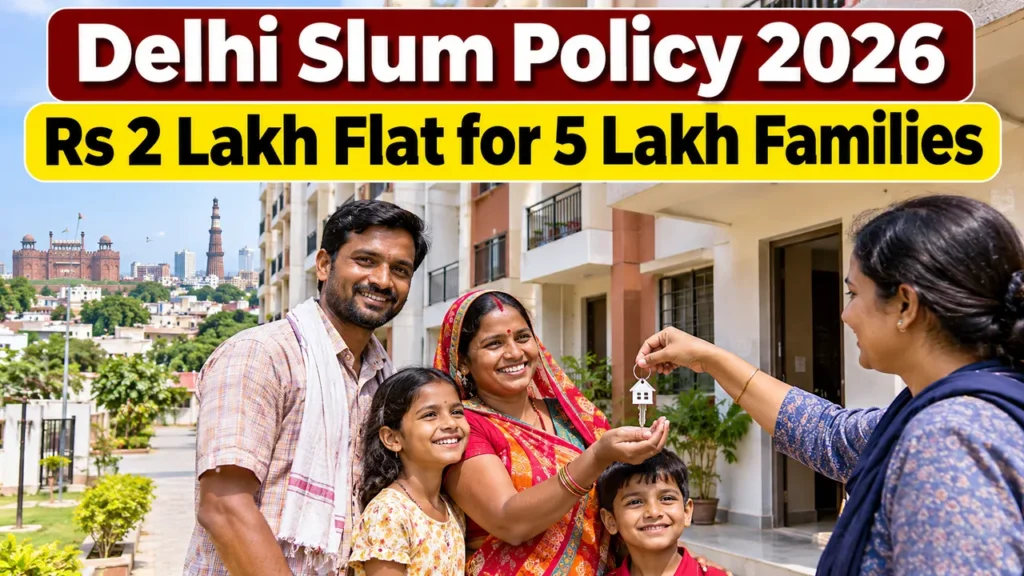
The Delhi government, led by Chief Minister Rekha Gupta, has notified the Delhi Slum and Jhuggi Jhopri Relocation and Rehabilitation Policy, 2026, opening the way to permanent homes for nearly 4 to 5 lakh families — around 20 lakh people — living in slum settlements across the national capital. The policy was published in the Delhi Gazette on 4 November 2026 and covers about 675 slum clusters. Chief Minister Rekha Gupta said the government’s aim is not merely to remove slums but to ensure that every eligible family gets a permanent home where they can live safely and with dignity. The policy gives fresh momentum to the government’s ‘Jahan Jhuggi, Wahan Makan’ (where the slum is, there the home) scheme.
Under the policy, each eligible family will get a one-bedroom, hall and kitchen (1-BHK) flat with a minimum carpet area of 25 square metres, including a living room, kitchen, bathroom, toilet and balcony. The family will contribute Rs 2 lakh in total — Rs 1.5 lakh towards alternative housing and Rs 50,000 towards common-area maintenance for the first five years. The government may revise both amounts through future notifications. The allotted flat will carry a 10-year lock-in period, during which it cannot be sold or transferred. Rehabilitation complexes will also have supporting infrastructure such as schools, Anganwadi centres, healthcare facilities and playgrounds.
The biggest condition is the cut-off date — only families whose slum existed in the settlement before 1 January 2025 are eligible. The applicant must be an Indian citizen aged 18 years or above, and their name must appear in the voter list issued before the cut-off date and in the voter list of the year of the official survey. To prove eligibility, the applicant must produce at least one of ten prescribed documents issued before 1 January 2025 and showing the same address — these include the ration card, electricity bill, driving licence, passport and bank or post office passbook. Families that already own a pucca house anywhere in the country are excluded, as are serving and retired government employees.
In-situ rehabilitation gets priority — wherever possible, families will be rehoused at the existing settlement site or within a radius of three kilometres, so that jobs, children’s schools and daily life are not disrupted. No eligible family’s jhuggi will be removed without alternative accommodation being provided. The Delhi Urban Shelter Improvement Board (DUSIB) and the Delhi Development Authority (DDA) will implement the policy on land under their respective jurisdictions. Allotment will be through a computerised draw of lots, and a grievance redressal and appeal system will be set up. The government will maintain common infrastructure, services and security for five years from the first allotment, after which the responsibility will pass to beneficiary associations. The policy also has special provisions for families with persons with disabilities, separate families living on different floors of the same jhuggi, and temporary accommodation during redevelopment. It replaces the earlier rehabilitation guidelines and orders issued under the Delhi Urban Shelter Improvement Board Act, 2010. The cut-off date itself was moved from 1 January 2015 to 1 January 2025 at a DUSIB meeting on 23 June 2026, and the Gazette notification has now given it legal form.
Frequently Asked Questions
How can a Delhi slum family get a flat for Rs 2 lakh?
Under the Delhi Slum and Jhuggi Jhopri Relocation and Rehabilitation Policy 2026, an eligible family pays Rs 1.5 lakh towards housing and Rs 50,000 towards five years of common-area maintenance, and gets a 25 square metre 1-BHK flat. Allotment is through a computerised draw of lots.
Who is eligible under the Delhi slum rehabilitation policy?
Families whose slum existed in the settlement before 1 January 2025, who are Indian citizens aged 18 or above, whose name is in the voter list from before the cut-off date, and who do not own a pucca house anywhere in India.
How big is the flat and what will it cost?
The flat has a minimum carpet area of 25 square metres, with one bedroom, a living room, kitchen, bathroom, toilet and balcony. The total contribution is Rs 2 lakh — Rs 1.5 lakh for housing and Rs 50,000 for five years of maintenance.
Can the flat given under the Delhi rehabilitation policy be sold?
No. The allotted flat carries a 10-year lock-in period, during which it cannot be sold or transferred.
Next Action: See Haryana’s government schemes and utility tools in one place here — Haryana Utility Tools.
Leave a Reply