
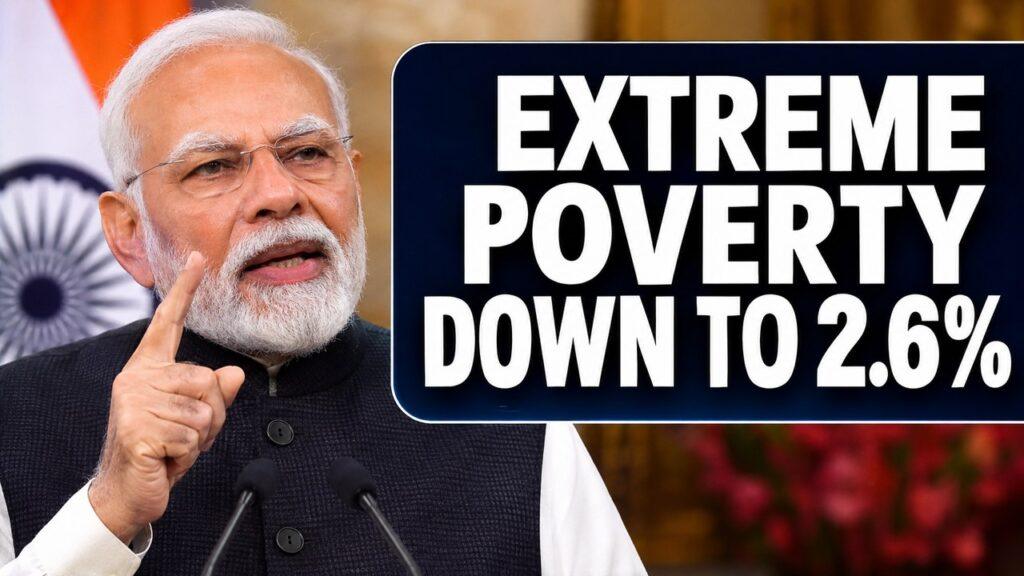
World Bank India Poverty Report: Extreme Poverty Falls from 27.1% to 2.6% as PM Modi Hails Historic Decline
Prime Minister Narendra Modi has highlighted a historic fall in poverty in India after the World Bank’s October 2026 Poverty and Equity Brief recorded extreme poverty dropping from 27.1 per cent in 2011 to 2.6 per cent in 2023. Sharing the findings on 1 November, the Prime Minister described the decline as a historic fall in poverty and a generational rise in opportunity.
The World Bank brief, released on 30 October 2026, measures extreme poverty at three dollars a day and the lower-middle-income poverty line at 4.20 dollars a day, both at 2021 purchasing power parity. On the 4.20-dollar line, the share of Indians living in poverty fell from 57.7 per cent in 2011 to 16.1 per cent in 2023, lifting an estimated 496 million people above that line over the period.
The report describes India’s progress as one of the fastest poverty declines in the world. It points to strong consumption growth, rising employment, especially among women, and expanded social transfers, including food subsidies, as the main drivers of the improvement.
Finance Minister Nirmala Sitharaman welcomed the findings and said the government’s sustained policy efforts under Prime Minister Modi’s leadership are yielding tangible results. She said the progress strengthens the foundations for inclusive growth and greater economic opportunity, and links it to the continued trust and mandate of the National Democratic Alliance government.
The brief also records sharp progress on non-monetary measures of poverty. Multidimensional poverty fell from 53.8 per cent in 2005-06 to 16.4 per cent in 2019-21, while the World Bank’s own multidimensional measure stood at 15.5 per cent in 2022-23.
Looking ahead, the World Bank projects poverty to keep declining, though more gradually, with the rate at the 4.20-dollar line expected to fall from 14.2 per cent in 2026 to 12.1 per cent by 2028. The report also flags persistent wage disparities and broadly unchanged real earnings as areas that still need attention, even as the headline poverty numbers show a dramatic improvement over twelve years.