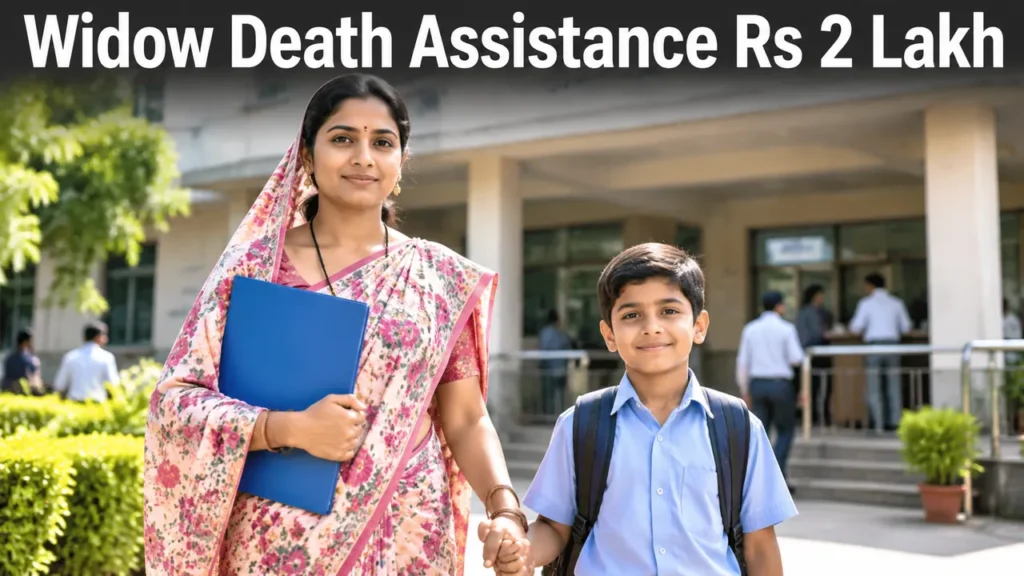
If a worker employed in a factory, shop or industrial establishment in Haryana dies, his family gets a one-time financial assistance of Rs 2,00,000 from the Haryana Labour Welfare Board (HLWB). This assistance is given to the deceased worker’s widow or dependent — provided the worker was registered with the Board, his period of service was at least 6 months, and his monthly wage was not more than Rs 20,000. In addition, a separate Rs 15,000 is given for cremation, so by claiming both, the family can receive a total of Rs 2,15,000. This guide gives the full eligibility, documents, online and offline application process, timeline, and the answers to the confusions in which people mix this scheme up with the Rs 2 lakh death assistance for construction workers or the Rs 5 lakh accident-death scheme.
Scheme at a Glance
This scheme belongs to the Haryana Labour Welfare Board, which was constituted under Section 4 of the Punjab Labour Welfare Fund Act, 1965. The Board exists for the welfare of workers in industrial establishments, shops and commercial establishments — the employer contributes to the Labour Welfare Fund on the workers’ behalf, and the benefits are paid from that fund. The table below puts the key facts in one place.
| Item | Detail |
|---|---|
| Scheme name | Financial Assistance to Widow/Dependent in case of Death of a Worker |
| Board | Haryana Labour Welfare Board (HLWB) |
| Law | Punjab Labour Welfare Fund Act, 1965 (Board constituted under Section 4) |
| Benefit | One-time Rs 2,00,000 — to the widow/dependent; separate Rs 15,000 for cremation |
| Who gets it | Widow or dependent of a registered worker (industrial establishment / shop / commercial establishment) |
| Period of service | 6 months |
| Monthly wage ceiling | Rs 20,000 (the deceased worker’s monthly wage must not exceed this) |
| Income limit | No family income limit is given in the table — only the worker’s wage ceiling applies |
| How to apply | Online — hrylabour.gov.in / Antyodaya SARAL portal; offline — District Labour Welfare Office |
| Fee | No fee |
| Timeline (RTS) | 90 days — under the Right to Service Act (service no. 273) |
| Last date to apply | None — applications are accepted year-round |
| Source | Hisar district Labour Welfare page (hisar.gov.in/labour-welfare/), row 19 — seen live on 8 November 2026 |
How Much Assistance Will You Get?
The assistance to the deceased worker’s family is one-time — the full amount in a single payment. The official table on the Hisar district Labour Welfare page states the amount clearly: Rs 2,00,000. In addition, the very next row of the same table provides Rs 15,000 separately for cremation (last rites). The summary of the Haryana Labour Department’s 2019 notification also says that the Labour Welfare Fund gives the widow and dependants a total of Rs 2,15,000 — that is, Rs 2,00,000 death assistance + Rs 15,000 funeral assistance. The family should therefore apply for both claims separately, so that no amount is missed.
| Assistance | Amount | To whom | Condition |
|---|---|---|---|
| Death assistance (main claim) | Rs 2,00,000 one-time | Widow/dependent of the deceased worker | 6 months’ service; monthly wage up to Rs 20,000 |
| Cremation assistance | Rs 15,000 one-time | Widow/dependent (separate claim) | Same 6 months’ service; same documents as the main claim |
| Both claims together | Rs 2,15,000 | Family | Apply for both separately |
| Death in a workplace accident (separate scheme — Mukhya Mantri Shramik Samajik Suraksha Yojna) | Rs 5,00,000 one-time | Nominee / legal heir | Death due to an accident at the work place; FIR and postmortem report required |
| Disability in an accident (under the same scheme) | Rs 50,000 to Rs 1,00,000 | Worker | Depending on the percentage/severity of disability; in force since 1 January 2014 |
Understand one thing clearly — Rs 5 lakh is NOT this scheme’s amount. Rs 5 lakh is the amount under the Mukhya Mantri Shramik Samajik Suraksha Yojna, which applies only when the worker dies in an accident at the work place. If the death was due to illness or any natural cause, only this Board’s death assistance of Rs 2 lakh applies. Many websites and agents promote this scheme showing the Rs 5 lakh figure — that is wrong.
Nothing is written in the official table about the mode of payment, so this guide does not claim that the money will come directly to the bank account (DBT) or by cheque. Some aggregator websites say the approved amount is sent directly to the legal heir’s bank account, but that is not verified from an official source — do ask the District Labour Welfare Office about the payment mode while applying.
The Biggest Confusion — Three Schemes of Rs 2 Lakh
In Haryana, the figure of Rs 2 lakh appears in three different places for a worker’s death, and that is the biggest confusion. People read one scheme’s name and apply another scheme’s rules, apply at the wrong office, or carry the wrong documents. The table below separates the three — read it before applying.
| Scheme | Board | Amount | For whom | Main condition |
|---|---|---|---|---|
| Financial assistance to widows/dependants of deceased workers (this scheme — Hisar table row 19) | Haryana Labour Welfare Board (HLWB) | Rs 2,00,000 | Widow/dependent of a registered worker of an industrial establishment / shop / commercial establishment | 6 months’ service; monthly wage up to Rs 20,000; no cause of death stated in the table |
| Death Assistance (Rule 57) | Haryana Building and Other Construction Workers Welfare Board (HBOCWWB/BOCW) | Rs 2,00,000 | Nominee / legal heir of a registered construction worker | Natural death (illness / natural causes); must be a construction worker |
| Mukhya Mantri Shramik Samajik Suraksha Yojna (Hisar table row 21) | Listed in the tables of both boards — HLWB and BOCW | Rs 5,00,000 | Nominee / legal heir of a registered worker | Death due to an accident at the work place; FIR and postmortem report mandatory |
The second confusion comes from aggregator websites. Some popular scheme websites describe “Haryana Labour Welfare Board Death Assistance Scheme” for Rs 2 lakh, but inside they write about construction workers — Rule 57, the “Death Assistance” service on the SARAL portal, the natural-death condition. That information belongs to BOCW, not HLWB. Because the name looks the same, readers think both are one scheme, while the board, the eligible worker and the application route are all different. Every fact in this guide comes from the official table on the Hisar district Labour Welfare page and the Labour Department’s RTS service list.
The third confusion is about the cause of death. One aggregator says this assistance “applies only to losses incurred during work or as a result of workplace accidents” — but row 19 of the official Hisar table says nothing about the cause of death; a separate row (21) covers workplace accidents, with Rs 5 lakh. So as per the table, the Rs 2 lakh assistance carries no condition about the cause of death — even so, because some sources say the opposite, the safest course is to confirm with the District Labour Welfare Officer before applying.
The fourth confusion is about the Chief Minister’s direction. Chief Minister Nayab Singh Saini has directed that the Mukhya Mantri Shramik Samajik Suraksha Yojna rules be amended so that the family gets Rs 5 lakh even for a death outside the work site — at present the rule provides Rs 5 lakh for death at the work site and Rs 2 lakh for death outside it. This is still a direction, not a notification — until a new notification comes, the amount shown on the portal will be treated as final. And the direction was given in the context of construction workers’ Board (HBOCWWB) — whether it will extend to HLWB is not verified.
Who Is Eligible?
The eligibility conditions are written clearly in the table on the Hisar district Labour Welfare page. The first condition is that the deceased worker was registered with the Haryana Labour Welfare Board — his name was on the Board’s rolls and the employer contributed to the Labour Welfare Fund for him. The second condition is a period of service of 6 months. The third condition is the monthly wage ceiling of Rs 20,000 — the deceased worker’s monthly wage must not have exceeded this. Along with these three, the applicant must also prove her/his relationship with the deceased — the applicant must be the deceased’s widow or dependent.
| Condition | Detail | How to prove it |
|---|---|---|
| Registered worker | The deceased was a registered worker of the Haryana Labour Welfare Board — a worker of an industrial establishment, shop or commercial establishment | Employee Certificate and Employer Certificate |
| Period of service | At least 6 months | Employer Certificate and Salary Slip |
| Monthly wage | Not more than Rs 20,000 | Salary Slip — this ceiling is on the worker’s wage, not on the family’s income |
| Applicant’s relationship | Widow or dependent of the deceased | Death Certificate, Ration Card and Affidavit |
| Connection with Haryana | The worker was employed in an establishment in Haryana (no separate domicile condition is written in the table) | Employer Certificate and ESI Card |
Note one thing carefully — the table gives no family income limit. The Rs 20,000 ceiling is on the deceased worker’s monthly wage, not on the family’s annual income. Many schemes have an annual income limit of Rs 1.8 lakh or Rs 2.5 lakh, but this scheme has no such condition in the table. The list of documents in the table does not include an income certificate either — if one is asked for while applying, first ask under which rule it is being asked for.
One caution is also needed about the period of service. The table only says “Period of Service — Six Month” — it does not say whether these 6 months must be continuous service with the same employer or total registered service. If the worker changed jobs in between, or worked at two places in under 6 months, eligibility may be questioned. In such cases it is better to ask the District Labour Welfare Officer first, rather than finding out after the application is rejected.
Who Is Not Eligible?
Knowing who falls outside this scheme is as important as knowing who is eligible — because applying to the wrong board wastes time and gets the claim rejected. In the cases below, this scheme does not apply.
Family of a construction worker: If the deceased was a building and other construction worker — mason, labourer, or a worker at a construction site — his family cannot apply under this scheme. For them there is the Haryana Building and Other Construction Workers Welfare Board (HBOCWWB) with its Death Assistance (Rule 57, Rs 2,00,000) and the Mukhya Mantri Shramik Samajik Suraksha Yojna (Rs 5,00,000). Full details are in our guide Haryana BOCW Death Assistance 2026.
Less than 6 months’ service or wage above Rs 20,000: If the deceased worker’s period of service was less than 6 months, or his monthly wage was above Rs 20,000, the Rs 2 lakh claim does not arise under the table’s conditions. But if the death was due to an accident at the work place, the Rs 5 lakh scheme has no service-period or wage ceiling — that route may still be open.
Unregistered worker: If the worker was never registered with the Board — the employer never got him registered and never contributed to the fund — then no benefit of any Board scheme is available. For such families, a different route such as the DAYALU scheme may be possible, about which the “Understand the Difference” section below explains.
Fake registrations: In the fake work-slip scam that came to light in December 2025, 1,93,756 registrations were found fake in 13 districts — that scam was connected with construction workers (BOCW), not HLWB, but if a worker’s registration itself is found fake, every claim of his will be rejected. Do check the registration status before applying.
What Does “Dependent” Mean? — Definition Not Verified
The scheme is named “Financial assistance to widows/dependants of deceased workers”. “Widow” is clear — the deceased worker’s wife. But no definition of “dependent” was found in any available official source. Neither the Hisar table, nor the Labour Department’s RTS service list, nor the myScheme list says who counts as a dependent — children, parents, an unmarried daughter, or someone else.
The Labour Department’s RTS list names this service “Financial assistance to dependent of deceased employee” — but there too, “dependent” is not defined. Some aggregator websites say the assistance goes to the nominee or legal heir and that a legal-heir certificate must be produced. That is aggregator information, not verified from an official source, so this guide does not state it as fact — it is mentioned only so that readers know this question may come up at the office.
The practical advice is this: if the deceased’s wife is alive, file the claim in her name — the word “widow” comes first in the scheme’s name. If there is no wife, keep a Legal Heir Certificate and an affidavit ready for the claim of children or parents, and first ask the District Labour Welfare Officer what definition of “dependent” is followed in his office. Do not apply on the basis of a list of dependants taken from any guide or website — no such list is deliberately given in this guide, because it is not verified.
Documents Required
The table on the Hisar district Labour Welfare page lists 7 documents for this scheme — the same documents asked for in almost every scheme of the Board. So if the family has already applied for another Board scheme (such as a scholarship or marriage assistance), some documents may already be ready. The table below also gives the purpose of each document, so that it is clear why each paper is asked for.
| Document | Purpose | Where to get it |
|---|---|---|
| Employee Certificate | Proof that the deceased worker was registered with the Board | From the employer (owner / establishment) |
| Employer Certificate | Proof of the period of service (6 months) and monthly wage (up to Rs 20,000) | From the employer |
| Ration Card | Identity of the family and details of its members | Available with the family |
| ESI Card | Proof of the worker’s employment in the organised sector and insurance registration | Available with the family; if lost, from the ESIC office |
| Salary Slip | For checking the monthly wage ceiling of Rs 20,000 | From the employer |
| Death Certificate | Official proof of the worker’s death — the most important document | Municipality / Gram Panchayat / birth-death registration office |
| Affidavit | Sworn statement of the applicant’s relationship with the deceased and the truth of the claim | From a notary / tehsil; ask the office for the format |
Note — FIR and postmortem report are NOT among this scheme’s documents. They are asked for only under the Mukhya Mantri Shramik Samajik Suraksha Yojna (Rs 5 lakh, workplace accident). If any officer asks for an FIR in the Rs 2 lakh claim, ask under which rule it is being asked for — it is not written in the table. Similarly, no income certificate is asked for in this scheme, because the table has no income limit at all.
For the cremation assistance (Rs 15,000), the documents column in the table says “Do-” — meaning the same documents as the main claim. So keep one set of documents ready for both claims and submit both applications together, so that you do not have to visit the office twice.
How to Apply — Online and Offline
The “How to Apply” column in the Hisar table says Hrylabour.gov.in, and the “Download Form” column says Online — that is, the application is to be made online; no paper form to download and fill is given in the table. The Labour Department’s RTS list also says SARAL / Labour under “Where to Apply” — that is, the Antyodaya SARAL portal or the Labour Department’s office. The process below is based on these two official sources.
| Step | What to do | Points to note |
|---|---|---|
| 1. Prepare the documents | Collect all 7 documents from the table above; get the Death Certificate made first | A Death Certificate takes time to be issued — get that paper confirmed first |
| 2. Get certificates from the employer | Take the Employee Certificate, Employer Certificate and Salary Slip from the deceased’s employer | If the employer does not cooperate, contact the District Labour Welfare Officer — the employer’s certificate is a compulsory document |
| 3. Get the affidavit made | Get an affidavit of the applicant’s (widow/dependent’s) relationship with the deceased from a notary | Ask the office for the affidavit format — a wrong format can stall the application |
| 4. Apply online | Go to hrylabour.gov.in or the Antyodaya SARAL portal (saralharyana.gov.in), select the service and fill the form | The exact SARAL service name is not verified — search for “Death Assistance” on the portal; if not found, ask the district office |
| 5. Upload the documents | Scan and upload all 7 documents | Scans must be clear — a blurred document can send the application back |
| 6. Also claim the funeral assistance | Apply separately for the Rs 15,000 (same documents) | File both applications together — the total comes to Rs 2,15,000 |
| 7. Keep the application number safe | Note down the application/reference number received after submission | This number will be needed for status checks and complaints |
| 8. Get offline help | If the online application is not possible, go to the District Labour Welfare Office or the nearest Antyodaya Kendra / Atal Seva Kendra | Always take a receipt (acknowledgement) for the application at the office |
An honest warning: both hrylabour.gov.in and saralharyana.gov.in could not be opened from this environment on 8 November 2026 (timed out — HTTP 000). That does not mean these sites are down — government portals are often slow from some networks or under maintenance. If a portal does not open, try again after some time, or go directly to the District Labour Welfare Office. The exact SARAL service name is not given in this guide because it could not be verified from any available official source — it is better to ask the office for the correct name than to select the wrong service on the portal.
The offline route is also open — the RTS list says “Labour” under “Where to Apply”, meaning the application can also be made at the Labour Department’s office. The Labour Welfare Officer of the district is the designated officer for this service — he will examine your claim and approve it.
Fee, Timeline and Status Check
There is no fee for this scheme — the “Fee” column in the Hisar table clearly says “No”. If any agent or person asks for money in the name of the application, that is wrong — complain directly to the District Labour Welfare Office or the helpline. There is no last date to apply — the scheme is open year-round; the claim can be made at any time after the death, although the sooner the application is made, the sooner the assistance will come. No time limit such as “apply within X days of death” is written anywhere in the table either — so an application can be made even after a delay, though the reason for the delay may be asked.
The disposal timeline for the claim is 90 days — written against service no. 273 in the Labour Department’s Right to Service (RTS) list. The designated officer for this service is the Labour Welfare Officer; if no decision comes within 90 days, the first appeal can be made to the Deputy Labour Commissioner (Welfare) and the second appeal to the Welfare Commissioner. There is a contradiction here too: the Hisar table says “N.A.” in the “RTS” column for this very scheme, while the department’s RTS list records 90 days. The guide gives 90 days because the RTS list is the source of the notified timeline — the table’s “N.A.” is likely because that column was simply not filled in the table.
For the status check, keep the application number received at the time of applying safe. If the online application was made on the SARAL portal, the status can be seen by logging in to the portal; for an offline application, the number on the receipt can be used to ask at the District Labour Welfare Office by phone or in person. If there is still no reply after 90 days, follow the appeal process described above — under RTS, there is a right of appeal against delay.
Funeral Assistance of Rs 15,000 — A Separate Claim
The funeral assistance is part of this scheme, yet it is a separate claim. Row 20 of the Hisar table names it — “Financial assistance for cremation to widows/ dependents workers” — amount Rs 15,000, the same 6 months’ service, and “Do-” in the documents column, meaning the same documents as the main claim. The family will not get this assistance automatically — a separate application must be made for it.
The summary of the Labour Department’s 2019 notification also says that the Labour Welfare Fund gives the widow and dependants a total of Rs 2,15,000, and that the funeral expense is included in it — that is, the department itself treats the two as one family-assistance package. The practical way is to submit both applications — death assistance (Rs 2 lakh) and funeral assistance (Rs 15,000) — together, on the same day, so that both are examined together and the money comes together.
Death in a Workplace Accident — The Rs 5 Lakh Scheme
If the worker died in an accident at the work place, another scheme applies to the family — the Mukhya Mantri Shramik Samajik Suraksha Yojna. Under it, the nominee or legal heir gets a one-time assistance of Rs 5,00,000. This scheme is in force since 1 January 2014. The same scheme also provides Rs 50,000 to Rs 1,00,000 for disability in an accident.
The special feature of this scheme is that it has no period-of-service ceiling and no wage ceiling — row 21 of the Hisar table says “No ceiling has been fixed” in both columns. But its documents are more: besides the Death Certificate and affidavit, a DDR/FIR and Postmortem Report are also compulsory, because the accident is proved only by these. The scheme’s name is written differently at different places — “Mukhya Mantri Shramik Samajik Suraksha Yojna” in the Hisar table, “Mukhya Mantri Samajik Suraksha Yojna” in the RTS list — it is the same scheme, only the spelling differs.
If the death was due to a workplace accident, the family should ask about both claims — the Rs 2 lakh death assistance and the Rs 5 lakh accident-death assistance — and ask the office whether both can be received together or only one. No official source clearly states whether the two amounts will be paid together; this guide does not claim that. The Chief Minister’s direction (Rs 5 lakh even for death outside the work site) has not yet become a notification — until a new notification comes, Rs 5 lakh applies only to workplace accidents.
Understand the Difference — This Scheme vs Other Schemes
There are several schemes connected with a deceased worker’s family — the table below compares this scheme with the ones it is most often confused with. The rule for choosing the right scheme is simple: with which Board was the deceased registered, and how did the death happen — these two facts decide which scheme applies.
| Scheme | Amount | For whom | Difference from this scheme |
|---|---|---|---|
| This scheme — HLWB Widow/Dependent Death Assistance | Rs 2,00,000 (+ Rs 15,000 funeral) | Widow/dependent of an HLWB-registered worker | — |
| BOCW Death Assistance (Rule 57) — Guide 6121 | Rs 2,00,000 | Legal heir of an HBOCWWB-registered construction worker | Same amount, different board; for natural death |
| Mukhya Mantri Shramik Samajik Suraksha Yojna | Rs 5,00,000 | Legal heir of a registered worker | Only for death in a workplace accident; FIR + postmortem required |
| Haryana Widow Pension — Guide 6019 | Rs 3,200 per month | Widow woman of Haryana | A monthly pension, not one-time; no link with a worker needed |
| DAYALU Scheme — Guide 5476 | Rs 1–5 lakh (by age) | Antyodaya family (annual income up to Rs 1.8 lakh) | Based on income and age; if the Board rejects, Haryana Parivar Suraksha Nyas pays |
| Pneumoconiosis Policy (death) — Guide 7407 | Rs 1,00,000 + Rs 15,000 funeral | Widow/parents of a worker who died of a lung disease | Only for silicosis and similar diseases; family pension Rs 3,500/month also |
| HLWB Scholarship — Guide 7695 | Rs 4,000–15,000 per year | Children of HLWB workers | Linked to studies, not death; children of living workers also eligible |
| HLWB Marriage Assistance — Guide 7710 | Rs 51,000 | Woman worker / worker’s daughter | Linked to marriage; no connection with death |
Frequently Asked Questions (FAQ)
1. How much assistance will the deceased worker’s widow get?
A one-time Rs 2,00,000 — provided the worker was registered with the Board, his service was at least 6 months, and his monthly wage was not more than Rs 20,000. Also claim the separate Rs 15,000 for cremation — the total comes to Rs 2,15,000.
2. Will the Rs 15,000 cremation assistance also come with the Rs 2 lakh?
Yes, but a separate application must be made. The cremation assistance is recorded in a separate row (20) of the table, with the same documents as the main claim. Submit both applications together so that both are examined together.
3. If the death was in a workplace accident, how much will come — Rs 2 lakh or Rs 5 lakh?
For death in a workplace accident, Rs 5,00,000 is given under the Mukhya Mantri Shramik Samajik Suraksha Yojna — FIR and postmortem report are required, and there is no service-period or wage ceiling. The Rs 2 lakh death assistance is a separate scheme. Whether both will be paid together is not clearly written in any official source — ask the District Labour Welfare Officer.
4. Who counts as a “dependent” — children, parents?
There is no official definition available in the sources. The word “widow” comes first in the scheme’s name, so the wife’s claim is the most straightforward. If there is no wife, keep a Legal Heir Certificate ready for the claim of children or parents, and first ask the District Labour Welfare Officer what definition of “dependent” is followed in his office.
5. Can the family of a construction worker (BOCW) apply under this scheme?
No. Construction workers have a separate Board (HBOCWWB) — their family should apply under Death Assistance (Rule 57, Rs 2,00,000) and the Mukhya Mantri Shramik Samajik Suraksha Yojna (Rs 5,00,000). The amount looks the same, but the Board is different.
6. Is there any last date to apply?
No. There is no last date for this scheme — applications are accepted year-round. The 90-day figure is not a last date to apply; it is the RTS timeline for disposing of the claim.
7. What if the worker’s service was less than 6 months?
Under the table’s conditions, the Rs 2 lakh claim does not arise. But if the death was due to an accident at the work place, the Rs 5 lakh scheme has no service-period ceiling — that route may still be open. You can also ask the district office about the DAYALU scheme.
8. Will the application be online or offline?
As per the official table, the application is online — through hrylabour.gov.in or the Antyodaya SARAL portal. If online application is not possible, take help from the District Labour Welfare Office or the nearest Antyodaya Kendra / Atal Seva Kendra. The exact SARAL service name is not verified, so search for “Death Assistance” on the portal or ask the office for the name.
9. How long will it take for the claim to be approved?
As per the Labour Department’s RTS list, 90 days. The Hisar table says “N.A.” in this column, but the notified timeline in the RTS list is 90 days. If no decision comes within 90 days, the first appeal can be made to the Deputy Labour Commissioner (Welfare).
10. Can help also be taken from the DAYALU scheme?
The DAYALU scheme gives Antyodaya families (annual income up to Rs 1.8 lakh) Rs 1–5 lakh according to age. Registered workers also fall within its scope, but their compensation comes from their own Board; if the Labour Department rejects the claim, the Haryana Parivar Suraksha Nyas pays. Ask the district office before claiming under both schemes together.
Official Links and Contact
The links below are from official sources. Two portals — hrylabour.gov.in and saralharyana.gov.in — could not be opened from this environment on 8 November 2026 (timed out); that does not mean they are down — try again after some time or go directly to the office.
- Official table of the scheme (Hisar district): hisar.gov.in/labour-welfare/ — rows 19, 20, 21
- Haryana Labour Department (online application): hrylabour.gov.in — timed out on 8 November 2026 (did not open)
- Antyodaya SARAL portal (online application): saralharyana.gov.in — timed out on 8 November 2026 (did not open)
- RTS timeline list (Labour Department): audit.hrylabour.gov.in/content/rts — services 273, 274, 275 (90 days)
- myScheme — Haryana schemes: myScheme Haryana list, entry no. 57 — detail-page slug not verified
- Shramik Sahayata Sewa (helpline): 1800-180-2129 (8am–8pm, Monday–Saturday)
- Haryana Labour Welfare Board: 0172-2560015
- Shramik Helpline: 0172-2971057
- SARAL Helpline: 0172-3968400
- Designated officer: Labour Welfare Officer — District Labour Welfare Office
- First appeal: Deputy Labour Commissioner (Welfare)
- Second appeal: Welfare Commissioner
Related guides — other schemes of the Board: Workers’ Children Scholarship Rs 4,000–15,000 | Marriage Assistance Rs 51,000 | School Uniform & Books Assistance Rs 2,000–3,000 | BOCW Death Assistance Rs 5 lakh / Rs 2 lakh | DAYALU Scheme up to Rs 5 lakh | Widow Pension Rs 3,200 per month
Disclaimer
This guide was prepared on 8 November 2026 from available official sources — the table on the Hisar district Labour Welfare page and the Labour Department’s RTS service list. The benefit amount, eligibility and process can change — before applying, do confirm the latest information from the District Labour Welfare Officer, Shramik Sahayata Sewa 1800-180-2129 or the Haryana Labour Welfare Board (0172-2560015). Where sources differ or information could not be verified (especially the definition of “dependent”, the condition on the cause of death, the SARAL service name, whether the Rs 2 lakh and Rs 5 lakh can be taken together, and the status of the Chief Minister’s direction), the guide says so clearly. Viksit Haryana is not an official portal of any government department.




Leave a Reply