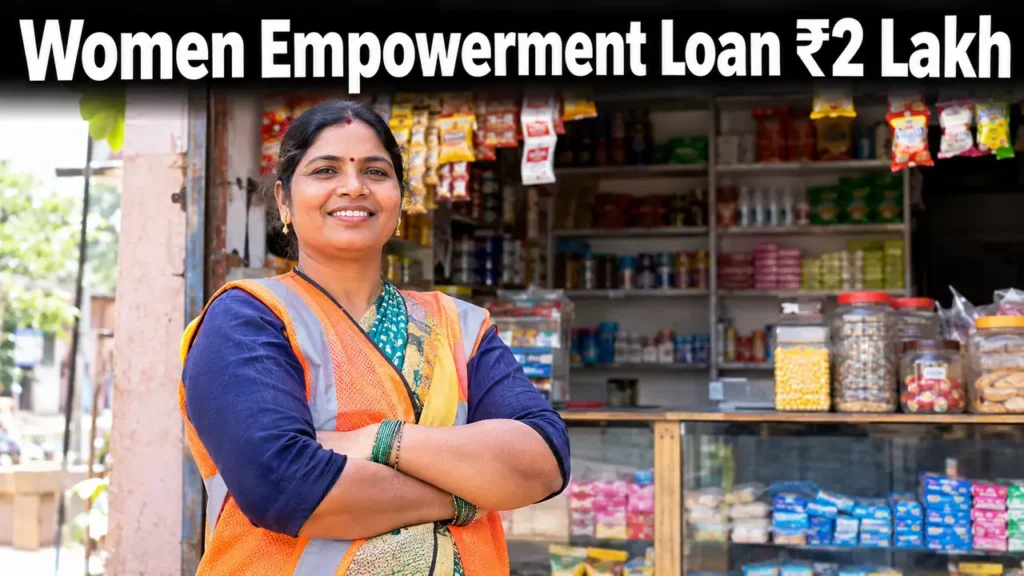
There is a special loan scheme of the Central Government for women who do sanitation work and their daughters — the Mahila Adhikarita Yojana (MAY). Under this scheme, women Safai Karamcharis and manual scavengers, and their dependant daughters, can take a loan for starting a small business on a project cost of up to Rs 2 lakh — up to 90% of the project cost comes as a loan, and the beneficiary pays only 7% interest per year. The scheme is run by the National Safai Karamcharis Finance and Development Corporation (NSKFDC), and in Haryana applications are made through the Haryana Scheduled Castes Finance and Development Corporation (HSFDC). This guide covers the loan amount, interest, eligibility, documents and the complete application process.
What is this scheme?
The National Safai Karamcharis Finance and Development Corporation (NSKFDC) is a Government of India undertaking under the Ministry of Social Justice & Empowerment. It was established on 24 January 1997 as a not-for-profit (Section 8) company and has been operational since October 1997. Its objective is the socio-economic upliftment of Safai Karamcharis, manual scavengers and their dependants, and the eradication of the inhuman practice of manual scavenging.
Among NSKFDC’s several loan schemes, the Mahila Adhikarita Yojana (MAY) is meant specifically for women. Under it, women Safai Karamcharis and manual scavengers, and their dependant daughters, are given loans for small and petty trade/business and sundry income-generating activities — so that they can start their own work and become self-reliant. The loan is routed through a State Channelising Agency (SCA), a Regional Rural Bank (RRB) or a Nationalised Bank.
The scale of NSKFDC’s work is large — according to PIB (11 September 2026), from inception up to 10 September 2026, NSKFDC sanctioned and disbursed Rs 3,365.93 crore in concessional loans, benefiting 6,10,902 persons. Between January and December 2024 alone, loans worth Rs 242.66 crore were sanctioned for 40,942 beneficiaries, of which Rs 239.69 crore was disbursed to 40,803 women under the Mahila Samridhi Yojana (MSY) and Mahila Adhikarita Yojana (MAY).
Understand this first — this is a LOAN, not a grant: the money given under MAY is a loan — it must be repaid with interest. It is not free money or a subsidy. The remaining 10% of the project cost is given by the Channelising Agency as a loan, subsidy or from other funds — that part may be a subsidy, but NSKFDC’s 90% share is a loan.
How much loan will you get?
The loan amount under MAY is fixed by NSKFDC’s Lending Policies & Guidelines (LPG). Under the current LPG (updated 02.09.2026):
| Item | Details |
|---|---|
| Maximum unit cost | Rs 2,00,000 per beneficiary / unit |
| NSKFDC loan (maximum) | 90% of unit cost — i.e. maximum Rs 1,80,000 |
| Remaining 10% share | Up to Rs 20,000 — given by the Channelising Agency as a loan, subsidy or from other available funds |
| Promoter’s contribution | Not insisted upon — the beneficiary is not asked to invest her own money under MAY |
| Interest — NSKFDC to Channelising Agency | 3% p.a. |
| Interest — payable by beneficiary | 7% p.a. |
| Repayment period | Up to 5 years — after an implementation period of 4 months + moratorium of 6 months |
Example: if your project costs Rs 2,00,000, you can get a maximum loan of Rs 1,80,000 from NSKFDC and the remaining Rs 20,000 from the Channelising Agency. If the project costs Rs 1,00,000, the loan will be Rs 90,000.
History of the amount and interest — clearing the confusion: MAY’s amount and interest rate have changed over time. NSKFDC’s old document (ncsk.nic.in) had a maximum project cost of Rs 75,000 and interest of 2% (NSKFDC to SCA) / 5% (beneficiary). Later sources (IndiaFilings, September 2026) quoted a maximum of Rs 1 lakh, with interest still 2%/5%. The current LPG (02.09.2026) has a maximum unit cost of Rs 2 lakh and interest of 3%/7%. This guide follows the current LPG figures, as those are the rules in force today — the old Rs 75,000 or Rs 1 lakh figures are no longer valid.
Who is eligible?
MAY’s benefit is available only to women who meet the following conditions:
- Women Safai Karamcharis (including Wastepickers): a woman who does sanitation work — including wastepicker women.
- Women Manual Scavengers: a woman who does or did manual scavenging work.
- Their dependant daughters: a dependant daughter of a woman Safai Karamchari or manual scavenger can also take a loan under this scheme.
- Occupation Certificate: the applicant must prove that she belongs to the target group. The certificate can be obtained from any one of these competent authorities — local Revenue Officer, Municipal Officer, Cantonment Executive Officer, Railway Officer, Head of a Government Department (not below the rank of a Gazetted Officer) such as school, college, forest, health, education or animal husbandry, Elected Members of a Municipal Body, Pradhan of a Gram Panchayat, or Regional Managers of RRBs/PSBs. Under the MS Act, 2013, a woman manual scavenger identified in a survey needs no separate certificate — if her name is in the final list prepared by the State Government/UT (www.mssurvey.nic.in), that is enough.
- Project viability: the work for which the loan is sought must be financially viable and income-generating — the loan is sanctioned only after assessing the project’s financial viability and income-generating capacity.
Special point: NSKFDC’s LPG clearly states that no income limit is fixed for availing financial assistance. Also, other things being equal, NSKFDC gives preference to — (i) manual scavengers, especially those whose income is below double the poverty line; (ii) women of the target group; and (iii) disabled persons of the target group.
Who is NOT eligible?
- Male applicants — MAY is only for women and their dependant daughters. Men Safai Karamcharis have NSKFDC’s other schemes (such as General Term Loan GTL and Micro Credit Finance MCF) — see the comparison table below.
- Domestic workers — in NSKFDC’s definition, “Safai Karamchari” means a person engaged in sanitation work, including wastepickers, but domestic workers and manual scavengers are not included (manual scavengers form a separate category and they ARE eligible — domestic workers are not).
- A woman who is not a Safai Karamchari, wastepicker or manual scavenger, and is not their dependant daughter.
- Someone whose project is not found financially viable — i.e. there is no likelihood of regular income from it.
Income limit — clear the confusion first
Two different statements are found on MAY’s income limit — do not mix them up:
| Source | What it says |
|---|---|
| NSKFDC LPG (02.09.2026) | No income limit is fixed — “No income limit is fixed for availing financial assistance” |
| HSFDC drive in Haryana (October 2026) | HSFDC fixed an annual family income ceiling of Rs 3 lakh for self-employment loan applications (UNI, 18 October 2026) |
This means — MAY’s own rules have no income limit, but when applying in Haryana through HSFDC, the Rs 3 lakh condition of HSFDC’s current drive may apply. So before applying, confirm the income limit at your district’s HSFDC district office. In this guide we state the Rs 3 lakh ceiling as an HSFDC-drive condition, not as a condition of MAY itself.
For which activities can you take the loan?
The MAY loan is given for small and petty trade/business and sundry income-generating activities. According to NSKFDC’s LPG, the Corporation can assist “a wide range of viable income-generating activities”. Examples include:
| Sector | Examples |
|---|---|
| Agriculture | Poultry, goatery, milch animals, fertilizer shop |
| Services | Fabrication, shuttering, computer work, carpentry, mobile repair, battery winding & repairing, two/four-wheeler repairing, barber shop, auto-rickshaw, automobile repair shop, photocopier booth |
| Trade | General provision store (kirana shop), small shopkeeping, petty trade |
The list above is indicative, not exhaustive — your project can be any viable income-generating activity. The viability of the project proposal is assessed by the SCA/RRB/bank and then by NSKFDC’s Project Appraisal Committee.
Interest and repayment — the full calculation
Interest under MAY is charged at two levels — first NSKFDC lends to the Channelising Agency at 3% p.a., then the agency lends to the beneficiary at 7% p.a. The beneficiary pays only 7%. Repayment is to be made in 5 years — including a 4-month implementation period and a 6-month moratorium, i.e. instalments begin after the moratorium ends.
| Project cost | Loan (90%) | Monthly instalment (EMI, 7%, 5 years) | Total payment | Total interest |
|---|---|---|---|---|
| Rs 2,00,000 | Rs 1,80,000 | Rs 3,564 | Rs 2,13,853 | Rs 33,853 |
| Rs 1,50,000 | Rs 1,35,000 | Rs 2,673 | Rs 1,60,390 | Rs 25,390 |
| Rs 1,00,000 | Rs 90,000 | Rs 1,782 | Rs 1,06,926 | Rs 16,926 |
The EMI figures above are indicative — based on 7% annual interest, a 5-year repayment period and monthly instalments. The actual instalment may differ slightly depending on your sanctioned loan, the disbursement date and the Channelising Agency’s rules.
A note on the women rebate: according to PIB (September 2026), NSKFDC loans carry a 1% interest rebate for women beneficiaries and an additional 0.5% rebate for timely repayment. But MAY’s LPG states the beneficiary rate directly as 7%, with no separate mention of a rebate. So it is not clear whether the 1% rebate applies on top of MAY’s 7% (making the effective rate 6%) — confirm this at the HSFDC district office before applying. This guide states the LPG rate of 7%.
Documents required
NSKFDC’s LPG gives the format of the Preliminary Loan Application Form (Annexure-i) — the information asked for in it is listed below. In addition, the following documents are usually required with a loan application:
| Document / information | Why it is needed |
|---|---|
| Aadhaar Card (Aadhaar No.) | Identity proof — a mandatory field in the preliminary form |
| Name, father’s/husband’s name, age, address, mobile number | Fields of the preliminary form (LPG Annexure-i) |
| Educational qualification | Asked for in the preliminary form |
| Category (SK / MS) — Safai Karamchari or Manual Scavenger | To be entered in the preliminary form |
| Name of scheme (MAY) and name of activity | To be entered in the preliminary form |
| Loan amount sought | To be entered in the preliminary form |
| Occupation Certificate | Proof of belonging to the target group — issued by a competent authority (list in the eligibility section above); a manual scavenger woman recorded in the survey does not need it |
| Parivar Pehchan Patra (PPP) | Usually asked for in Haryana when applying through HSFDC — confirm with the HSFDC district office |
| Photocopy of bank passbook | The loan amount is sent directly to the bank account |
| Passport-size photograph | With the application form |
| Project proposal / quotation | To show the cost and viability of the work for which the loan is sought — the SCA examines it |
Note: the items from the LPG preliminary form above are taken from the official format; documents such as PPP, bank passbook and project proposal are usually asked for — confirm the final list of documents with your district’s HSFDC district office before submitting the application, so that the form does not come back for being incomplete.
How to apply online?
The honest answer: no direct online application portal has been verified from NSKFDC for MAY — according to NSKFDC’s official “How to Apply” process, the application is submitted to the district office of the SCA / RRB branch / Nationalised Bank branch. So no official online method can be given for this scheme. In Haryana, information about the schemes can be seen on HSFDC’s website (hscfdc.org.in), but no online MAY form was verified there either.
If any website or agent asks for money for online application under MAY, be careful — the official process is offline only. Use the offline process given below to apply.
Offline application — the complete process
According to NSKFDC’s official “How to Apply” process (nskfdc.nic.in), the application process is as follows:
- Take the form at an awareness camp (or go directly to the district office): the SCA (HSFDC in Haryana) holds awareness camps from time to time in the localities/villages of the target group, where preliminary loan application forms are distributed in the vernacular. You can also take the form directly from your district’s HSFDC district office or the nearest RRB / Nationalised Bank branch.
- Fill the preliminary form: fill in name, father’s/husband’s name, age, address, mobile number, Aadhaar number, educational qualification, category (SK/MS), name of scheme (MAY), name of activity and loan amount sought. Attach the documents.
- Submit at the district office: submit the filled form at your district’s SCA district office / bank branch and definitely take a receipt (acknowledgement).
- Scrutiny and appraisal: the district office scrutinises the application and sends it to its Head Office. The SCA/RRB/bank appraises the viability of the project proposal and sends viable proposals to NSKFDC with their recommendation.
- Appraisal and sanction at NSKFDC: NSKFDC’s Project Appraisal Committee appraises the proposal. Proposals found in order are placed before NSKFDC’s Board of Directors for sanction.
- Letter of Intent: after sanction by the Board of Directors, a Letter of Intent is issued to the SCA/RRB/bank.
- Loan agreement and release of funds: after acceptance of the terms of sanction and execution of the loan agreement/other documents, NSKFDC releases the funds to the SCA/RRB/bank, which passes them on to the beneficiary. Funds are released in accordance with NSKFDC’s LPG, on the demand of the SCA/RRB/bank.
Fee, timeline and status check
| Item | Status |
|---|---|
| Application fee | No application fee is written in NSKFDC’s LPG or the official process — confirm about the fee at the HSFDC district office. If anyone asks for money in the name of the application, be careful. |
| Timeline (RTS) | No fixed timeline for loan sanction has been published — the proposal passes through SCA scrutiny, NSKFDC’s appraisal committee and Board sanction, so how many days it will take cannot be stated in advance. |
| Last date | MAY itself has no last date — it is a year-round scheme. But the current HSFDC drive has a last date of 31 December 2026 (UNI, 18 October 2026) — see below. |
| Status check (online) | There is no verified online portal to check the status of a MAY loan — contact the HSFDC district office / bank branch where the application was submitted. |
| Status check (offline) | Ask at your district’s HSFDC district office by giving the acknowledgement number. |
| Payment | After sanction, the amount is sent through the SCA/RRB/bank to the beneficiary’s bank account. The bank account should be linked with Aadhaar. |
Current drive in Haryana — last date 31 December 2026: according to a UNI report dated 18 October 2026, the Haryana Scheduled Castes Finance and Development Corporation (HSFDC) invited applications for self-employment loans under various government-backed schemes including NSKFDC loan facilities — with an annual family income ceiling of Rs 3 lakh and a last date of 31 December 2026. The announcement was made by the Panchkula district administration. So if you wish to apply for MAY in Haryana through HSFDC, contact your district’s HSFDC district office before 31 December 2026. Note — this date belongs to the HSFDC drive, not to MAY itself; even after the drive, applications can be made through the normal process, so contact the HSFDC office even if the date has passed.
Understand the difference — MAY vs other NSKFDC schemes
Several NSKFDC schemes look alike — the table below makes it clear how MAY differs from them. All figures are from NSKFDC’s LPG (02.09.2026):
| Item | Mahila Adhikarita Yojana (MAY) — this guide | Mahila Samridhi Yojana (MSY) — NSKFDC | Micro Credit Finance (MCF) | General Term Loan (GTL) | Education Loan (EL) — NSKFDC |
|---|---|---|---|---|---|
| For whom | Women only — Safai Karamcharis (incl. wastepickers), manual scavengers, their dependant daughters | Women only — same target group | Both men and women — Safai Karamcharis, manual scavengers, their dependants | Safai Karamcharis, manual scavengers, their dependants (men and women) | Students from the Safai Karamchari community (professional/technical courses) |
| Maximum unit cost | Rs 2,00,000 | Rs 1,00,000 | Rs 1,00,000 per beneficiary (Rs 10 lakh for a group of 10) | Rs 15,00,000 | Rs 10 lakh in India, Rs 20 lakh abroad |
| NSKFDC loan | Up to 90% (max Rs 1,80,000) | Up to 90% (max Rs 90,000) | Up to 90% | Up to 90% | Up to 90% |
| Interest (beneficiary) | 7% p.a. | 6% p.a. | 7% p.a. | 8% p.a. (up to Rs 10 lakh); 9% on Rs 10–15 lakh | 6% in India, 7% abroad p.a. |
| Repayment period | Up to 5 years | Up to 3 years | Up to 3 years | Up to 10 years | 5 years after course completion + 1-year moratorium |
| For what work | Small/petty trade, income-generating activities | Small/petty trade, income-generating activities | Small/petty trade, income-generating activities | Any viable income-generating scheme (including sanitation-related) | Studies — medical, engineering, management, law, IT etc. |
Clear two more confusions: (1) Mahila Samridhi Yojana (MSY) exists in two different corporations — NSKFDC’s MSY (in the table above, for Safai Karamchari women, Rs 1 lakh) and NBCFDC’s MSY (for Backward Classes women, Rs 60,000 unit cost) — they are two different schemes, do not treat them as one. (2) NBCFDC’s Backward Classes Education Loan (our guide — Haryana Backward Classes Education Loan 2026: Up to Rs 15 Lakh at 4% Interest) is a different corporation’s different scheme — it is for Backward Classes students, not for the Safai Karamchari community. (3) Haryana SC Self-Employment Loan Scheme (loan up to Rs 2 lakh) is an HSFDC state-level scheme — it also gives up to Rs 2 lakh, but it is not NSKFDC’s MAY; their rules and application processes are different.
Frequently asked questions (FAQ)
1. How much loan is given under the Mahila Adhikarita Yojana?
The maximum unit cost is Rs 2,00,000, of which up to 90% i.e. maximum Rs 1,80,000 comes as a loan from NSKFDC. The remaining 10% (up to Rs 20,000) is given by the Channelising Agency as a loan, subsidy or from other funds. The beneficiary is not asked to invest her own money.
2. How much interest will be charged?
The beneficiary pays 7% per year (NSKFDC lends to the Channelising Agency at 3% per year). According to PIB, women beneficiaries get a 1% interest rebate and an additional 0.5% rebate for timely repayment — but MAY’s LPG states the rate directly as 7%, so whether the rebate applies or not should be confirmed at the HSFDC district office.
3. Who can apply?
Women Safai Karamcharis (including wastepicker women), women manual scavengers and their dependant daughters. Belonging to the target group must be proved with an Occupation Certificate; a woman manual scavenger recorded in the survey does not need a separate certificate.
4. Is there an income limit?
NSKFDC’s LPG fixes no income limit for MAY. But in HSFDC’s current drive in Haryana (October 2026), an annual family income ceiling of Rs 3 lakh has been fixed for applications. Confirm the income limit at your district’s HSFDC district office before applying.
5. How much time will I get to repay the loan?
Up to 5 years — instalments begin after a 4-month implementation period and a 6-month moratorium. On a loan of Rs 1,80,000 at 7% interest, the monthly instalment is about Rs 3,564.
6. Where should I apply — online or offline?
Offline — submit the application at your district’s HSFDC district office or the nearest RRB / Nationalised Bank branch. There is no verified online application portal for MAY — do not look for this scheme on the SARAL portal, as applications for it are not made through SARAL.
7. Is this a subsidy or a loan?
It is a loan — it must be repaid with interest in 5 years. Only the remaining 10% of the project cost is given by the Channelising Agency as a loan, subsidy or from other funds — that part may be a subsidy, but NSKFDC’s 90% share is a loan.
8. What is the difference between MAY and Mahila Samridhi Yojana (MSY)?
Both are NSKFDC schemes and both have the same target group (women Safai Karamcharis and their dependant daughters). The difference is in amount and tenure — MAY: maximum Rs 2 lakh, 7% interest, 5-year repayment; MSY: maximum Rs 1 lakh, 6% interest, 3-year repayment. MAY suits a bigger project, MSY a smaller one.
9. What is the last date for application?
MAY itself has no last date — it is a year-round scheme. But under HSFDC’s current drive, the last date for applications is 31 December 2026 (UNI, 18 October 2026). Even after the drive, applications can be made through the normal process, so contact your district’s HSFDC office even if the date has passed.
Official links and contacts
| Item | Link / contact |
|---|---|
| NSKFDC — official website (schemes, How to Apply, LPG) | nskfdc.nic.in |
| NSKFDC — application process (How to Apply) | nskfdc.nic.in/en/node/178 |
| NSKFDC — headquarters | NTSC, 3rd Floor, E-Block, NSIC, Okhla Industrial Area Estate-III, New Delhi – 110020 | Phone: 011-26382476, 26382477, 26382478 | Email: [email protected] |
| HSFDC — Haryana SCA (apply here) | hscfdc.org.in | Head office: Bay No. 53-54, Sector-2, Panchkula – 134109 | Phone: 0172-2584438 |
| myScheme — scheme detail page | myscheme.gov.in/schemes/mayunh (detail page is client-rendered and could not be read directly; also see the list page) |
| myScheme — Haryana schemes (list) | myscheme.gov.in/search/state/Haryana |
| Manual scavengers survey (MS Act, 2013) | mssurvey.nic.in (no separate certificate needed if the name is in the final list) |
| CSC centre | Nearest Common Service Centre — for information and help (MAY applications are NOT made through CSC — submit the application at the HSFDC district office / bank branch only) |
Related guides — also read: Haryana Backward Classes Education Loan 2026: Up to Rs 15 Lakh at 4% Interest | Haryana SC Self-Employment Loan Scheme: Loan up to Rs 2 Lakh | Mukhyamantri Mahila Shramik Samman Yojana 2026: Rs 5,100 per Year | Mudra Yojana: Up to Rs 20 Lakh Loan without Guarantee | PM Vishwakarma Yojana: Rs 15,000 Toolkit + Loan up to Rs 3 Lakh
Disclaimer
This guide was prepared on 8 November 2026 on the basis of available official sources — NSKFDC’s Lending Policies & Guidelines (LPG, updated 02.09.2026), NSKFDC’s official website (How to Apply page), NSKFDC’s old scheme document (ncsk.nic.in), the PIB press release (11 September 2026), the UNI report (18 October 2026 — HSFDC drive), and the myScheme portal’s Haryana list. Amounts, interest rates, eligibility and the application process may change by a decision of the Government/Corporation — before applying, definitely confirm the current information from your district’s HSFDC district office or NSKFDC. Wherever sources differ or information is unverified, this guide states it clearly. Viksit Haryana is not an official portal of any government department.


Leave a Reply