PM Modi Highlights India’s Solar Opportunities Through PM Surya Ghar and PM-KUSUM
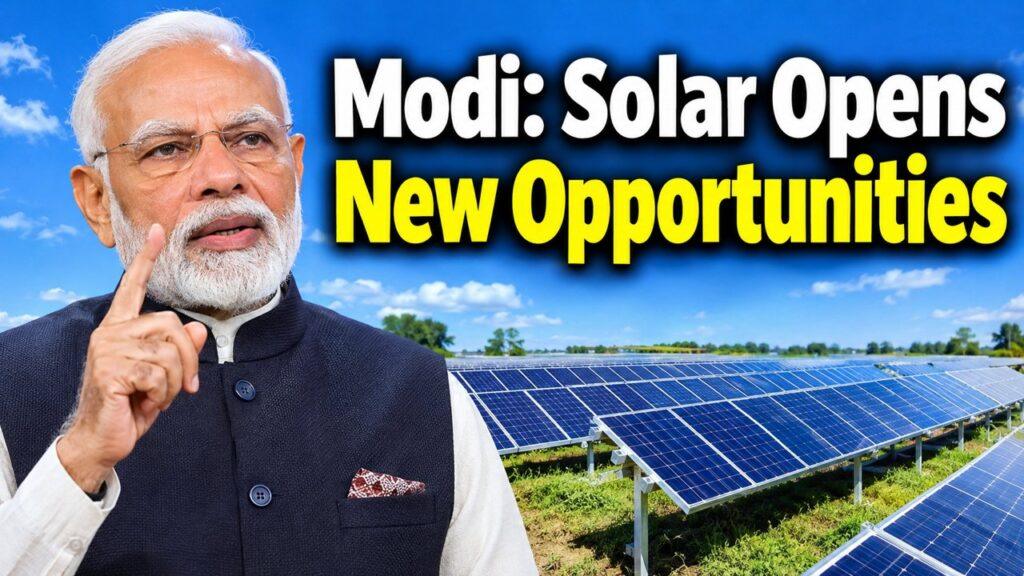
Prime Minister Narendra Modi on Monday, 2 November 2026, highlighted the new opportunities emerging from India’s solar energy expansion, sharing an article by Union Minister Pralhad Joshi on the country’s clean energy transition.
The Prime Minister’s Office said Joshi’s article examined the growth of solar power through flagship schemes such as PM Surya Ghar and PM-KUSUM, alongside opportunities in solar-powered agriculture, energy storage, manufacturing and green jobs. It said the article looked at the road ahead as India works towards its target of 500 GW of renewable energy capacity.
In his post, Joshi said India’s clean energy transition was creating possibilities for millions, from rooftops to farmlands. He credited Prime Minister Modi’s vision for advancing the transition through PM Surya Ghar, PM-KUSUM, green hydrogen and domestic solar manufacturing, and said he looked forward to welcoming global leaders and innovators to strengthen clean energy partnerships.
PM Surya Ghar Muft Bijli Yojana supports households in putting solar panels on their rooftops, cutting electricity bills and reducing dependence on the grid. PM-KUSUM supports farmers in solarising agriculture, including solar pumps and solar-powered farming, giving rural households a cleaner and more reliable source of power and, where surplus power is fed to the grid, an additional source of income.
The article comes ahead of the Bharat Renewable Energy Summit and Expo 2026, which Prime Minister Modi is to inaugurate at Bharat Mandapam in New Delhi on 2 November. The four-day summit, running from 2 to 5 November under the theme ‘Invest. Innovate. Inspire.’, is expected to bring together policymakers, investors, financial institutions and industry leaders from more than 130 countries, including over 40 ministers.
The summit will be held alongside the ninth session of the International Solar Alliance Assembly and the fourth International Conference on Green Hydrogen, bringing three major clean energy platforms together in one place.
For households, the message is lower bills and greater energy independence. For farmers, it is cheaper and cleaner power for irrigation. For industry and young workers, the expansion of solar manufacturing, storage and green hydrogen points to new jobs and investment. Together, the schemes and the summit underline how solar energy has moved from a niche technology to a central part of India’s energy future.