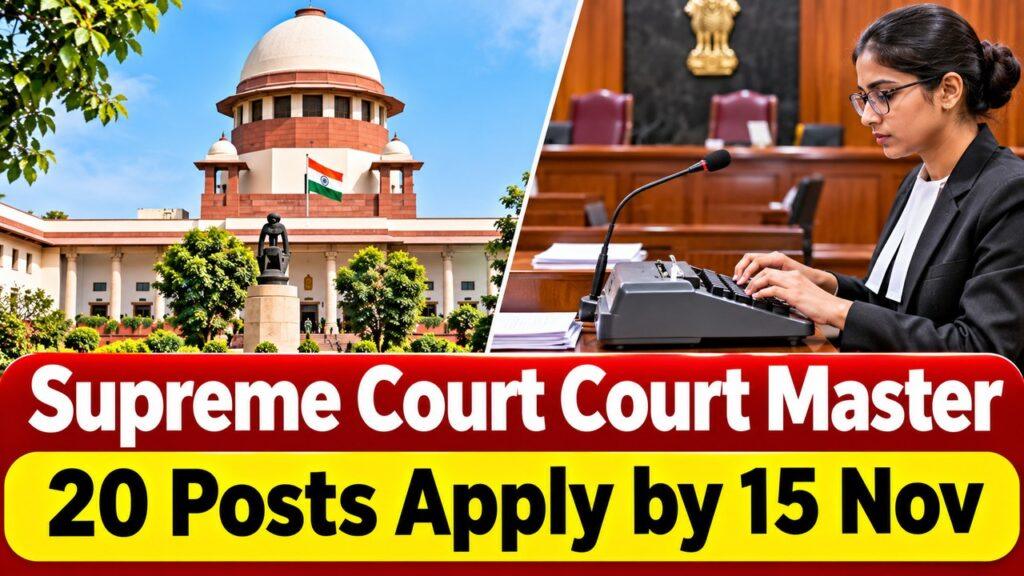
Supreme Court of India Court Master Recruitment 2026: 20 Posts Apply by 15 November
The Supreme Court of India has invited online applications for 20 Court Master (Shorthand) posts in its Registry. The recruitment, advertised on 15 October 2026 under advertisement number F.6/11/CM(S)/2026-SC (RC), is being conducted to prepare a panel for these gazetted posts. The online application window opened on 25 October 2026 and will close on 15 November 2026 at 11:55 pm. Applications must be submitted only through the official website of the Supreme Court of India, sci.gov.in. Candidates are advised not to wait until the last day, as the portal may face heavy traffic near the deadline. Court Masters play a central role in the functioning of the court, recording proceedings in shorthand and preparing accurate transcripts that form part of the judicial record. The post is placed in Level 11 of the pay matrix, with a pay scale of Rs 67,700 to Rs 2,08,700 per month and an initial basic pay of Rs 67,700 plus admissible allowances. For eligibility, candidates must hold a bachelor’s degree and demonstrate an English shorthand speed of at least 120 words per minute and a computer typing speed of at least 40 words per minute. In addition, applicants need at least five years of prescribed regular service in the specified stenography and personal assistant cadre. The age limit is 30 to 45 years as on 1 October 2026. The selection process includes an objective-type test, tentatively scheduled for 7 December 2026, followed by further stages as laid down in the notification. Candidates should note that the number of vacancies is tentative and may change as per the Registry’s requirements, and that placement on the panel does not by itself guarantee appointment. To apply, candidates should visit sci.gov.in, open the recruitments section, read the full notification carefully, and complete the online registration with accurate details and documents. Any update about the test date or further stages will be published on the Supreme Court’s official website.