
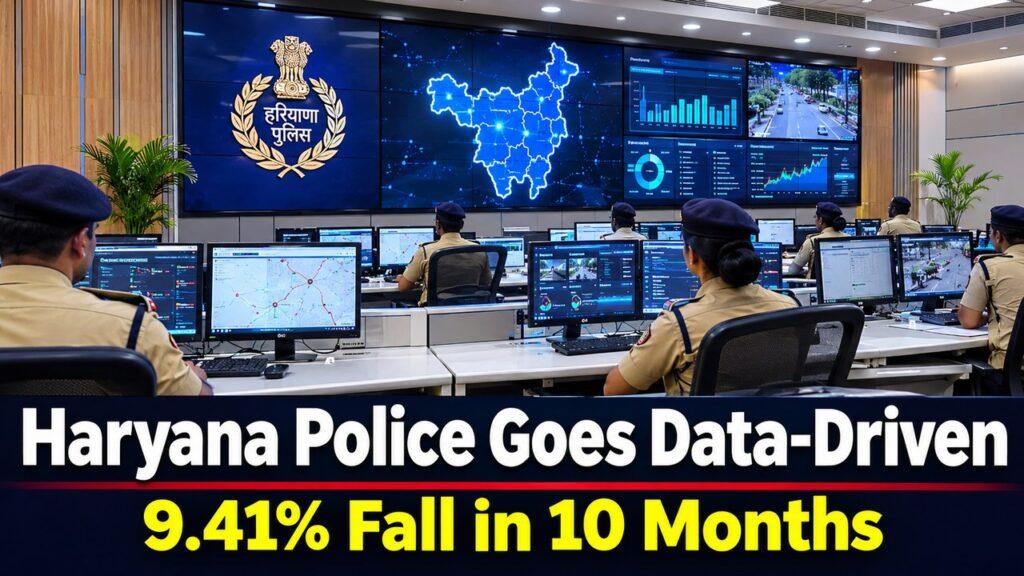
Haryana Police Goes Data-Driven: DGP Ajay Singhal Orders Station-Level Strategy After 9.41% Fall in 10 Months
Haryana Police will now plan its work police station by police station, using local data rather than state-level averages, Director General of Police Ajay Singhal directed at a review meeting at the police headquarters in Panchkula on Wednesday, 4 November 2026. Senior officers reviewed the law-and-order position, station-level trends and the preparedness of the force, and Singhal said total cases in the state in the first ten months of 2026 were 9.41 per cent lower than in the corresponding period last year. The message of the meeting was that the improvement should be consolidated through better information, closer monitoring and clear accountability at the station level.
The new approach puts the police station at the centre of planning. Inspector General (Law and Order) Rakesh Arya presented the changing pattern of cases across different station areas, and Singhal directed officers to study those patterns in detail and identify the causes wherever any category shows a rise. Patrolling is to be matched to the nature and location of cases, CCTV cameras are to be ensured at all police stations, and officers found negligent in prevention work will have their responsibility fixed. Superintendents of Police were also told to keep ready-made action plans, prepared in line with the standard operating procedure, for situations arising from protests by employees, social organisations or political parties, and to keep the force well equipped at every level.
A particular priority in the new plan is the protection of vulnerable people. Singhal directed that special teams be formed in station areas for cases of missing persons below the age of 18, especially missing girls, and that such cases be taken up on priority with a sensitive and prompt approach so that tracing and recovery are completed quickly. The state government, he said, treats this subject with great seriousness, and officers have been asked to show the same urgency and care in every such case, rather than treating it as routine paperwork.
The digital backbone of the strategy is a comprehensive database of offenders. Singhal reviewed the verification and digitisation work being done by the RJSF unit and directed that it be completed at the earliest, after which data on proclaimed offenders, bail jumpers and most-wanted persons will be verified and available for effective monitoring of their activities and movement. Night nakabandi will be made more effective, with police commissioners and inspectors general themselves monitoring nakas, and action will be taken against vehicles running without number plates or without high-security registration plates. For extortion calls, officers must follow the prescribed standard operating procedure, with information received through the Abhedya app shared regularly with districts and analysed by technical teams.
Public-facing safety measures were also part of the review. If an ATM machine is tampered with or an attempt is made to uproot it, an alert will now reach the Dial 112 helpline directly, allowing a police team to reach the spot immediately, while data on ATM card cloning and financial fraud will be analysed to shape a stronger prevention strategy. Singhal underlined that accurate, detailed and reliable data is the foundation of effective prevention: with better data, the police can prepare a better strategy, stay ready for every situation and act strictly in accordance with the standard operating procedure. The review will therefore continue at station level, with regular monitoring, rather than ending with a single meeting.