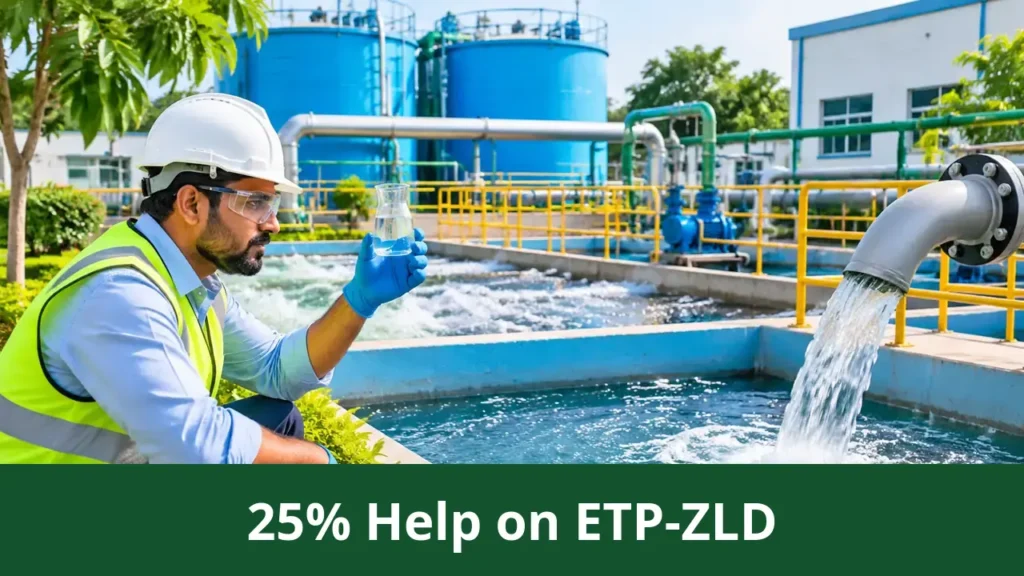
The Haryana government is giving direct financial help to the state’s small and medium industries for cleaning the dirty water from their factories and reusing every drop of water. Under Incentive 4 — Assistance for Environment Compliance — of the Greening & Sustainable Development Scheme, an Effluent Treatment Plant (ETP) gets 25 percent of the total cost, up to Rs 1 crore, as reimbursement, and a Zero Liquid Discharge (ZLD) plant gets 25 percent of the total cost, up to Rs 5 crore. The scheme was notified in the Haryana Government Gazette on 16 November 2026 and is being implemented under the Haryana Progressive MSME & Export Promotion Policy 2026.
This assistance comes as reimbursement — the plant must be installed and the money spent first, and the claim made afterwards. ETP assistance is available only in Sub-Prime and Prime/Focus areas, while the notification sets no area limit for ZLD assistance. This guide gives the eligibility, area categories, calculation of expenditure, documents and the full application process, based on the notification.
At a glance: ETP/ZLD assistance scheme
| Point | Details |
|---|---|
| Scheme name | Greening & Sustainable Development Scheme — Incentive 4 (Assistance for Environment Compliance) |
| Notification | 16 November 2026, No. 02/04/2026-1IB-II, Gazette Extraordinary No. 175-2026/Ext, pp. 3451–3470 |
| Parent policy | Haryana Progressive MSME & Export Promotion Policy 2026 (in force from 29 July 2026) |
| Validity of the scheme | 5 years from 29 July 2026; purchase/installation must be between 29 July 2026 and 28 July 2031 |
| Assistance on ETP | 25% of total cost (civil works + machinery), up to Rs 1 crore — only in Sub-Prime and Prime/Focus areas |
| Assistance on ZLD | 25% of total cost (civil works + machinery), up to Rs 5 crore — no area limit |
| Nature of assistance | Reimbursement (spend first, then claim) — no advance |
| How many times | Each incentive only once during the policy period |
| Who it is for | Micro, small and medium manufacturing enterprises of Haryana (new and existing) |
| Overall cap | Total assistance under Policy 2026 + Government of India schemes for the same project cannot exceed 100% of Fixed Capital Investment (FCI) |
| Department | Department of Industries & Commerce, Directorate of MSME, Haryana |
| Application deadline | Within 3 months of the date of complete installation or the date of notification, whichever is later |
What is ETP and what is ZLD?
An ETP, or Effluent Treatment Plant, is the plant that cleans the dirty water (effluent) coming out of a factory so that it can be discharged within the standards of the Pollution Control Board. For industries from which water containing chemicals, dyes, metals or other pollutants flows out, installing an ETP is a basic condition of pollution control. ZLD, or Zero Liquid Discharge, is a step beyond this — in ZLD, all the dirty water of the factory is cleaned and reused in production, and not a single drop of liquid waste is discharged outside. ZLD usually involves evaporation and crystallisation units along with an ETP, so its cost is several times that of an ETP — which is why the notification sets the maximum limit for ZLD (Rs 5 crore) at five times the limit for ETP (Rs 1 crore).
The notification states the purpose of environment compliance clearly — following environmental standards not only avoids penalties, but also reduces the enterprise’s carbon footprint and makes access to green financing easier. As global buyers and large customers increasingly demand green standards, plants like ETP and ZLD are becoming a condition for staying in the market even for small enterprises.
How much assistance? 25% reimbursement, up to Rs 1 crore on ETP and Rs 5 crore on ZLD
Both incentives are given on a reimbursement basis, and each incentive can be taken only once during the policy period. One enterprise can take both incentives — or one or all of the scheme’s four incentives, individually or in combination — provided the eligibility conditions of each incentive are met.
| Plant | Reimbursement rate | Maximum limit | Area condition |
|---|---|---|---|
| ETP (Effluent Treatment Plant) | 25% of total cost | Rs 1 crore | Only in Sub-Prime and Prime/Focus areas |
| ZLD (Zero Liquid Discharge) | 25% of total cost | Rs 5 crore | No area limit |
There is a special rule for calculating the cost of ZLD — the eligible cost will be fixed on the actual cost or Rs 5 crore per MLD (million litres per day), whichever is less. That is, for a ZLD plant of 1 MLD capacity, the eligible cost will be taken as at most Rs 5 crore, even if the actual expenditure is higher. The examples below are only to explain the calculation — they are not scheme figures:
| Example | Total eligible expenditure | 25% calculation | Amount payable |
|---|---|---|---|
| ETP expenditure of Rs 2 crore (Sub-Prime area) | Rs 2 crore | Rs 50 lakh | Rs 50 lakh (within the limit) |
| ETP expenditure of Rs 5 crore (Prime/Focus area) | Rs 5 crore | Rs 1.25 crore | Rs 1 crore (limit applies) |
| 1 MLD ZLD expenditure of Rs 6 crore | Rs 5 crore (Rs 5 crore/MLD limit) | Rs 1.25 crore | Rs 1.25 crore |
| 0.5 MLD ZLD expenditure of Rs 3 crore | Rs 2.5 crore (Rs 5 crore x 0.5 MLD) | Rs 62.5 lakh | Rs 62.5 lakh |
Remember that reimbursement is given only on eligible expenditure — tax, GST, duties, working capital, consultancy fees and the cost of old machinery are not eligible (details below). The cost of civil works will be checked against the CPWD or Haryana Schedule of Rates, and if the claimed expenditure is found excessive or unreasonable, the Directorate may reduce the eligible capital expenditure.
In which areas is ETP assistance available? Understanding area categories
ETP assistance is available only in Sub-Prime and Prime/Focus areas. If your unit is in a Core or Intermediate area, this assistance will not be available for ETP — the notification sets no area limit for ZLD assistance. The notification defines four area categories as follows:
| Area category | Which areas fall in it | ETP assistance |
|---|---|---|
| Prime/Focus area | Area within the Industrial Investment Promotion Zones notified by the Department of Industries & Commerce | Yes |
| Sub-Prime area | Conforming industrial areas in the development plan; vacant unallotted plots in HSIIDC Industrial Model Townships/Estates; vacant unallotted plots in private industrial parks/colonies; area with an industrial colony licence granted after the policy; area outside the limits of the controlled area (not falling in Prime/Focus) | Yes |
| Intermediate area | Allotted plots in HSIIDC townships/estates; allotted plots in private industrial parks/colonies; area between the municipal limits and the controlled area limits | No |
| Core area | Area within the municipal limits (excluding the above categories) | No |
If the land of your project falls in more than one category, the category that applies will be the one in which the largest proportion of the project land falls. The area category of your unit can be checked on the Haryana Government’s Single Window portal, and the category shown on the portal will be taken for deciding eligibility and the amount of assistance — unless the competent authority decides otherwise. Do check your category before applying, because in the case of ETP, this category itself will decide whether you get the assistance or not.
Who is eligible?
The benefit of the scheme will be available only to enterprises that fulfil all the conditions below:
1. Type of enterprise: Individual, proprietorship firm, partnership firm, LLP, public or private sector company, corporation, cooperative society, self-help group (SHG), trust or Farmer Producer Organisation (FPO) — any of these forms is eligible.
2. Category of enterprise: Micro, small or medium manufacturing enterprise — both new and existing are eligible. The category will be checked from the latest Udyam Registration Certificate.
| Category of enterprise | Investment in plant and machinery (maximum) | Annual turnover (maximum) |
|---|---|---|
| Micro | Rs 2.5 crore | Rs 10 crore |
| Small | Rs 25 crore | Rs 100 crore |
| Medium | Rs 125 crore | Rs 500 crore |
3. Land: The land for the project must be by purchase or on a registered lease of at least 15 years.
4. New machinery: Only new machinery must be bought for the project — assistance will not be given on old, second-hand or refurbished machinery.
5. Clean record: The applicant or its promoters must not be wilful defaulters under RBI rules and must not be blacklisted or debarred from business by any government agency/department or the Central/State Government.
6. No double benefit: Incentive cannot be taken for the same component under any other scheme/policy of the Haryana Government — and the reverse also applies. Yes, if a later policy of the Haryana Government expressly permits taking benefit under both policies, that benefit can be taken — but assistance will not be given under both policies for the same or nearly the same incentive.
7. Project of a large enterprise: If a project is owned/controlled by a large enterprise, group or private equity fund and cannot obtain a Udyam Registration Certificate, but falls within the MSME range on the basis of investment/turnover, it can also be considered eligible as a separate entity — provided it has a separate GST registration and separate accounts are maintained. In such cases, the competent authority will decide eligibility case by case.
Which expenditure counts, which does not?
Eligible expenditure is the NEW expenditure incurred on building and machinery and related components/infrastructure for approved technology, solar rooftop, ETP or ZLD within the project premises during the policy period. But some expenditure is clearly not eligible:
Not eligible: Plant and machinery brought in from another unit; taxes, duties, cess and other statutory charges — including GST, customs duty, excise duty and registration charges; handling charges, working capital, goodwill, preliminary and pre-operative expenses, capitalised interest; the cost of acquiring technology or technical know-how — including consultancy fees, royalty, design and drawings, patents, licences and other intellectual property rights, whether or not they are capitalised in the accounts.
So while preparing a claim, count only the actual cost of the civil works and machinery of the ETP/ZLD — keep GST and consultancy fees separate. The cost of civil works will be checked against the CPWD or Haryana Schedule of Rates, and if the claimed expenditure is found excessive or unreasonable, the Directorate may reduce the eligible expenditure.
Which documents are needed?
The documents below must be uploaded with the online application, with the signature of the authorised representative. Two of these documents are only for Incentive 4 (ETP/ZLD) — keep them ready in particular:
| No. | Document | Remarks |
|---|---|---|
| 1 | Application in the prescribed form (Annexure-I) | For all |
| 2 | Incorporation/registration certificate of the organisation, Memorandum and Articles of Association, bye-laws of the society (as applicable) | For all |
| 3 | Land papers — sale deed or registered lease deed of at least 15 years, or Regular Letter of Allotment (RLA) of HSIIDC/IMT/industrial estate | For all |
| 4 | Change of Land Use (CLU)/NOC from the competent authority | For all |
| 5 | CA certificate of actual expenditure on the project and means of finance | For all |
| 6 | Consent to Establish/Operate (CTE/CTO) from the Haryana State Pollution Control Board (HSPCB) | For all |
| 7 | Chartered Engineer (Civil) certificate with item-wise and cost-wise details of civil works | Where applicable |
| 8 | Chartered Engineer (Mechanical) certificate with item-wise and cost-wise details of plant and machinery | Where applicable |
| 9 | Design and implementation scheme of the ETP/ZLD, approved by the competent authority | Incentive 4 ONLY |
| 10 | Certificate from the Regional Officer of the Pollution Control Board | Incentive 4 ONLY |
| 11 | Udyam Registration Certificate (URC) and GST registration certificate | For all |
| 12 | Board resolution/Power of Attorney for the authorised signatory | For all |
| 13 | Declaration of guarantee (as per Annexure-VIII) | For all |
The documents list also has two documents for solar rooftop (Incentive 3) — the installation certificate of the MNRE/HAREDA-empanelled vendor and the net metering letter from the electricity department — but they will not be needed in an ETP/ZLD claim.
How to apply?
1. Where to apply: The complete application in the prescribed form (Annexure-I) must be filed online on the Invest Haryana New Single Window portal.
2. By when: Within 3 months of the date of complete installation of the ETP/ZLD or the date of notification of the scheme (16 November 2026), whichever date is later. That is, if your plant was already installed before the notification, you will get 3 months from the date of the notification.
3. Important information: The notification clearly states that until the new portal becomes operational, applications will be accepted through the existing procedure or e-mail as specified by the Directorate. After the portal becomes operational, applications will be taken only through the portal — an application sent by any other method will not be considered. So before preparing a claim, do check the current method of application and the form from your District MSME Centre — no link or method has been given here on guesswork.
4. Scrutiny process: On receiving the application, the portal — wherever the system is connected — will itself pull the connected records from the Revenue Department, the electricity departments (UHBVN/DHBVN), the Pollution Control Board and GST. The Directorate of MSME or a third-party agency appointed by it will first carry out a preliminary scrutiny. If any deficiency is found, it will be communicated on the portal within 10 working days of the date of submission of the complete application — all deficiencies will be communicated in one go. 30 working days will be given to remove the deficiency, and this chance will be given only ONCE. If the deficiency is not removed within the given time, the claim will be rejected and intimation given by e-mail.
5. Detailed scrutiny: After all information is complete, the Directorate or the third-party agency will carry out a detailed scrutiny — the CA and Chartered Engineer certificates, the existence of the eligible assets, their installation and their use will be checked. After this, the case will be placed before the State Level Steering Committee (SLSC).
Who will approve it?
The power of approval under this scheme rests with the State Level Steering Committee (SLSC), which will be chaired by the Administrative Secretary, Department of Industries & Commerce, Haryana. The committee includes the Director General (Industries & Commerce), the Managing Director (HSIIDC), the representative of the Finance Department and the Director General (MSME, Member Secretary) — and in Incentive 4 (ETP/ZLD) cases, the representative of the Haryana State Pollution Control Board will also be a member. The committee meets at least once every two months (at least 6 meetings a year). After the SLSC’s approval, the grant amount will be released by the Director General, Directorate of MSME.
The notification also makes it clear that the SLSC’s decision on the interpretation of the scheme’s provisions will be final and binding on all. This scheme’s notification does not provide for a 30-day appeal arrangement like the AI Labs or MSE Insurance schemes — so no claim of appeal has been made in this guide.
Timelines and condonation of delay
Keeping to the application deadline — 3 months from complete installation or the notification — is the most important thing, because the notification gives no general route for claiming after that. Yes, if the delay happened for reasons beyond your control, condonation can be sought: the Director/Director General, Directorate of MSME, can condone delay of up to 3 months after the prescribed time limit, and the Administrative Secretary, Department of Industries & Commerce, can condone delay of up to 6 months — provided sufficient evidence and documents for the reasons of delay are produced.
What happens if wrong information is given?
The notification has a strict provision for wrong information. If at any stage it is found that the grant was obtained on the basis of wrong information, misrepresentation, concealment of facts, fraud or deception, the applicant will have to refund the entire assistance amount with compound interest at 12 percent per annum. Apart from this, the applicant can also be debarred from the incentives of the State Government and from government procurement. However, before action and recovery, the applicant will be given a fair opportunity of being heard.
Subsidy will also not be released in these situations — if the required declarations, matching or supporting documents are not given, or if any condition of the scheme is violated. If only a part of the claim is disputed or needs further examination, the competent authority can hold back the disputed part and proceed on the remaining eligible part.
Know the scheme’s other assistance too
Apart from ETP/ZLD, the Greening & Sustainable Development Scheme has two more incentives — these are not the subject of this guide, but one enterprise can take them too, separately or together (each incentive only once):
Incentives 1 and 2 — Energy efficiency and circular economy: One-time assistance on adopting approved technology — 25% in Core and Intermediate areas, up to Rs 50 lakh; 40% in Sub-Prime and Prime/Focus areas, up to Rs 1 crore.
Incentive 3 — Solar rooftop: 30% assistance on installing a solar rooftop with net metering — up to Rs 25 lakh in Core and Intermediate areas; up to Rs 35 lakh in Sub-Prime and Prime/Focus areas.
Full information on both these incentives is given in our MSME Green Subsidy guide, published in Hindi on this site. Remember that the 25%/Rs 50 lakh and 40%/Rs 1 crore figures of Incentives 1–2 are NOT those of ETP/ZLD — mixing the two would be the most common mistake.
Frequently asked questions
1. What is the Haryana ETP/ZLD scheme?
It is Incentive 4 of the Haryana Government’s Greening & Sustainable Development Scheme, under which MSME enterprises get 25% of the total cost (up to Rs 1 crore) as reimbursement for installing an ETP and 25% of the total cost (up to Rs 5 crore) for installing ZLD. The scheme was notified on 16 November 2026.
2. In which area is ETP assistance available?
ETP assistance is available only in Sub-Prime and Prime/Focus areas — a unit in a Core or Intermediate area will not get this assistance for ETP. The notification sets no area limit for ZLD assistance. Check your area category on the Single Window portal.
3. How is the cost of ZLD calculated?
The eligible cost of ZLD will be fixed on the actual cost or Rs 5 crore per MLD, whichever is less. Then 25% of that eligible cost is given, up to Rs 5 crore. For example, if Rs 6 crore was spent on a 1 MLD ZLD, the eligible cost is taken as Rs 5 crore and 25% — that is, Rs 1.25 crore — is given.
4. By when must the application be made?
Within 3 months of the date of complete installation of the ETP/ZLD or the date of notification (16 November 2026), whichever date is later. If the installation was completed before the notification, 3 months’ time is available from the date of the notification.
5. Which documents are needed only for ETP/ZLD?
Two documents are only for Incentive 4 — the design and implementation scheme of the ETP/ZLD (approved by the competent authority) and the certificate of the Regional Officer of the Pollution Control Board. Apart from these, the CA certificate, Chartered Engineer (Civil and Mechanical) certificates, CTE/CTO, CLU/NOC, URC and GST certificates are also needed.
6. Who will approve it and who will release the money?
Approval will be given by the State Level Steering Committee (SLSC), chaired by the Administrative Secretary, Department of Industries & Commerce, and including the representative of the Pollution Control Board in ETP/ZLD cases. After approval, the amount will be released by the Director General, Directorate of MSME.
Quiz — test yourself
Question 1: What is the maximum reimbursement on ETP?
A. Rs 50 lakh B. Rs 1 crore C. Rs 5 crore D. Rs 10 lakh Answer: B — Rs 1 crore.
Question 2: What are the rate and limit of reimbursement on ZLD?
A. 25%, Rs 1 crore B. 40%, Rs 1 crore C. 25%, Rs 5 crore D. 30%, Rs 35 lakh Answer: C — 25%, up to Rs 5 crore.
Question 3: In which area is ETP assistance NOT available?
A. Prime/Focus area B. Sub-Prime area C. Core area D. None of these Answer: C — Core area (and not in the Intermediate area either).
Question 4: Within how much time of the installation date must the application be made?
A. One month B. Two months C. Three months D. Six months Answer: C — Three months.
Question 5: Which committee gives the approval?
A. District MSME Centre B. State Level Steering Committee (SLSC) C. Pollution Control Board D. Finance Department Answer: B — State Level Steering Committee (SLSC).
Official links
- Directorate of MSME, Haryana (departmental portal) — msme.haryana.gov.in
- District MSME Centres / list of field offices — msme.haryana.gov.in/field-offices/
- Invest Haryana (New Single Window portal) — investharyana.in
- Udyam Registration (URC) — udyamregistration.gov.in
- Related guide: PADMA Branding Scheme — PADMA Branding Scheme Haryana: 50% of Branding-Marketing Cost Back, up to Rs 10 Lakh a Year
- Related guide: Diesel Generator Set Subsidy — Diesel Generator Set Subsidy Haryana: 50% Help on RECD, up to Rs 20 Lakh on New CPCB Sets
- Related guide: EV for Cargo Logistic Scheme — Haryana EV for Cargo Logistic Scheme: 15% Help on Electric Cargo Vehicles, up to Rs 5 Lakh
Source: The information in this guide is based on the Haryana Government Gazette Extraordinary No. 175-2026/Ext (16 November 2026), Notification No. 02/04/2026-1IB-II, “Greening & Sustainable Development Scheme” (pp. 3451–3470). Disclaimer: This guide is based on the information available on 24 November 2026. Before applying, do check the latest information on the notification from the website of the Directorate of MSME, Haryana (msme.haryana.gov.in) or your district’s District MSME Centre.