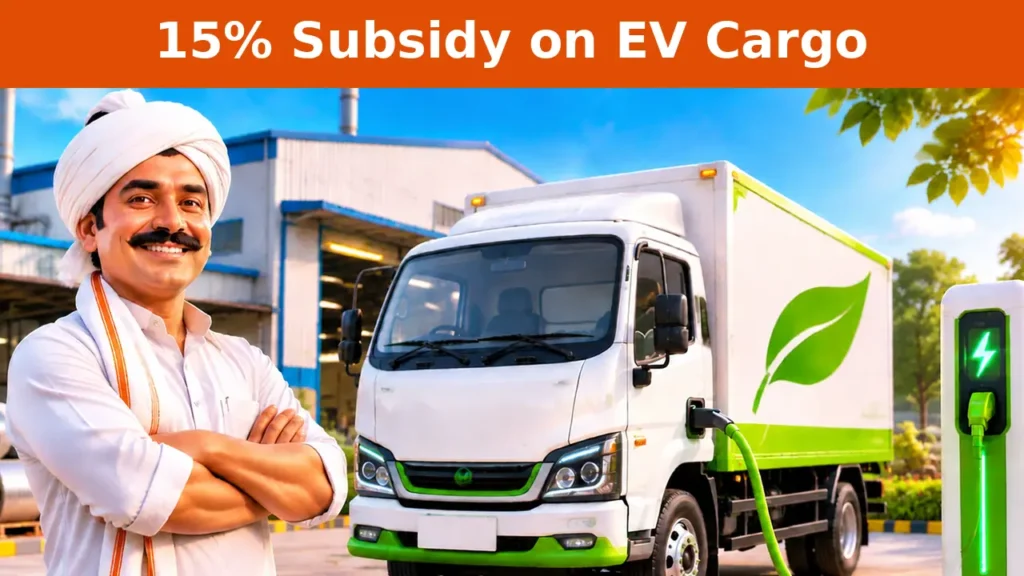
The Haryana government has launched a scheme giving direct financial help to the state’s MSME entrepreneurs for buying electric vehicles for transporting their goods. Under the Haryana EV for Cargo Logistic Scheme, micro, small and medium enterprises get 15 percent of the ex-showroom price, up to Rs 5 lakh, as reimbursement on buying a new electric cargo vehicle (truck or 3/4-wheeler commercial vehicle). The scheme was notified in the Haryana Government Gazette on 9 September 2026.
This is not news from 22 November — the scheme has been running under the September 2026 notification. It was created after the approval of Haryana’s Strategic Investment Plan (SIP) under the World Bank-supported RAMP (Raising and Accelerating MSME Performance) programme. This guide gives the amount of assistance, eligibility, documents and application process from the notification.
At a glance: EV for Cargo Logistic Scheme
| Point | Details |
|---|---|
| Scheme name | Haryana EV for Cargo Logistic Scheme |
| Notification | 9 September 2026, No. 02/06/2026-1IB-II, Gazette (Extraordinary) No. 137-2026/Ext. |
| Who it is for | Micro, small and medium enterprises (MSMEs) of Haryana |
| Form of assistance | Reimbursement (buy the vehicle first, then claim) — no advance payment |
| Amount of assistance | 15% of the ex-showroom price, up to Rs 5 lakh per vehicle |
| Vehicles covered | New EV cargo trucks / commercial cargo EVs (3/4 wheelers) — BEV, HEV, PHEV, FCEV; load capacity 700 kg–10,000 kg |
| Limit | One vehicle per MSME during the operative period; first 250 eligible MSMEs, first-applied first-served |
| Eligible purchase | Vehicle bought on or after 1 April 2026; from an authorised dealer in Haryana; registered in the firm’s name in Haryana |
| Application deadline | Within 3 months of purchase or notification, whichever is later |
| Validity of the scheme | 3 years from notification, or till the validity of the RAMP programme, or till the target number of vehicles is reached — whichever is later |
| Sanctioning authority | HOD, Directorate of MSME, Haryana |
Background: What is the RAMP programme?
The Government of India has launched the World Bank-supported RAMP (Raising and Accelerating MSME Performance) programme to improve the COVID resilience, productivity and competitiveness of MSMEs. Under it, Haryana’s Strategic Investment Plan (SIP) was approved by the Union Ministry of MSME through a letter dated 8 February 2024 (D.O. No. L/AFI/RAMP/2023/SIPCycle2) — and on the basis of that approval the state government notified this scheme on 9 September 2026.
The primary objective of the scheme is to encourage technology upgradation within Haryana’s MSMEs and to promote the adoption of commercial electric vehicles (trucks/cargo vehicles). By switching to EVs, enterprises benefit from reduced fuel and maintenance expenses and lower pollution.
How much assistance? 15% reimbursement, up to Rs 5 lakh
On buying a new EV cargo truck or commercial cargo EV (3/4 wheeler), the ex-showroom price is reimbursed at 15 percent, up to a maximum of Rs 5 lakh. Assistance is given on only one vehicle per MSME during the operative period of the scheme. The eligible vehicles are BEV (Battery Electric Vehicle), HEV (Hybrid Electric Vehicle), PHEV (Plug-in Hybrid Electric Vehicle) and FCEV (Fuel Cell Electric Vehicle) — with a load capacity between 700 kg and 10,000 kg.
Note: clause 3 of the notification lists all four vehicle types (BEV, HEV, PHEV, FCEV), while the definitions in clause 4 define BEV, FCEV and PHEV — this guide follows the list in clause 3. Assistance is given only to the first 250 eligible MSMEs, on a first-applied-first-served basis, for complete applications — subject to the availability of budget. Micro enterprises get priority on the basis of the date of application submitted on the portal.
The vehicle types are defined in the notification as follows:
- BEV (Battery Electric Vehicle): a vehicle powered exclusively by an electric motor, whose energy is supplied by a traction battery.
- FCEV (Fuel Cell Electric Vehicle): a vehicle in which energy stored as hydrogen is converted to electricity by the fuel cell.
- PHEV (Plug-in Hybrid Electric Vehicle): a strong hybrid vehicle with off-vehicle charging (OVC) of the battery.
- Commercial Cargo EV (CCEV): a vehicle designed for transporting goods or raw material, running on electricity instead of fossil fuels.
Worked examples: how much subsidy will you get?
The examples below are only to explain the calculation of the 15 percent rule and the Rs 5 lakh cap — they are not scheme figures:
- Example 1 — electric cargo vehicle of Rs 10 lakh: 15 percent of the ex-showroom price of Rs 10,00,000 is Rs 1,50,000, which is within the Rs 5 lakh cap — so Rs 1,50,000 will be reimbursed.
- Example 2 — electric cargo truck of Rs 40 lakh: 15 percent of the ex-showroom price of Rs 40,00,000 is Rs 6,00,000, but the maximum cap is Rs 5 lakh — so the reimbursement will be Rs 5,00,000 only.
Who is eligible? Micro, small and medium definitions
The scheme is for all three categories of MSME — micro, small and medium. Note that the definitions given in this notification apply:
| Category | Investment in plant and machinery / equipment | Annual turnover |
|---|---|---|
| Micro enterprise (in this scheme) | Not more than Rs 2.5 crore | Not more than Rs 10 crore |
| Small enterprise (in this scheme) | Not more than Rs 25 crore | Not more than Rs 100 crore |
| Medium enterprise (in this scheme) | Not more than Rs 125 crore | Not more than Rs 500 crore |
For comparison: under the standard MSMED definition, the micro limit is Rs 1 crore investment and Rs 5 crore turnover, and the small limit is Rs 10 crore investment and Rs 50 crore turnover. The limits in this notification are higher — so check your unit’s category against this notification’s definition before applying.
Eight eligibility conditions
All MSMEs operating in the State of Haryana can be beneficiaries, provided these conditions are met:
- The unit should be in regular commercial production/operations at the time of disbursement — a closed unit will not get the subsidy.
- The unit should hold a valid Udyam Registration Certificate (URC) from the Government of India’s Udyam Registration Portal.
- The applicant should not have claimed an incentive under FAME or any other State/Central policy for the same vehicle.
- Assistance is given on a first-applied-first-served basis, for complete applications — micro enterprises get priority on the basis of the date of application, subject to the availability of budget.
- The vehicle should have been bought from an authorised dealer in Haryana and registered in the state in the firm’s name (Company/LLP/Partnership Firm/Proprietorship).
- The vehicle should be used only for the unit’s own logistics requirements — enterprises whose primary business is logistics and transportation (such as logistics and courier companies) are not eligible.
- The unit can take the benefit on only one EV cargo vehicle during the operative period of the scheme.
- No benefit is available on the purchase of a second-hand vehicle.
How to apply: the full process
The application must be submitted on Annexure-I, with the listed documents, to the HOD, Directorate of MSME, on the department’s web portal — within 3 months of the purchase of the vehicle, or from the date of notification, whichever is later. The process runs as follows:
- Submit the application — fill Annexure-I, attach all documents and submit it to the HOD, Directorate of MSME, on the department’s web portal.
- Scrutiny — the office of the HOD, Directorate of MSME, will examine the application. Any deficiency will be communicated to the applicant in writing on the portal within 7 days, and 10 days will be given to rectify it.
- Claim closed if deficiency is not removed — if the deficiency is not removed within the prescribed period, the claim will be closed and the application will not be entertained again.
- Decision — the application will be approved or rejected within 30 working days from the date of application.
- No additional documents — no document other than those specified in Annexures I, II and III will be required, unless needed to establish the genuineness of the claim.
Important note: the notification mentions only “the web portal of the department” — no scheme-specific portal link is given, and the correct place for online filing had not been confirmed as of November 2026. So before preparing an application, confirm the current form and portal from your District MSME Centre. The list of district offices is given in the official links below. No link has been given by guesswork.
Which documents are needed?
These documents must be attached with Annexure-I:
- Copy of the Udyam Registration Certificate (URC).
- Annexure-II — declaration on non-judicial stamp paper, duly sworn before a Notary Public or First-Class Magistrate.
- Board Resolution / Power of Attorney — signed by the majority of the Directors/Partners, attested by the authorised signatory, with DIN (where applicable).
- Certificate of Incorporation / Registration of Partnership firm — with the partnership deed along with Form ‘A’ and ‘C’ / Co-operative Society Registration etc.
- Chartered Accountant’s certificate of expenditure (in original) — as per Annexure-III, with details of investment in plant and machinery.
- Copy of the Annual GST return (Form 9/9C) or Audited Balance Sheet for the last financial year, as applicable.
- Copy of the first sale bill of the beneficiary unit.
- Copy of the purchase bill/invoice of the EV vehicle.
- Copy of the Registration Certificate (RC) of the EV vehicle in the name of the unit (Haryana unit only).
- Copy of the insurance of the EV vehicle.
What are Annexures II, III and IV?
Annexure-II — an undertaking/declaration on non-judicial stamp paper, duly sworn before a Notary Public or First-Class Magistrate. It declares that the applicant has not taken a benefit under FAME or any other State/Central policy for the same vehicle; that the entire or excess assistance must be refunded if the audit team of the Principal Accountant General, Haryana, points out an omission or discrepancy; and that wrong information will mean refund of the entire assistance with compound interest at 12 percent per annum, besides legal action and debarment from public procurement.
Annexure-III — a Chartered Accountant’s certificate on the CA’s letterhead, recording the amount spent on buying the EV, details of payment, investment in plant and machinery and the turnover of the last financial year — with the CA’s signature, seal, membership number and UDIN.
Annexure-IV — an undertaking/declaration on non-judicial stamp paper, duly sworn before a Notary Public or First-Class Magistrate. It covers the 15 percent assistance (up to Rs 5 lakh), taking no benefit under any other State/Central scheme for the same component, and refund of the assistance if the verification finds otherwise.
Time limit: the 3-month rule
The time limit matters most in this scheme, because delay ends the entitlement:
- 3 months — to submit the claim: the complete claim (with all documents) must be submitted within 3 months of the date of purchase, or from the notification (9 September 2026) — whichever is later — otherwise the entitlement will be forfeited. The vehicle must have been bought on or after 1 April 2026.
- Condonation of delay: the HOD, Directorate of MSME, can condone a delay of up to 3 months after the prescribed time limit; the Administrative Secretary, Industries and Commerce Department, can condone a delay of up to 6 months — provided the competent authority is satisfied with the reasons for the late submission on the basis of substantial evidence, documents or arguments.
- Submit the RC: the Registration Certificate (RC) of the EV bought under the scheme must be submitted within 3 months of the release of the subsidy — the RC must be in the name of the applicant entity and include complete vehicle details.
Sanction, appeal and interpretation
The competent authority for sanction is the HOD, Directorate of MSME, Haryana. An appeal against the HOD’s orders lies with the Administrative Secretary, Industries and Commerce Department, within 30 days of the communication of the order; the Administrative Secretary’s orders in appeal are final. The Administrative Secretary is also competent to interpret the scheme’s provisions and to remove difficulties.
What happens on a false claim? Penal provisions
Clause 16 of the notification is clear on penalties. If it is found at any stage that the assistance was claimed on the basis of wrong facts, the applicant must:
- refund the assistance with compound interest at 12 percent per annum;
- face legal action;
- be debarred from the grant of any incentive/assistance from the State Government;
- if the subsidy amount with interest is not refunded, the amount will be recovered as an arrear of land revenue; and
- be debarred from public procurement as a result of the mismatch in facts and figures.
There are two further bars. No migration to another scheme: an applicant who has applied for this scheme cannot move to any other scheme for the same component, even after approval of assistance. No double benefit: an applicant cannot take a similar benefit under any other scheme for the same component — a declaration to this effect (Annexure-IV) must be submitted; if the verification finds otherwise, the entire amount must be refunded.
Five things to check before applying
- Buy first, then claim: this is a reimbursement scheme, not an advance — buy the vehicle first, then claim. A vehicle bought before 1 April 2026 is not eligible.
- Do not miss the 3-month deadline: submit the complete claim within 3 months of purchase or notification, whichever is later, otherwise the entitlement will be forfeited.
- Only the first 250 get it: assistance goes only to the first 250 eligible MSMEs — the application must be complete and correct; micro enterprises get priority.
- For your own logistics only: courier or logistics businesses are not eligible; no benefit is available on a second-hand vehicle either.
- No double benefit under FAME or another scheme: if you have taken a benefit on the same vehicle under another scheme, this scheme will not apply — give the Annexure-IV declaration carefully.
Frequently asked questions
How much assistance is given on an EV cargo vehicle?
15 percent of the ex-showroom price of a new electric cargo vehicle, up to a maximum of Rs 5 lakh as reimbursement. One MSME gets assistance on only one vehicle during the operative period of the scheme.
Which vehicles are eligible under this scheme?
New EV cargo trucks and commercial cargo EVs (3/4 wheelers) — BEV, HEV, PHEV and FCEV — with a load capacity between 700 kg and 10,000 kg. Second-hand vehicles are not eligible.
Can a logistics or courier company apply?
No. Assistance is given only to units that use the vehicle for their own logistics requirements. Enterprises whose primary business is logistics and transportation are not eligible.
When should the vehicle have been bought?
The vehicle must have been bought on or after 1 April 2026 — a vehicle bought before that date is not eligible.
Within how much time must the claim be submitted?
The complete claim must be submitted within 3 months of the date of purchase of the vehicle, or from the notification (9 September 2026) — whichever is later — otherwise the entitlement will be forfeited. The HOD can condone a delay of up to 3 months and the Administrative Secretary up to 6 months.
How long will this scheme run?
3 years from the notification, or till the validity of the RAMP programme, or till the target number of vehicles is reached — whichever is later. Assistance goes only to the first 250 eligible MSMEs, on a first-applied-first-served basis.
Test your knowledge — 5 questions
1. What is the maximum reimbursement on an EV cargo vehicle?
Rs 5 lakh — 15 percent of the ex-showroom price, up to a maximum of Rs 5 lakh.
2. How many vehicles can one MSME get the benefit on during the operative period?
One — assistance is given on only one EV cargo vehicle per MSME.
3. What should the load capacity of the vehicle be?
Between 700 kg and 10,000 kg.
4. Within how much time is a decision taken on the application?
Within 30 working days — approval or rejection from the date of application.
5. What interest must be paid on a false claim?
Compound interest at 12 percent per annum — along with legal action and debarment from state incentives.
Official links
- Directorate of MSME, Haryana (departmental portal) — msme.haryana.gov.in
- List of District MSME Centres / field offices — msme.haryana.gov.in/field-offices/
- Gazette notification (9 September 2026, PDF) — Notification No. 02/06/2026-1IB-II
- News report on the scheme (Economic Times, 11 September 2026) — ETInfra: Haryana notifies scheme to subsidise electric cargo vehicles for MSMEs
- Udyam Registration (URC) — udyamregistration.gov.in
This guide is based on Notification No. 02/06/2026-1IB-II, published in the Haryana Government Gazette (Extraordinary) No. 137-2026/Ext. on 9 September 2026. The conditions, forms and portal of the scheme may change from time to time — before applying, confirm the current position from your District MSME Centre or the Directorate of MSME. The information in this guide is for general guidance only; it is not legal advice.