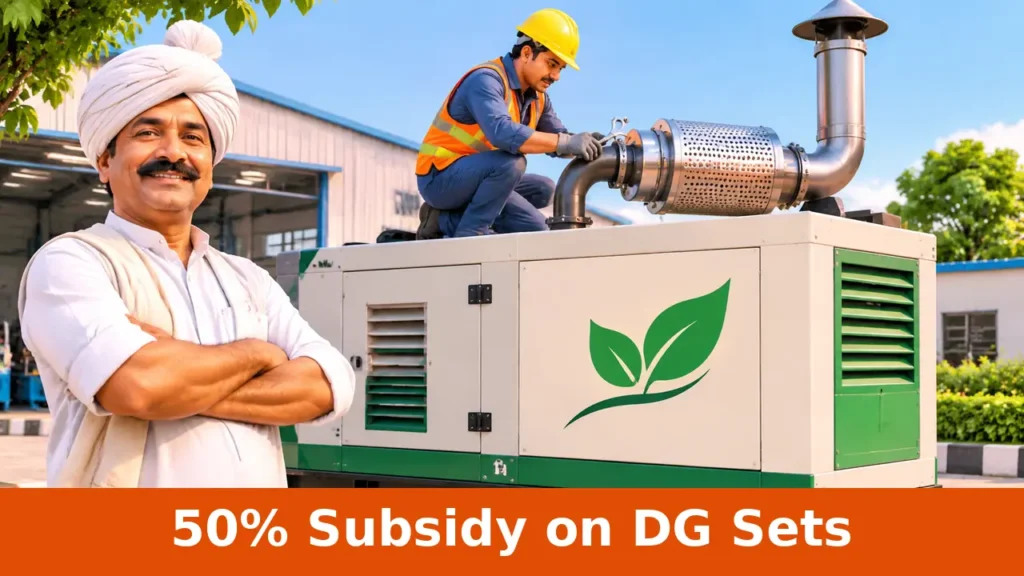
The Haryana government has started a scheme giving direct financial help to small industries in the state for switching their diesel generator sets to clean fuel and fitting them with pollution-control devices. Under the Diesel Generator Set Subsidy Scheme, micro and small enterprises get 50 percent of the cost back, up to Rs 5 lakh, for fitting a RECD (Retrofit Emission Control Device) on an old DG set or converting it to dual-fuel mode, and 50 percent of the cost, up to Rs 20 lakh, for buying a new CPCB-compliant generator set. The scheme was notified in the Haryana Government Gazette on 19 August 2026 and will remain in force for 6 years (till 18 August 2032).
This is not news from 22 November — the scheme has been running since the August 2026 notification. At present its first phase is in force, covering the four districts adjoining Delhi — Faridabad, Gurugram, Sonipat and Jhajjar; the second phase will cover the remaining NCR districts and the third phase all districts of Haryana. This guide explains the amount of assistance, benchmark rates, eligibility, documents and the full application process, based on the notification.
At a glance: Diesel Generator Set Subsidy Scheme
| Point | Detail |
|---|---|
| Scheme name | Diesel Generator Set Subsidy Scheme |
| Notification | 19 August 2026, No. 02/05/2026-1IB-II, Gazette (Extraordinary) No. 126-2026/Ext. |
| Who it is for | Micro and small enterprises of Haryana (in the phased districts) |
| Nature of help | Reimbursement of expenses (spend first, then claim) — no advance money |
| RECD retrofit / dual-fuel conversion | 50% of RECD cost, maximum Rs 5 lakh (target: 1,000 DG sets across the three phases) |
| New CPCB generator set | 50% of the generator cost, maximum Rs 20 lakh (target: 1,400 new generators in Gurugram and Faridabad) |
| Benchmark rate | DG sets: Rs 10,000/KVA (up to 100 KVA), Rs 9,000/KVA (100–500 KVA), Rs 8,000/KVA (above 500 KVA); RECD/dual-fuel kit: Rs 2,500 per KVA |
| Phases | Phase-I (2 years): Faridabad, Gurugram, Sonipat, Jhajjar; Phase-II (2 years): NCR districts; Phase-III (2 years): all districts |
| Scheme validity | 6 years from notification — till 18 August 2032 |
| Department | Industries & Commerce Department, Directorate of MSME, Haryana |
| Application deadline | Within 3 months of purchase/conversion or notification, whichever is later |
| Sanctioning authority | Joint Director / Additional Director, MSME |
Background: why DG sets must change for clean air
The scheme was created under the Haryana government’s Budget 2025-26 announcement and the Haryana Clean Air Project for Sustainable Development (HCAPSD 2025-2031). Its purpose is to help micro, small and medium industries comply with the standards of the Commission for Air Quality Management (CAQM), so that pollution from diesel generators falls and industry moves towards clean fuel. According to the Ministry of Environment, Forests and Climate Change (MoEFCC), stationary diesel generators account for 18 percent of urban pollution. As DG sets age, their emissions can exceed permissible standards by up to 11 times, contributing 7–18 percent to ambient air pollution in non-attainment cities. A 2018 study found that 2–5 percent of Particulate Matter (PM) emissions in industries are linked to DG set usage — a figure expected to rise with ongoing urbanization and industrialization.
That is why the state government is now moving towards completely phasing out diesel-only generators, rather than merely restricting their use during winter months. The scheme gives industries two options — fit a RECD on the existing generator or convert it to dual-fuel mode, or buy a new CPCB-compliant generator set. All DG sets and retrofit systems supported under the scheme must mandatorily comply with the emission norms notified by CPCB and the directions issued by CAQM from time to time.
| Phase | Duration | Districts covered |
|---|---|---|
| Phase-I | 2 years | Faridabad, Gurugram, Sonipat, Jhajjar (districts adjoining Delhi) — live now |
| Phase-II | 2 years | Districts of Haryana falling under the National Capital Region (NCR) |
| Phase-III | 2 years | All districts of Haryana |
The scheme’s objectives are clear — complying with CAQM norms, successfully transforming diesel generator set engines to more environment-friendly alternatives, pushing the adoption of RECD in DG sets, ensuring compliance with CPCB emission standards, and facilitating the transition to dual-fuel and cleaner technologies.
How much help is available? Two components, 50% reimbursement
The assistance is divided into two components. Both carry a 50 percent reimbursement, but the maximum limits and targets are different:
- Component I — Retrofit / dual-fuel conversion of existing DG sets: for fitting a RECD on an existing diesel generator set or converting it to dual-fuel mode, 50 percent of the RECD cost, up to a maximum of Rs 5 lakh (excluding taxes, freight and carriage charges) is reimbursed. The state targets 1,000 DG sets for retrofit/dual-fuel conversion across the three phases. Eligible interventions include dual-fuel conversion kits, RECD devices, and associated balance-of-system components.
- Component II — Purchase of a new CPCB-compliant DG set: for buying a new generator set complying with CPCB emission standards, 50 percent of the generator cost, up to Rs 20 lakh (excluding taxes, freight, installation and carriage charges) is reimbursed. The state targets a total uptake of 1,400 new generators in the districts of Gurugram and Faridabad.
The eligible project cost for subsidy calculation is capped on benchmark rates derived from prevailing market prices. The subsidy is calculated on the actual cost or the upper limit of the benchmark cost, whichever is lower — and it excludes GST and installation cost:
| Item | Capacity / Component | Benchmark upper limit |
|---|---|---|
| DG set | Up to 100 KVA | Rs 10,000 per KVA |
| DG set | 100–500 KVA | Rs 9,000 per KVA |
| DG set | Above 500 KVA | Rs 8,000 per KVA |
| RECD / dual-fuel conversion kit | Per KVA | Rs 2,500 per KVA |
Examples: how much subsidy will you get?
The examples below are arithmetic illustrations of the 50 percent rule and the benchmark caps only — they are not scheme figures. Your actual subsidy will depend on your set’s capacity, the actual cost, and the benchmark limit:
- Example 1 — RECD on a 125 KVA set: the benchmark rate for a RECD/dual-fuel kit is Rs 2,500 per KVA, so the benchmark cost for a 125 KVA set is Rs 3,12,500. Fifty percent of that is Rs 1,56,250, which is within the Rs 5 lakh maximum — so Rs 1,56,250 would be reimbursed. Even if the kit’s actual cost were Rs 4,00,000, the calculation would still use the benchmark cost (Rs 3,12,500, which is lower).
- Example 2 — New CPCB set of 100 KVA: the benchmark rate up to 100 KVA is Rs 10,000 per KVA, so the benchmark cost of the set is Rs 10,00,000. Fifty percent is Rs 5,00,000, which is within the Rs 20 lakh maximum — so Rs 5,00,000 would be reimbursed.
- Example 3 — New CPCB set of 500 KVA: the benchmark rate for 100–500 KVA is Rs 9,000 per KVA, so the benchmark cost is Rs 45,00,000. Fifty percent would be Rs 22,50,000, but the maximum limit is Rs 20 lakh — so the reimbursement would be capped at Rs 20,00,000.
Who is eligible? Definitions of micro and small enterprises
The scheme is only for micro and small enterprises — medium enterprises are outside its scope. Note that the definitions of micro and small in this notification differ from the standard MSMED Act definitions — the definitions in the Gazette will apply for this scheme:
| Category | Investment in plant & machinery / equipment | Annual turnover |
|---|---|---|
| Micro enterprise (in this scheme) | Not more than Rs 2.5 crore | Not more than Rs 10 crore |
| Small enterprise (in this scheme) | Not more than Rs 25 crore | Not more than Rs 100 crore |
For comparison: under the standard MSMED definition, a micro enterprise is limited to Rs 1 crore investment and Rs 5 crore turnover, and a small enterprise to Rs 10 crore investment and Rs 50 crore turnover. The limits in this notification are higher — so check your unit’s category against this notification’s definitions, not against another guide’s definitions. The scheme defines some terms as follows: a RECD is an add-on device that can be retrofitted to an existing DG set to reduce its emissions — it controls NOx, Particulate Matter and carbon by converting these pollutants into less harmful substances before they are released into the atmosphere, typically using a catalytic converter and a diesel oxidation catalyst (DOC). A DG set is a compact machine in which mechanical energy produced by a diesel engine is converted into electrical energy, and it functions only on diesel fuel. A dual-fuel set can operate on a combination of diesel and another fuel, typically natural gas or LPG — it can run on a gas mixture of up to 70 percent gas, which lowers fuel consumption and operational cost. A CPCB DG set is one that complies with the Central Pollution Control Board (CPCB) emission norms — the CPCB IV+ norms.
At the time of application the unit must also meet these conditions:
- The unit must have filed its Udyam Registration Certificate (URC) and Haryana Udhyam Memorandum (HUM).
- The unit must not be on the restrictive list notified by the State Government from time to time.
- The unit must be in commercial production — the benefit can be availed only after commercial production has begun.
- The unit must be in regular production at the time of disbursement — no subsidy is released to a closed unit.
- The unit must not have availed subsidy for the purchase/conversion of DG sets under any other State/Central scheme.
- The RECD equipment / CPCB-compliant diesel genset must be intact and must have been certified by the Haryana State Pollution Control Board (HSPCB).
How to apply: the complete process
The application must be submitted on the prescribed form Annexure-I, along with the listed documents, to the Director / Director General, MSME, on the web portal of the department. It must be filed within 3 months from the purchase of the RECD equipment / CPCB-compliant genset, or from the date of notification of the scheme, whichever is later. The process runs as follows:
- Submit the application — fill in the Annexure-I form, attach all documents and submit it on the department web portal to the Director/Director General, MSME.
- Scrutiny and inspection — the Joint Director/Deputy Director of the concerned District MSME Centre will scrutinise and verify the documents and inspect the unit, then clearly recommend the claim for approval or rejection.
- Deficiencies will be communicated — if there is any deficiency in the documents, the applicant will be informed in writing within 7 days and given 10 days to rectify it.
- Rejection if not rectified — if the deficiency is not removed within the prescribed period, the claim will be filed by the Competent Authority, with intimation to the enterprise by email.
- Sanction — the Joint Director / Additional Director, MSME is the competent authority for sanctioning the assistance (note: in this scheme the sanction comes from the Joint/Additional Director, not the HOD).
- Appeal — an appeal against the competent authority’s order lies with the Director General, Directorate of MSME, Haryana, within 30 days of the communication of the order; the Director General’s orders are final.
Important note: the notification mentions only “the web portal of the department” — it does not give a scheme-specific portal link for the Annexure-I form, and as of November 2026 the exact online filing destination has still not been confirmed. So before preparing a claim, do confirm the current application form and portal from your District MSME Centre. The list of district offices is given in the official links below. No link has been given on guesswork.
The service delivery timeline (in working days) is fixed in the notification as follows:
| Task | Time limit (working days) |
|---|---|
| Letter of Approval | 30 days |
| Letter of Sanction | 7 days |
| Disbursement | 7 days |
Which documents are needed?
These self-attested documents must be attached with Annexure-I:
- Certificate of Incorporation / Partnership deed / Partnership registration / Co-operative society registration, whichever is applicable.
- Board resolution / Power of attorney or duly notarised stamp paper.
- Change of Land Use (CLU) / NOC from the competent authority, if applicable.
- CA certificate of expenditure (in original) — giving the details as per the prescribed format.
- Copies of the bills and proof of payment thereof.
- Certificate from the pollution control board.
- First sale bill.
- Latest sale bill / electricity bill of the last 2 months (proof of production).
- Copy of GST returns.
There are three more annexures: Annexure-II — an undertaking/declaration on non-judicial stamp paper of Rs 50 (minimum), duly sworn before a Notary Public (with notarial stamp, seal and registration number) or a First-Class Magistrate; it declares that the applicant has not availed assistance for the same DG set under any other scheme, and that if any fact is found wrong, the entire assistance will be refunded with compound interest at 12 percent per annum. Annexure-III — a CA certificate on the CA’s letterhead, recording the expenditure incurred, the investment in plant and machinery and the turnover of the last financial year, with the CA’s signature, stamp, membership number and UDIN. (Note: the heading of Annexure-III mentions an “energy audit”, but its full text concerns certification of DG set/RECD expenditure — a drafting quirk in the Gazette; there is no separate energy-audit requirement in this scheme.) Annexure-IV — a certificate from the Regional Officer of the State Pollution Control Board that the RECD device / dual-mode conversion kit / CPCB-compliant genset has been installed in accordance with CPCB emission standards.
Deadlines: the 3-month rule
The deadline matters most in this scheme, because a delay ends the entitlement:
- 3 months — to file the claim: the claim, complete in all respects, must be submitted within 3 months of the date of conversion of the existing DG set / purchase of the new DG set, or from the date of notification of the scheme, whichever is later — otherwise the enterprise forfeits its entitlement to the reimbursement.
- Condonation of delay: the Director/Director General, MSME can condone a delay of up to 3 months after the prescribed time limit; the Administrative Secretary, Industries & Commerce, can condone a delay of up to 6 months after the prescribed time limit — provided the reasons for late submission are backed by substantial evidence, documents or arguments.
- Delay in appeal: the same condonation power applies to delays in filing an appeal.
Monitoring and compliance: a 6-year responsibility after the subsidy
Receiving the subsidy is not the last step — the notification also fixes the monitoring that follows:
- Post-installation verification: before the subsidy is released, the concerned District MSME Centre and/or any agency designated by the Directorate will carry out a physical and technical verification of the DG set, RECD device and dual-fuel system — confirming installation, operational status, and compliance with the prescribed technical specifications and emission norms.
- Compliance with regulatory standards: the beneficiary unit must ensure that the installed DG set, RECD device or dual-fuel system complies with the emission standards notified by CPCB and the directions issued by HSPCB and CAQM from time to time — non-compliance renders the unit ineligible for assistance.
- Minimum 6 years of operation: the beneficiary unit must operate and maintain the supported equipment for a minimum period of 6 years from the date of disbursement — the equipment must not be disposed of, transferred, or rendered non-operational during this period without prior approval of the competent authority.
- Periodic inspections: the Directorate of MSME, HSPCB or any other agency authorised by the Government may undertake periodic inspections of beneficiary units — the unit must extend full cooperation and provide access to records, equipment and premises.
What happens on a wrong claim? Penal provisions
Clause 15 of the notification states the penalty clearly. If at any time it is found that government assistance was availed on the basis of false information, the applicant must:
- Refund the assistance with compound interest at 12 percent per annum;
- Face legal action;
- Be debarred from the grant of any incentive or assistance from the State Government; and
- Be debarred from public procurement because of the mismatch in facts and figures.
If the applicant fails to refund the subsidy amount with interest, the amount will be recovered as an arrear of land revenue. So check all bills, the CA certificate and the declarations carefully before filing a claim.
5 things to note before applying
- Spend first, claim later: this is a reimbursement scheme, not an advance — first fit the RECD or buy the new set, then file the claim.
- The benchmark decides the calculation: the subsidy is calculated on the actual cost or the benchmark upper limit, whichever is lower — GST and installation cost are not counted.
- HSPCB certification is essential: the RECD equipment or CPCB set must be intact and certified by the Haryana State Pollution Control Board — without it, no claim will succeed.
- Do not miss the 3-month deadline: file the complete claim within 3 months of purchase/conversion, otherwise the entitlement is forfeited.
- The equipment must run for 6 years: after the subsidy, the equipment must be operated for at least 6 years — selling it or shutting it down without permission would breach the scheme’s conditions.
Frequently asked questions
How much help is available for RECD retrofit?
Fifty percent of the RECD cost, up to a maximum of Rs 5 lakh (excluding taxes, freight and carriage charges), for fitting a RECD on an existing DG set or converting it to dual-fuel mode. The state targets 1,000 DG sets for retrofit across the three phases.
How much help is available for a new CPCB generator set?
Fifty percent of the generator cost, up to Rs 20 lakh (excluding taxes, freight, installation and carriage charges), for buying a new CPCB-compliant generator set. The state targets 1,400 new generators in Gurugram and Faridabad.
Which districts does the scheme cover right now?
Phase-I is live now — Faridabad, Gurugram, Sonipat and Jhajjar. Phase-II (2 years) will cover the NCR districts, and Phase-III (2 years) will cover all districts of Haryana.
What are the definitions of micro and small enterprises in this scheme?
Under this notification, a micro enterprise is one with investment in plant and machinery/equipment up to Rs 2.5 crore and turnover up to Rs 10 crore; a small enterprise is one with investment up to Rs 25 crore and turnover up to Rs 100 crore. These limits differ from the standard MSMED definitions (micro Rs 1 crore/Rs 5 crore; small Rs 10 crore/Rs 50 crore) — the Gazette’s definitions apply for this scheme.
Within how much time must the claim be filed?
The complete claim must be filed within 3 months of the purchase/conversion, or from the date of notification (19 August 2026), whichever is later — otherwise the entitlement is forfeited. The Director/Director General can condone a delay of up to 3 months, and the Administrative Secretary up to 6 months.
How long must the equipment be operated after the subsidy?
At least 6 years — from the date of disbursement. During this period the equipment must not be disposed of, transferred, or rendered non-operational without prior approval of the competent authority.
Check your understanding — 5 questions
1. What is the maximum reimbursement for RECD retrofit?
Rs 5 lakh — 50% of the RECD cost, capped at Rs 5 lakh.
2. What is the maximum help for a new CPCB generator set?
Rs 20 lakh — 50% of the generator cost, capped at Rs 20 lakh.
3. What is the benchmark cost of a RECD kit for a 125 KVA DG set?
Rs 3,12,500 — the benchmark rate of Rs 2,500 per KVA multiplied by 125 KVA.
4. Within how much time must the claim be filed after purchase/conversion?
Within 3 months — otherwise the entitlement to the reimbursement is forfeited.
5. Who is the sanctioning authority for the assistance?
The Joint Director / Additional Director, MSME — in this scheme the sanction does not come from the HOD.
Official links
- Directorate of MSME, Haryana (department portal) — msme.haryana.gov.in
- District MSME Centres / field offices list — msme.haryana.gov.in/field-offices/
- Gazette notification (19 August 2026, PDF) — Notification No. 02/05/2026-1IB-II
- Udyam Registration (URC) — udyamregistration.gov.in
This guide is based on Haryana Government Gazette (Extraordinary) No. 126-2026/Ext., published on 19 August 2026, Notification No. 02/05/2026-1IB-II. The scheme’s conditions, forms and portal may change from time to time — confirm the current position from your District MSME Centre or the Directorate of MSME before applying. The information in this guide is general guidance only; it is not legal advice.