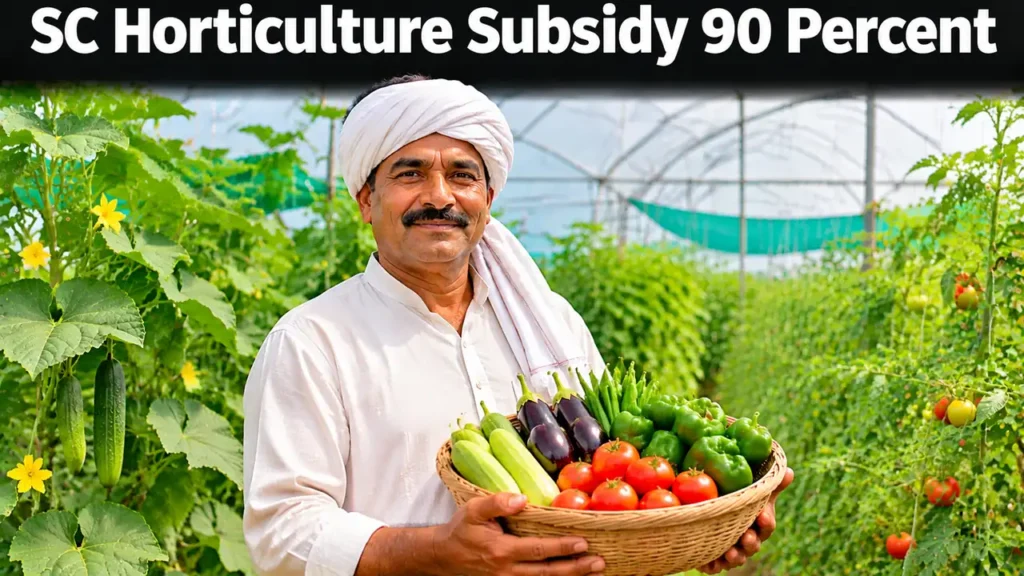
The Haryana Government’s Integrated Horticulture Development Plan Scheme for Scheduled Caste Families helps Scheduled Caste farmers take up horticulture. Under this scheme, farmers get a subsidy of up to 90% on mushroom cultivation, bamboo staking in vegetable crops, protected structures like Poly House / Net House / Walk-in-Tunnels, and cultivation of high-value vegetables and flowers — along with training in modern horticulture techniques. The scheme is run by the Department of Horticulture, Haryana, and applications are made offline — at the District Horticulture Office of the applicant’s district. This guide gives the eligibility, benefits, documents, the full application process, fees, status check and helpline — and wherever the information could not be confirmed from an official source, that is written clearly.
Scheme at a Glance
| Point | Details |
|---|---|
| Scheme name | Integrated Horticulture Development Plan Scheme for Scheduled Caste Families |
| State / level | Haryana / State Plan Scheme (SB No. 98) |
| Nodal department | Department of Horticulture, Government of Haryana |
| Implementing agency | Department of Horticulture, Haryana (through District Horticulture Offices) |
| Benefit | Up to 90% subsidy on mushroom trays, bamboo staking, protected cultivation (poly house / net house / walk-in-tunnel), high-value vegetables and flowers + training |
| Who it is for | Scheduled Caste farmers of Haryana — small landholding families (own or leased agricultural land) |
| How to apply | Offline — District Horticulture Office |
| Application fee | Not stated on myScheme — see ‘Fees and timelines’ below |
| Last date | No last date is given on myScheme (schemeCloseDate: null) — applications remain open through the year |
| DBT scheme | No (dbtScheme: No) |
Read this first — the most important point: two official sources disagree on the subsidy rate — myScheme says 90%, while the Horticulture Department’s own scheme-details document (December 2022) gives 85% for the same scheme (SCSP-98) with per-unit amounts. Both are given below — before spending any money, confirm the applicable rate in writing from your District Horticulture Officer. The full detail is in the ‘Please note’ section.
What Benefit Will You Get
According to myScheme, Scheduled Caste farmers get a subsidy of up to 90% on these components:
- Mushroom Trays — subsidy on trays for mushroom cultivation.
- Bamboo Stacking in vegetable crops — subsidy on bamboo staking used to support climbing vegetables.
- Protected Structures — subsidy on Poly House, Net House and Walk-in-Tunnels.
- High-value vegetables / flowers under protected structures — subsidy on growing high-value vegetables and flowers inside a poly house or net house.
- Other cultivation technologies — subsidy on other modern horticulture technologies (myScheme does not name them separately).
- Training — training is provided on various aspects of horticultural crop cultivation technologies.
Objectives of the scheme (as stated by the department): to encourage SC farmers to take horticultural crops as a diversification option; to acquaint SC farmers with the latest technologies in horticulture; and to increase the income from the land of SC families by adopting horticultural crops. The scheme is aimed especially at SC families with small landholdings.
Component-Wise Rates in the Department’s Document — the 85% Table
The Horticulture Department’s scheme-details document (hkkp.org.in, December 2022) calls this scheme Scheme-II: State Plan Scheme for Integrated Horticulture Development for Scheduled Caste Families (SCSP-98) and gives component-wise rates of 85%. This table is from that document:
| Component | Subsidy | Amount (as per the department’s document) |
|---|---|---|
| Vegetable cultivation | 85% | Rs 25,500 per acre |
| Bamboo staking in vegetable crops | 85% | Rs 53,125 per acre |
| MS-iron staking in vegetable crops | 85% | Rs 1,19,850 per acre |
| Mushroom trays | 85% | Rs 255 per tray |
| Seasonal Mushroom Cultivation — Low-Cost thatched Hut | 85% | Rs 25,500 per unit |
| Protected cultivation — Naturally Ventilated Polyhouse (NVPH) | 85% | On total cost of Rs 717.4–901 per sq m |
| Protected cultivation — Hi-Tech Green House (HTGH) | 85% | On total cost of Rs 1,400–1,650 per sq m |
| Protected cultivation — Walk-in-Tunnel (WIT) | 85% | On total cost of Rs 600 per sq m |
| Protected cultivation — Anti-Insect Net House / Shade Net House (AINH/SNH) | 85% | On total cost of Rs 630–710 per sq m |
| Protected cultivation — Poly Net House (PNH) | 85% | On total cost of Rs 710 per sq m |
| Protected cultivation — Cable Purlin Net House (CNH) | 85% | On total cost of Rs 500–525 per sq m |
Two warnings on this table: first — this table is at the 85% rate, while myScheme says 90%; if the applicable rate is 90%, the per-unit amounts will also differ. Second — the per-sq-m subsidy figures printed alongside the polyhouse rows in the department’s document (for example Rs 422–530 for NVPH) do not match 85% — they look like the 50% figures of the general scheme, printed there by mistake. So the table above gives only the total-cost ranges; confirm the actual payable amount in writing from the District Horticulture Office.
Who Can Apply — Eligibility
The eligibility conditions in myScheme are as follows — all of them must be met together:
- The applicant should be a farmer.
- The farmer should be a resident of Haryana.
- The applicant should belong to the Scheduled Caste community.
- The applicant should own or lease agricultural land — owned land or leased land both qualify.
Note (myScheme): the scheme targets Scheduled Caste families with small landholdings in the state. No acreage limit for “small landholding” is stated on myScheme — ask the District Horticulture Office what counts as a small holding. No income limit is stated on myScheme either.
Do Not Confuse These — Separate Schemes
There are several horticulture schemes with similar names — the benefit and eligibility are different in each. Applying under the wrong scheme wastes time:
- Mukhyamantri Bagwani Vikas Yojana (Bagwani Vikas): the general scheme — subsidy of up to Rs 1.4 lakh per acre on orchards. It is NOT an SC-specific scheme, and it does not give the 90% subsidy on mushroom trays / bamboo staking. Our site has a separate guide for it (post 6190).
- General Integrated Horticulture Development Scheme (IHD-65): the department’s general scheme — 60% on new gardens, 40% on mushroom projects and 50% on polyhouses. The SCSP-98 rates (this scheme) are higher — do not mix the two up.
- Mission for Integrated Development of Horticulture (MIDH): a Central scheme — different rules and a different application process. It is not this state SCSP-98 scheme.
- Free horticulture training (mushroom batch): the department also runs free training at centres like Sunderah, Mahendragarh — that is training only, with no subsidy. Our site has a separate news post on it (post 3838). The training under this scheme is separate from it.
Documents Required
myScheme does not give a document list for this scheme. The list below is based on the documents usually asked for under the Horticulture Department’s schemes and on this scheme’s eligibility conditions — it is NOT myScheme’s official list, so whatever the form asks for at the time of application is what counts:
- Aadhaar card
- Parivar Pehchan Patra (PPP / Family ID)
- Scheduled Caste certificate (SC caste certificate)
- Haryana domicile certificate
- Land documents — Jamabandi / Fard (for owned land) or lease deed (for leased land)
- Bank account details (bank passbook / account number)
- Passport-size photographs
- Mobile number (application updates are sent by SMS)
- Meri Fasal Mera Byora (MFMB) registration — if asked for in the form
Keep clear photocopies of all documents and carry the originals with you — the District Horticulture Office may ask to see the originals during verification. If any document is missing (such as the caste certificate or PPP), get it made first, because an incomplete application can get stuck.
How to Apply Offline — District Horticulture Office
No online application process is given on myScheme for this scheme — applications are made offline only, at the District Horticulture Office. The process given on myScheme is as follows:
Step 1: Visit the respective District Horticulture Office.
Step 2: Collect the scheme application form and attach all necessary documents.
Step 3: Submit the completed application form along with the required documents at the concerned office.
Step 4: After verification, the applicant will receive confirmation of registration.
Keep the acknowledgement / receipt of the submitted form safely — it will carry your reference number. Before applying, visit the office and ask whether applications are open for the current year, because the scheme originated as a 2018-19 plan scheme (SB No. 98) and year-wise availability is confirmed at the district level.
Online Application — Not on SARAL
Many Haryana schemes accept applications through the Antyodaya SARAL portal, but no SARAL process is given on myScheme for this scheme — the application route stated is offline only (District Horticulture Office). So do not try to apply by searching for the scheme name on the SARAL portal — even if the name appears there, check with the District Horticulture Office first. No online form for this scheme was found on the Horticulture Department’s own website (hortharyana.gov.in) either.
Fees and Timelines
Application fee: no application fee for this scheme is stated on myScheme. If any fee is asked for at the office along with the form, that is the applicable fee — no fee amount is written here on our own, because it was not found in any official source.
Last date: myScheme gives no last date for the scheme (schemeCloseDate: null) — the scheme remains open through the year. But the application window for each year (for example, up to which month applications are taken) is decided at the district level — ask your District Horticulture Office.
Disposal timeline: no RTS (Right to Service) timeline is given on myScheme for this scheme — ask the District Horticulture Office how long approval takes.
How to Check the Application Status
No online status-check portal is given on myScheme for this scheme. To know the status, contact your District Horticulture Office — keep the reference number from the acknowledgement receipt with you. The SARAL status portal (status.saralharyana.nic.in) is not for this scheme, because applications are not made through SARAL — searching there will give nothing. If the department sends updates by SMS, they will come to your registered mobile number.
Helpline
| Whom to Contact | Details |
|---|---|
| Horticulture Department — Head Office | Directorate of Horticulture, Udyan Bhawan, Sector-21, Panchkula – 134116; Phone: 0172-2582322; Email: [email protected], [email protected] |
| Horticulture Helpline (toll-free) | 1800-180-2021 (Monday–Friday, 9:00 AM to 5:00 PM) |
| District Horticulture Office | Your district’s office — contact it for applications and status (ask the head office for its address/phone) |
| SARAL Helpline | 0172-3968400 — for general information only; this scheme is not applied for through SARAL |
The contact details above are taken from the department’s website and other public sources — confirm them on the head office number before applying.
Please Note — These Points Could Not Be Confirmed
Every figure in this guide is taken from an official source (myScheme and the Horticulture Department’s document). Even so, some important points could not be confirmed from any official source — we are not inventing them; please ask the District Horticulture Office in writing before applying:
- Subsidy rate — 90% or 85%: myScheme says 90%, while the department’s own scheme-details document (December 2022) gives 85% for all components of SCSP-98. This is the biggest difference — confirm the applicable rate in writing before spending money.
- Per-unit amounts exist only in the 85% document: Rs 25,500/acre (vegetables), Rs 53,125/acre (bamboo staking), Rs 1,19,850/acre (MS-iron staking), Rs 255/tray (mushroom trays), Rs 25,500/unit (seasonal mushroom hut) — these amounts are on the 85% basis. If the applicable rate is 90%, the amounts will differ.
- Polyhouse figures in the document do not match: the per-sq-m subsidy figures printed alongside the NVPH and other rows in the department’s document do not match 85% — they look like the 50% figures of the general scheme. Ask the office for the real amount.
- “Small landholding” is not defined: the scheme is for SC families with small landholdings, but no acreage limit is stated in any source.
- No official document list: myScheme gives no document list. The list above is based on documents usually asked for — whatever the form asks for is final.
- Fee / RTS timeline not found: the application fee and disposal timeline are not stated on myScheme — nothing has been written on our own.
- No online application / status portal: myScheme gives only the offline process — no SARAL route and no online form were found. Status is available only from the district office.
- A 2018-19 plan scheme: the department’s website records this scheme as “SB No. 98 … for the year 2018-19”. myScheme still lists it as open (no closing date), but whether applications are open in the current year can only be confirmed at the district office.
- The 2018-19 guidelines PDF could not be read: the department’s site links a 45.36 KB PDF for this scheme, but opening its direct link returns only the website’s blank page — so the conditions inside the guidelines could not be read.
- Contact details are from secondary sources: the department’s website is an app-like site whose pages do not open directly — the head office address/phone/email matched across three public sources, but confirm them before applying.
- Training schedule / venue not stated: myScheme only says training will be provided — when, where and for how many days is not stated. The free mushroom training at Sunderah (Mahendragarh) is not this scheme’s training — it is a separate department programme.
- No income limit stated: no income limit is given on myScheme for this scheme — so none is written here.
Frequently Asked Questions
1. How much subsidy is given under this scheme?
According to myScheme, up to 90% subsidy — on mushroom trays, bamboo staking, poly house / net house / walk-in-tunnels and high-value vegetables and flowers. But the department’s own document gives 85% for the same components — confirm the applicable rate in writing from the District Horticulture Office before applying.
2. Who can apply?
A farmer resident of Haryana, belonging to the Scheduled Caste community, who owns or leases agricultural land. The scheme is aimed especially at SC families with small landholdings.
3. Can I apply on leased land?
Yes — myScheme clearly states that the applicant should own or lease agricultural land. The lease deed will have to be attached with the documents.
4. Is the application online or offline?
Offline only — at your District Horticulture Office, by filling and submitting the form with documents. No SARAL process is given on myScheme for this scheme.
5. How much assistance is given for mushroom cultivation?
As per the department’s document (at the 85% rate), Rs 255 per mushroom tray and Rs 25,500 per unit for seasonal mushroom cultivation in a low-cost thatched hut. If the applicable rate is 90%, the amount will differ — confirm it at the office.
6. How much subsidy is given on a poly house?
As per the department’s document, protected cultivation is subsidised at 85% — for example, a Naturally Ventilated Polyhouse on a total cost of Rs 717.4–901 per sq m, and a Hi-Tech Green House on Rs 1,400–1,650 per sq m. At myScheme’s 90% rate the amount could differ — confirm it at the office.
7. Is the Bagwani Vikas Yojana (Rs 1.4 lakh/acre) the same as this scheme?
No — the Mukhyamantri Bagwani Vikas Yojana is a general scheme giving up to Rs 1.4 lakh per acre for orchards. This scheme is only for Scheduled Caste families and gives subsidy on mushroom, bamboo staking and protected cultivation. They are two different schemes.
8. How will I get the training?
According to myScheme, training will be provided on horticultural crop cultivation technologies under the scheme. When and where the training will be held, ask the District Horticulture Office — the free mushroom training at Sunderah (Mahendragarh) is not this scheme’s training.
Official Links
- myScheme — Integrated Horticulture Development Plan Scheme for Scheduled Caste Families: https://www.myscheme.gov.in/schemes/ihdpsscf
- Department of Horticulture, Haryana — scheme page (SB No. 98, 2018-19): https://hortharyana.gov.in/en/plan-scheme-for-schedule-caste-sb-no-98-integrated-horticulture-development-plan-scheme-for
- Department of Horticulture — scheme-details document (PDF): https://hkkp.org.in/Other_Files/Details%20of%20scheme%20of%20Horticulture%20Dept%20eng.pdf
- Department of Horticulture, Haryana — official website: https://hortharyana.gov.in/
Disclaimer: This information is prepared on 9 November 2026 from myScheme (myscheme.gov.in) and the Horticulture Department, Haryana’s scheme-details document. Points such as the subsidy rate (90% or 85%), the per-unit amounts, the document list, the fee and the timelines were not confirmed clearly in official sources — please confirm them in writing from your District Horticulture Office or the department head office (0172-2582322) before applying. If the rules change, the Department’s notice will apply.