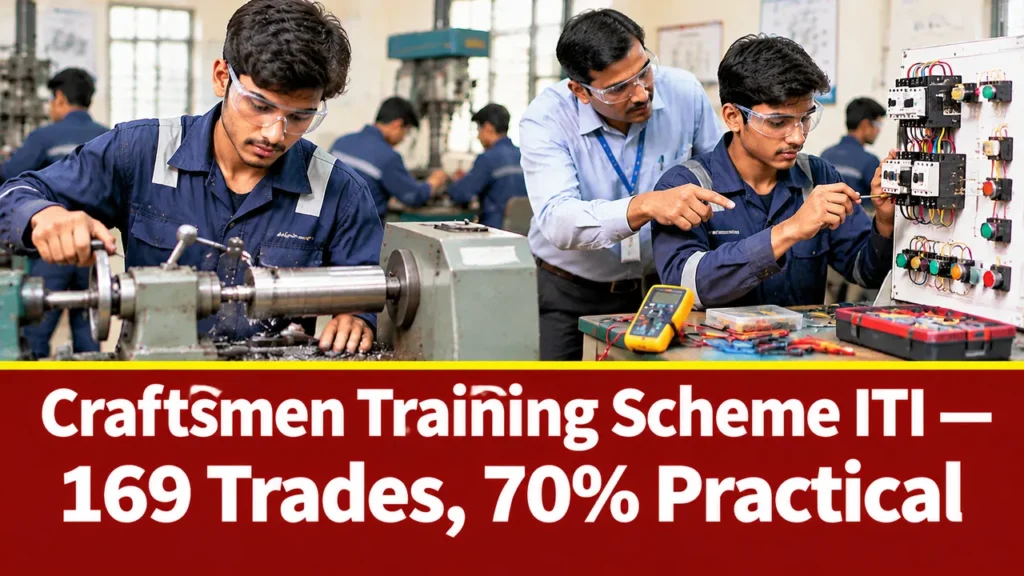
The Central Government’s Craftsmen Training Scheme (CTS) is India’s oldest and largest vocational training programme. It was launched in 1950 and runs through the Directorate General of Training (DGT) under the Ministry of Skill Development and Entrepreneurship. Under this scheme, young people get practical job skills at Industrial Training Institutes (ITIs) across the country. CTS currently covers 169 trades — from conventional trades to newer Industry 4.0 trades. The training is 70% practical work and 30% theory.
Which trades and how long
CTS trades fall into two groups — engineering trades (electrician, fitter, welder, turner, mechanic, refrigeration and air conditioning) and non-engineering trades (stenography, sewing technology, computer operator, health sanitary inspector, fashion design and technology). Course duration depends on the trade and ranges from 6 months to 2 years — 2-year trades such as electrician and fitter, 1-year trades such as welder and plumber, and 6-month short trades as well. The restructured course load is 1,200 hours of learning a year plus 150 hours of On-the-Job Training (OJT) in industry every year.
Who can apply
The entry qualification depends on the trade — Class 8th or 10th pass is required. Most trades need a 10th pass, while some trades accept an 8th pass. There is no upper age limit fixed by the scheme itself, but age conditions may differ by trade and state rules. ITI admissions happen every year in July–August — check the notification of your state’s skill development department. Admission is through merit or the state’s admission process. CTS trades run in both government and private ITIs.
Certificate and what comes next
After completing the training, candidates appear in the All India Trade Test (AITT). Those who pass get the National Trade Certificate (NTC), which is recognised across India. State-level trades get the State Trade Certificate (STC). The NTC is valid for recruitment to government jobs, PSUs and the private sector, and it also qualifies the holder for apprenticeship under the National Apprenticeship Promotion Scheme (NAPS). In Haryana, an industry-integrated CTS pathway also runs at the Maruti Suzuki plant in Gurugram, where ITI training happens inside the plant itself.
How to apply
For ITI admission, check the website of your state’s skill development or technical education department — in Haryana the admission notification is issued by the state directorate. Fill the online form, choose your trade and ITI, and seats are allotted as per the merit list. Keep your Class 8th/10th marksheet, Aadhaar card, caste certificate (if applicable) and photographs ready at admission time. Fees in government ITIs are very low, and in many states the fee is waived for SC/ST students — check your state’s fee structure in the admission notification.
Frequently Asked Questions
Q1: What is the Craftsmen Training Scheme?
A: It is the Central Government’s vocational training scheme run through ITIs — training in 169 trades for 6 months to 2 years, running since 1950.
Q2: Who can apply?
A: Young people who have passed Class 8th or 10th, depending on the trade — most trades need a 10th pass.
Q3: What certificate is given on completion?
A: The NCVT National Trade Certificate (NTC) after passing the AITT, recognised across India.
Q4: When do ITI admissions happen?
A: Every year in July–August — check your state skill development department’s notification.
Useful links
- Directorate General of Training (DGT): https://dgt.gov.in/
- Craftsmen Training Scheme on MyScheme: https://www.myscheme.gov.in/schemes/cts-msde
- Next Action: see all 726 Central Government schemes — /english/kendra-sarkar-ki-yojnayen-2/




Leave a Reply