Modi Cabinet Approves Rs 4,371 Crore VISTAR Scheme for India to Modernise National Statistics
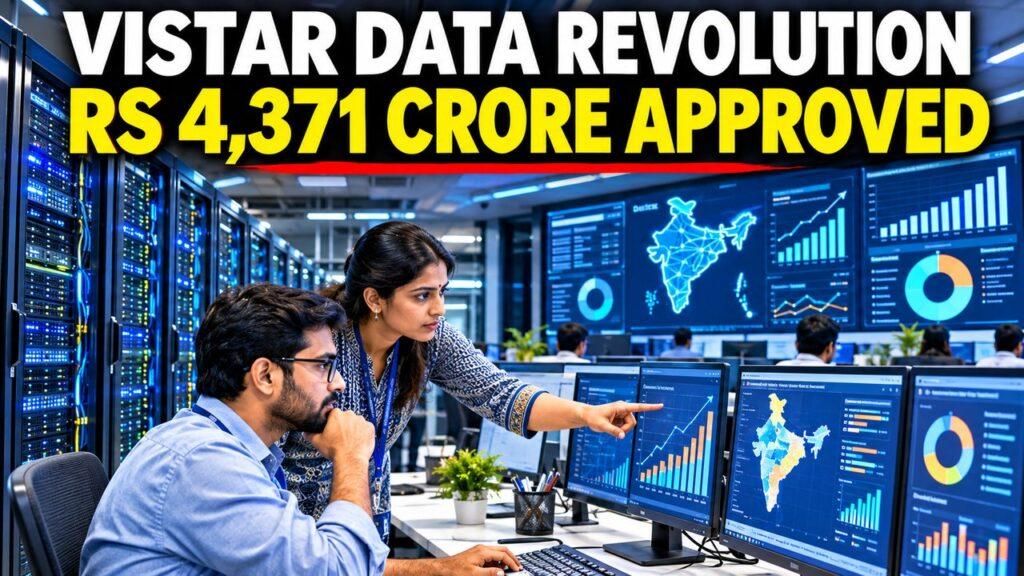
The Union Cabinet chaired by Prime Minister Narendra Modi on Wednesday approved the Viksit Bharat Initiative for Statistical Transformation, Analytics and Research, known as VISTAR, with an outlay of Rs 4,371.10 crore. Information and Broadcasting Minister Ashwini Vaishnaw announced the decision after the Cabinet meeting on 4 November 2026, saying the scheme will run from financial year 2026-27 to 2030-31. The scheme is designed to give India a dynamic, real-time and future-ready official statistical system, aligned with the national goal of Viksit Bharat by 2047.
Good statistics are the foundation of good policy. Governments, businesses and researchers all rely on official data to decide where to invest, which schemes are working and where help is needed most. The VISTAR scheme will bring together all statistical and data management activities of the Ministry of Statistics and Programme Implementation under one umbrella, with a focus on timeliness, finer detail, and datasets that can be combined across sources and used with modern analytical tools. The ministry says the scheme will allow resources to be allocated flexibly according to immediate policy needs, rather than being locked into rigid yearly plans.
The scheme has three components. The first is comprehensive statistical operations and strengthening of the ecosystem, under which the ministry proposes to conduct 59 surveys during the 16th Finance Commission cycle, compared with 43 major surveys conducted previously. The extra surveys are meant to fill data gaps in sectors where policy decisions are currently taken with incomplete information, enabling more timely and targeted interventions. The second component is Support for Statistical Strengthening, which helps states and union territories build their own statistical capacity, so that national and state data improve together. The third component is the Economic Census, the nationwide count of business establishments that maps the structure of the economy.
Technology runs through the whole design. Building on recent digital transformation in data collection, the ministry will focus on end-to-end digitalisation of statistical processes, from field collection on handheld devices to processing and dissemination. Artificial intelligence and machine learning will be embedded in regular workflows, mainly for data processing, validation and analysis, helping to catch errors early and speed up the release of results. The scheme also aims for harmonised, AI-ready datasets, so that data from different surveys can be compared and combined without lengthy manual reconciliation.
Minister Vaishnaw described the decision as a complete revamp of the country’s statistical system, pointing to better survey methods, stronger validation processes, university certification courses to build statistical skills, and reduced collection bias. The emphasis on ground truthing, collection frequency and periodic assessment reflects a simple idea: data is only useful if it is accurate, current and trusted. A statistical system that publishes faster, covers more of the economy and validates its figures more rigorously gives every policy decision a firmer base.
Over the five years to 2030-31, VISTAR will therefore shape how India measures itself. The 59 surveys, the Economic Census and the state-strengthening work will feed into growth estimates, employment figures, price indices and the many sectoral indicators that guide budgets and schemes. For citizens, the change will show up indirectly but importantly: in policies designed from fresher evidence, in schemes targeted with better data, and in a national debate grounded in numbers that are easier to trust.