The Haryana Government has notified a scheme to give major help to the state’s micro and small enterprises (MSEs) for jointly setting up a Common Facility Centre (CFC). Under the Haryana MSE Common Facility Centre Scheme, 10 or more MSEs can come together to form a Special Purpose Vehicle (SPV) and set up a shared centre — the government will give up to 80 per cent of the project cost, up to a maximum of Rs 5 crore. A group of 15 or more MSEs will get up to 70 per cent, up to a maximum of Rs 10 crore. The scheme was notified in the Haryana Government Gazette on 16 November 2026 and is being implemented under the Haryana Progressive MSME and Export Promotion Policy 2026.
This guide gives everything as per the Gazette — eligibility, the conditions for forming an SPV, which expenses get help, which documents are needed, the complete application process, DPR, approval and the arrangement for receiving the money in instalments.
At a Glance: MSE Common Facility Centre Scheme
| Point | Details |
|---|---|
| Scheme name | Haryana MSE Common Facility Centre Scheme |
| Notification | 16 November 2026, No. 02/04/2026-1IB-II, Gazette Extraordinary No. 175-2026/Ext, pp. 3589–3599 |
| Parent policy | Haryana Progressive MSME and Export Promotion Policy 2026 (in force from 29 July 2026) |
| Scheme duration | 5 years from 29 July 2026, or till the validity of the policy / a new policy — whichever is earlier |
| Help in Category I | At least 10 MSEs — 80% of project cost, up to Rs 5 crore |
| Help in Category II | At least 15 MSEs — 70% of project cost, up to Rs 10 crore |
| Applicant | SPV — a Section 8 (Not-for-Profit) company registered under the Companies Act, 2013 |
| For whom | Micro and small (manufacturing or service) units of Haryana — traders not eligible |
| Where to apply | Online on the Invest Haryana New Single Window portal |
| Approval | State Level Steering Committee (SLSC), chaired by the Administrative Secretary, Industries and Commerce Department |
| Who will release the money | Director General, Directorate of MSME, Haryana |
| Deadline for making the centre operational | Operational within 18 months of final approval; the complete project to be finished within 24 months of approval (extension of up to 6 months possible) |
What Is a Common Facility Centre?
A Common Facility Centre (CFC) is a shared centre — a facility that several small units build together and use together. A single small unit cannot install an expensive machine, a testing lab, a design centre or a cold storage on its own, because the cost is beyond its reach. In a CFC, 10–15 units share the same facility, which reduces the cost for each unit and gives it access to modern technology.
The objective of the scheme is clear — collective growth, greater competitiveness and the sustainable development of MSEs. Through a CFC, units will get modern technology, testing and quality facilities, shared production and processing facilities, skill development and other shared services that would not be economically possible for any single enterprise on its own. Sharing resources and economies of scale will reduce operating costs, raise productivity and efficiency, upgrade technology, improve product quality and market access, and increase investment and employment in the state.
How Much Help Will You Get? Up to 80%, Rs 5 Crore or Rs 10 Crore
The amount of help depends on how many MSEs are in the SPV:
| Category | Minimum MSEs in SPV | Government help | Maximum grant | Minimum SPV contribution |
|---|---|---|---|---|
| Category I | At least 10 (manufacturing/service) | 80% of eligible project cost | Rs 5 crore | 20% of total project cost |
| Category II | At least 15 (manufacturing/service) | 70% of eligible project cost | Rs 10 crore | 30% of total project cost |
The remaining project cost will have to be borne by the SPV from its own contribution or other eligible sources permitted under the scheme — the amount above the maximum limit will also be borne by the SPV. The number of MSEs in the SPV will be fixed as on the date of application and should remain the same throughout the period. The government’s contribution will be treated as “gap funding”, and no single member of the SPV can hold more than 10% of its equity capital (or equivalent capital contribution). All participating units will remain independent of each other in financial stakes and management.
The examples below are only to explain the calculation — these are not scheme figures:
| Example | Project cost | Calculation as per the rule | Help you will get |
|---|---|---|---|
| Category I — project of Rs 6 crore | Rs 6 crore | 80% = Rs 4.8 crore (within the Rs 5 crore limit) | Rs 4.8 crore; SPV contribution 20% = Rs 1.2 crore |
| Category I — project of Rs 7 crore | Rs 7 crore | 80% = Rs 5.6 crore (above the limit) | Rs 5 crore (the limit will apply) |
| Category II — project of Rs 12 crore | Rs 12 crore | 70% = Rs 8.4 crore (within the Rs 10 crore limit) | Rs 8.4 crore; SPV contribution 30% = Rs 3.6 crore |
| Category II — project of Rs 16 crore | Rs 16 crore | 70% = Rs 11.2 crore (above the limit) | Rs 10 crore (the limit will apply) |
| 1.5 times rule — Rs 5 crore help needed | — | Total plant-and-machinery investment of members must be at least 1.5 × Rs 5 crore | Investment of at least Rs 7.5 crore needed |
What Is an SPV and How Is It Formed?
The applicant under this scheme will not be a single unit, but a Special Purpose Vehicle (SPV) — a Section 8 (Not-for-Profit) company registered under the Companies Act, 2013. The members of the SPV will only be micro or small enterprises with valid Udyam registration and GST registration.
1. Who will form the SPV together: A group of functional micro and small units (manufacturing or service) engaged in similar activities in an identified area. Members of the SPV can also be from an adjoining district — units in a 50–60 km vicinity/geographical area can come together to form an SPV.
2. SPV first, centre later: Forming the SPV is necessary before setting up and running the proposed CFC. The SPV must be inclusive — it must have a provision for adding new members, so that new entrepreneurs of the cluster can also use the facility.
3. Number of members: There is no maximum limit on the number of members in the SPV — only the minimum number is fixed (10 for Category I, 15 for Category II).
4. One MSE, maximum two SPVs: An MSE that is already a member of one SPV can become a member of only one more SPV — no MSE is allowed to be a member of more than two SPVs, whether the SPV is old or new.
5. Monitoring committee: The SPV will have an Executive Monitoring Committee (EMC), which will include a representative of the local technical institute of the district concerned and at least 3 representatives of the applicant (including Board members). The EMC will monitor activities related to the CFC becoming operational and running.
Who Is Eligible?
Only those SPVs will get the benefit of the scheme that fulfil all the conditions given below:
1. Valid registration: All members must have a valid Udyam registration number and GST registration number as on the date of application.
2. 1.5 times investment: The total gross investment of all members in plant and machinery in their own units must be at least 1.5 times the help sought for the CFC. That is, if Rs 5 crore help is sought, the total investment of the members must be at least Rs 7.5 crore.
3. At least half the members experienced: At least 50% of the MSEs in the SPV must have been in operation for at least 4 years before the application. Proof will have to be given through balance sheets, income tax returns, GST returns, bank statements or other related documents.
4. Traders not eligible: Only micro/small units in the manufacturing or service sector are eligible — traders cannot get help under this scheme.
5. Clean record: Members of the SPV must not be wilful defaulters under RBI rules and must not be blacklisted or debarred by any government agency/department or the Central/State Government.
6. Service enterprises also eligible: Service-sector units can also set up an AI Lab, IT Lab, emerging technology, testing lab, common kitchen, common laundry or a similar facility that meets the shared need of the partner enterprises, as a CFC.
7. Upgradation of an existing CFC: A CFC built under the State Mini Cluster Development Scheme of HEEP 2020 and EPP 2015 and successfully running for at least 3 years can be upgraded under this scheme — only once during the policy period. “Successfully running” means: (a) the total revenue/turnover from operating the CFC in the preceding 3 financial years must be at least 50% of the government help received for its establishment — for CFCs with R&D and new-product development activities (tool/die/mould making, 3D printing, designing facility, sampling facility) this limit is 25%; (b) there must be operating profit in at least 2 of the preceding 3 financial years and a positive net worth; (c) all statutory filings must be complete and there must be no dues to any financial institution or government authority. Upgradation can be at the same location or at another location in the same district; in the case of a lease, a fresh registered lease deed of 10 years from the date of application will have to be given; new eligible members can be added with the approval of the competent authority. Upgradation can include modernisation of machinery and equipment, adoption of advanced technology, and improvement of shared infrastructure and testing and quality-control facilities.
8. Category of the enterprise: The category will be checked from the latest Udyam registration certificate:
| Category of enterprise | Investment in plant and machinery (maximum) | Annual turnover (maximum) |
|---|---|---|
| Micro | Rs 2.5 crore | Rs 10 crore |
| Small | Rs 25 crore | Rs 100 crore |
Which Expenses Count and Which Do Not?
Eligible expenditure is the new investment that the applicant makes within the CFC premises during the policy period on infrastructure/associated utilities (excluding land), building (including storage, testing, office space), plant, machinery, equipment, power backup arrangement, waste management plant, air pollution control system, hardware and software — this expenditure will be counted only once during the policy period.
Will not count: Taxes, fees, cess and other statutory charges — including GST, customs duty, excise duty, stamp duty and registration charges; working capital, goodwill, preliminary and pre-operative expenses (except the cost of preparing the DPR, project implementation charges and regulatory approval fees), capitalised interest, and the cost of acquiring technology or technical know-how — including royalty, design and drawings, patents, licences and other intellectual property rights, whether or not they are capitalised in the accounts.
Keep two things in mind about the building. First: the cost of constructing a new building for the CFC is also eligible, but only up to a maximum of 30% of the total project cost — that is, in a project of Rs 6 crore, only up to Rs 1.8 crore on the building will be treated as eligible expenditure (this is a calculation example, not a scheme figure). Second: the cost of your own land or building can be counted in the total project cost to decide the size of the project, but it will not be treated as eligible expenditure for the grant.
Machinery must be new — no help will be given under this scheme for old, second-hand or refurbished machinery.
What Facilities Can Be Built in the Centre?
The Gazette lists the facilities that can be built as a CFC under “hard interventions” — a common production/processing centre (to balance/improve the production line that a single unit cannot do on its own), design centre, testing facility, training centre, R&D centre, marketing display/selling centre, common logistics centre, common packaging and labelling centre, common cold storage centre, common printing/packaging design centre, common digital marketing/e-commerce centre, common raw material bank/sales depot, incubation centre, or any other specialised common service facility needed by the cluster.
The way is open for service-sector units too — an AI Lab, IT Lab, emerging technology, testing lab, common kitchen, common laundry or a similar facility that meets the shared need of the partner enterprises can be built as a CFC.
Which Documents Are Needed?
The following documents will have to be uploaded on the portal with the online application:
| No. | Document | Remarks |
|---|---|---|
| 1 | Application form in the prescribed format (Annexure-I) | For all |
| 2 | Certificate of Incorporation of the applicant (SPV) | For all |
| 3 | List of members of the applicant (Annexure-II) | For all |
| 4 | Incorporation/registration certificate or partnership deed of each member, along with a copy of the Udyam registration certificate and GST registration certificate | For all |
| 5 | Balance sheet, profit-and-loss statement and GST returns of each member for the immediately preceding financial year | For all |
| 6 | Audited accounts/financial statements for the preceding 3 financial years, for an existing CFC (HEEP 2020 / EPP 2015) | Only in case of upgradation |
| 7 | Background Verification Form of each member (prescribed format) | For all |
| 8 | Geo-tagged photographs of each member unit and the existing CFC | For all |
At the time of submitting the DPR, a CA certificate and, wherever applicable, CE (Mechanical) and CE (Civil) certificates will also have to be given. No application fee is given in the Gazette — so no fee is written here.
How to Apply?
1. Where to apply: The complete application, in the prescribed format (Annexure-I) with the necessary documents, will have to be made online on the Invest Haryana New Single Window portal. Until the new portal becomes operational, applications will be accepted through the existing procedure or e-mail decided by the Directorate. After the portal becomes operational, all applications will be taken only through the portal — before sending the application, do check the current method of application from your District MSME Centre; no method is written here on guesswork.
2. Last date to apply: No last date for the initial application is given in the Gazette — the scheme will remain in force for the policy period (5 years from 29 July 2026).
3. Preliminary scrutiny: On receiving the application, the portal — wherever the system is connected — will itself pull the records of the related government departments and agencies. The Directorate of MSME or a third-party agency appointed by it will carry out the preliminary scrutiny of the application.
4. If there is a deficiency: If any deficiency is found in the preliminary scrutiny, all deficiencies will be communicated together on the portal within 10 working days of receiving the complete application. 30 working days will be given to remove the deficiency, and this chance will be given only once. If the deficiency is not removed in time, the claim will be rejected and the applicant informed by e-mail.
5. Detailed scrutiny: After all the information is complete, the Directorate or the third-party agency will carry out a detailed scrutiny — checking the documents and certificates and other verification needed under the policy and the scheme. After that, the case will be put up to the Director General, Directorate of MSME, for approval to prepare the DPR.
How Will the DPR Be Prepared and Who Will Approve It?
The DPR (Detailed Project Report) can be prepared in two ways — (a) by an agency empanelled by the Directorate for cluster projects, on the applicant’s recommendation and with the approval of the Director General, MSME; or (b) by a consultancy agency appointed by the applicant, with the prior approval of the Director General (if the agency is not empanelled). The cost of preparing the DPR and implementation support will be treated as per the eligible provisions of the scheme. At the time of submitting the DPR, a CA certificate and, wherever applicable, CE (Mechanical) and CE (Civil) certificates will have to be given.
The DPR will be appraised by SIDBI or another commercial bank at the applicant’s cost. After the DPR is evaluated by the Director General, Directorate of MSME, the case will be placed before the State Level Steering Committee (SLSC).
The SLSC will be chaired by the Administrative Secretary, Industries and Commerce Department, Haryana. Its members will be — the Director General, Industries and Commerce; the Managing Director, HSIIDC; a representative of the Finance Department; a representative of the State Level Bankers’ Committee (SLBC)/SIDBI; and the Director General, MSME (Member Secretary). The Chairperson can add other members as needed for the proposal. Meetings will be held at least once every two months (at least 6 meetings a year); a meeting can also be called at other times at the Chairperson’s discretion.
Understand one thing clearly — SLSC approval does not mean the final sanction of the grant or a firm commitment from the government. The Directorate will carry out a detailed due diligence at the time of releasing the grant. The SLSC’s decision will be final and binding on all on the interpretation of the scheme’s provisions and on eligibility and selection. After approval, any change in the project can be approved only by the SLSC.
How Will the Money Come? In Two Instalments
The grant will come in two instalments of 50% each — and this too will depend on the availability of budget.
| Instalment | Amount | Time limit to apply | Main condition |
|---|---|---|---|
| First instalment | 50% of the total sanctioned grant | Within 6 months of the approval letter being issued | The SPV must have invested/spent 100% of its own contribution + adequate progress at the site |
| Second instalment | Remaining 50% | Within 10 months of receiving the first instalment | 100% utilisation of the first instalment + 100% civil work complete + sanctioned machinery delivered at the CFC |
Documents for the first instalment: A bank guarantee equal to the first instalment (in favour of the Director General, Directorate of MSME, valid for 2 years); a CA certificate — proof of actual expenditure on the project’s infrastructure and of 100% utilisation of the contribution; land papers — a sale deed in the applicant’s name or a registered lease deed of 10 years; CE (Civil) certificate (if applicable); CE (Mechanical) certificate; a Surety Bond on non-judicial stamp paper of not less than Rs 100 — notarised, with the signatures of 2 independent witnesses, along with a Board resolution; CLU/NOC (as applicable); Consent to Establish (CTE) from HSPCB; and other conditions of the approval letter. After all checks are complete, the Director General, Directorate of MSME, will give the final sanction for the first instalment.
Documents for the second instalment: A bank guarantee equal to the second instalment (valid for 2 years); a CA certificate — proof of 100% utilisation of the first instalment; CE (Civil) certificate; CE (Mechanical) certificate; and other conditions. Within 3 months of receiving the second instalment, its utilisation certificate and the actual expenditure certificate signed by a CA will have to be given.
What if there is a delay: If the application is not made within 6 months for the first instalment or within 10 months for the second instalment, a proper reason for the delay will have to be given with the application. The case will be placed before the SLSC, which will decide on continuing the financial assistance or on an extension.
Single instalment in special cases: If the project involves a single machine/equipment or limited machines and the project can be substantially completed without phased civil works, the entire sanctioned grant can be given in a single instalment — conditions: online application with reasons within 8 months of the approval letter; 100% of the own contribution invested and valid purchase orders placed for the sanctioned machinery; machinery delivered at the CFC before release; a bank guarantee equal to the complete grant (2 years); CA certificate; CE (Civil) and CE (Mechanical) certificates; land papers (10-year lease deed); Surety Bond; CLU/NOC; CTE from HSPCB. The utilisation certificate and CA expenditure certificate will have to be given within 3 months. This arrangement will apply only when the Directorate is satisfied that the project can be substantially completed in a single cycle and a one-time grant is appropriate.
Project management fee: The consultancy agency will get a maximum of 3.5% of the total project cost (including preparing the DPR and implementation support) — this will be part of the eligible expenditure and the Directorate will pay the agency directly by deducting it from the grant. Payment will be made in three stages — 1.5% of the project cost on DPR approval by the SLSC; 1% on release of the first instalment; and 1% on release of the second instalment. For example, on a project of Rs 10 crore, the maximum fee will be Rs 35 lakh — Rs 15 lakh on DPR approval, Rs 10 lakh on the first instalment and Rs 10 lakh on the second instalment (this is a calculation example).
Conditions and Timelines After Approval
By when must the centre be made operational: The CFC must be made operational within 18 months of the date of final approval — extension is possible with the approval of the Director General, MSME. The complete project must be finished and made operational within 24 months of the date of approval; the SLSC can give an extension of up to 6 months for reasons beyond the applicant’s control. These two time limits are given at different places in the Gazette and are written here exactly as they are — before applying, do check the time limit applicable to your project from the District MSME Centre.
How long must the centre be run: The CFC must be run for at least 5 years from the date of commencement of operations. The plant, machinery, fixtures and equipment must be insured at the applicant’s own cost for at least 5 years.
Records and audit: Complete records of the expenditure on the purchase of immovable assets and other eligible components for setting up the CFC will have to be kept — the statutory auditor(s) of the State Government can inspect and audit them.
If the cost rises: Any cost escalation above the sanctioned amount will have to be borne by the applicant. If the location of the CFC has to be changed, it can be changed to a nearby alternative location by informing the Directorate.
Who can use it: The services of the CFC can be used by the members of the SPV and by other units of the cluster as well. The user charges will be close to the prevailing market prices, to be decided by the EMC; members may get reasonable preference in charges and capacity utilisation.
Rules for purchase and construction: Plant and machinery must be purchased directly from the Original Equipment Manufacturer (OEM), its authorised dealer or another authorised channel. Building construction must be done through a contractor empanelled with any Haryana Government Department/Agency. For cost verification, the last 3 sale invoices/bills for the same or identical plant/machinery/equipment and estimates/quotations from eligible contractors for the building will have to be given with the DPR — the benchmarked cost fixed from these will be the eligible expenditure. Civil works will be as per the schedule of rates of CPWD, HSIIDC, PWD or an equivalent government department; if the actual cost is more than the benchmarked cost, the lower of the two amounts will be counted.
What Happens If Wrong Information Is Given?
At the time of taking the grant, the applicant will have to give a Surety Bond on stamp paper of Rs 100. As per the bond, if the conditions of the grant are violated, the applicant will have to return the entire grant with 12% annual interest. If any part of the grant remains unspent, 12% annual interest will be charged on it until it is refunded. If there is unauthorised use of the asset created from the grant (such as letting it out at a wrong rent or using it for a wrong purpose), the economic benefit gained from it will also have to be returned to the government — the decision of the Administrative Secretary, Industries and Commerce Department, in this regard will be final and binding.
There is no provision for appeal in this scheme’s notification — the SLSC’s decision is final. The government can withdraw, suspend, change or discontinue the scheme at any time; approval does not create any firm right to receive the grant.
Other Help Under the Same Policy You Should Know
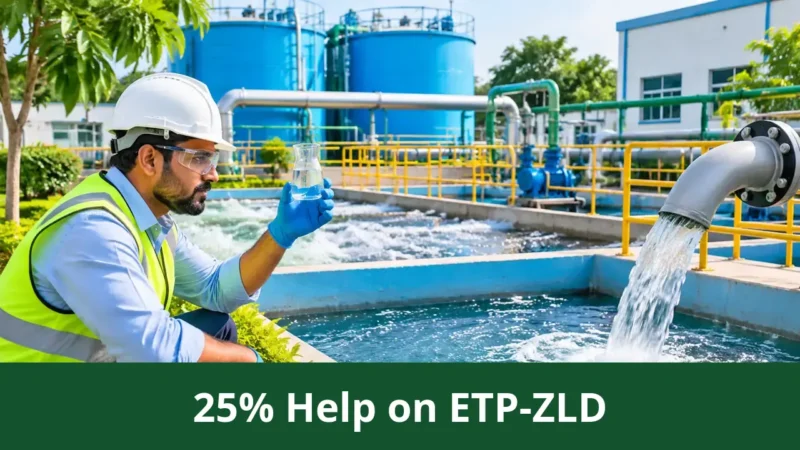
Under the same Haryana Progressive MSME and Export Promotion Policy 2026, there is more help for MSMEs — help on solar rooftop and energy efficiency under the Greening scheme (see our MSME Green Subsidy guide), 25% reimbursement on ETP and ZLD (up to Rs 1 crore on ETP, up to Rs 5 crore on ZLD), the AI Lab and MSE insurance schemes, PADMA branding, and help on diesel generator sets and EV cargo. These are separate schemes — do not mix their figures with the CFC; every scheme has its own conditions and limits.
Frequently Asked Questions
1. What is the Haryana MSE Common Facility Centre Scheme?
This is a Haryana Government scheme under which a group (SPV) of micro and small enterprises can jointly build a Common Facility Centre — such as a testing lab, design centre, shared production centre or cold storage. The government gives up to 80%, up to Rs 5 crore (10 MSEs), or up to 70%, up to Rs 10 crore (15 MSEs). The scheme was notified on 16 November 2026.
2. What is the difference between Category I and Category II?
Category I needs at least 10 MSEs — help of 80%, up to Rs 5 crore; the SPV’s contribution is at least 20%. Category II needs at least 15 MSEs — help of 70%, up to Rs 10 crore; the SPV’s contribution is at least 30%. In both, no single member can hold more than 10%.
3. Who can become a member of an SPV?
Only micro or small enterprises — in the manufacturing or service sector, with valid Udyam registration and GST registration. Traders are not eligible. At least half the members must have been in operation for at least 4 years. One MSE can be a member of at most two SPVs.
4. Can an existing CFC also be upgraded under this scheme?
Yes — a CFC built under the Mini Cluster scheme of HEEP 2020 and EPP 2015 and successfully running for at least 3 years can be upgraded, only once during the policy period. Condition for success: in the preceding 3 financial years, the total revenue of the CFC must be at least 50% of the government help received (25% for R&D CFCs), and there must be operating profit in at least 2 of the 3 years along with a positive net worth.
5. How will the money come in instalments?
The grant will come in two instalments — the first 50% and the second, remaining 50%. The first instalment must be claimed within 6 months of the approval letter, when the SPV has invested 100% of its contribution. The second instalment must be claimed within 10 months of receiving the first instalment, when the first instalment has been fully utilised, civil work is complete and the machinery has reached the CFC. A bank guarantee will have to be given for both instalments.
6. Who will approve it, and does approval mean assured help?
The State Level Steering Committee (SLSC) will approve it, chaired by the Administrative Secretary, Industries and Commerce Department. But SLSC approval does not mean the final sanction of the grant or a firm commitment from the government — the Directorate will carry out a detailed check at the time of releasing the money. The SLSC’s decision will be final and binding.
Quiz — Test Yourself
Question 1: How many MSMEs are needed in Category I, and how much help is given?
A. 5 MSMEs, 70% B. 10 MSMEs, 80% up to Rs 5 crore C. 15 MSMEs, 70% D. 20 MSMEs, 50% Answer: B — At least 10 MSMEs, up to 80%, up to Rs 5 crore.
Question 2: What is the maximum help in Category II?
A. Rs 5 crore B. Rs 7 crore C. Rs 10 crore D. Rs 15 crore Answer: C — Rs 10 crore (up to 70%).
Question 3: What kind of company should the SPV be?
A. Private Limited B. Section 8 (Not-for-Profit) company C. Partnership firm D. Sole proprietorship Answer: B — A Section 8 company under the Companies Act, 2013.
Question 4: How much is the first instalment of the grant?
A. 25% B. 40% C. 50% D. 100% Answer: C — 50% of the total sanctioned grant.
Question 5: Within how much time must the CFC be made operational after final approval?
A. 6 months B. 12 months C. 18 months D. 36 months Answer: C — 18 months (the complete project must be finished within 24 months).
Official Links
- Directorate of MSME, Haryana (departmental portal) — msme.haryana.gov.in
- List of District MSME Centres / field offices — msme.haryana.gov.in/field-offices/
- Invest Haryana (New Single Window portal) — investharyana.in
- Udyam Registration (URC) — udyamregistration.gov.in
- Other help under the same policy — MSME Green Subsidy Guide (solar rooftop and energy efficiency) — MSME Green Subsidy: Up to 30% on Solar Rooftop, 40% on Energy Efficiency
- Related: AI Lab Scheme — AI Labs Get up to Rs 15 Lakh, AI Solutions up to Rs 10 Lakh in Haryana
- Related: MSE Insurance Scheme — Haryana MSE Insurance Scheme: 33% of Insurance Premium Back, up to Rs 5 Lakh a Year
Source: The information in this guide is based on the Haryana Government Gazette Extraordinary No. 175-2026/Ext (16 November 2026), Notification No. 02/04/2026-1IB-II, “Haryana MSE Common Facility Centre Scheme” (pp. 3589–3599). Disclaimer: This guide is based on information available on 24 November 2026. Before applying, do check the latest information in the notification from the website of the Directorate of MSME, Haryana (msme.haryana.gov.in) or from your district’s District MSME Centre.