Thumbnail: Viksit Haryana | Haryana solar irrigation clusters: 100, 200 and 500-acre clusters, announced 12 November 2026
Haryana Announces Solar Irrigation Clusters: More Crops With Less Water
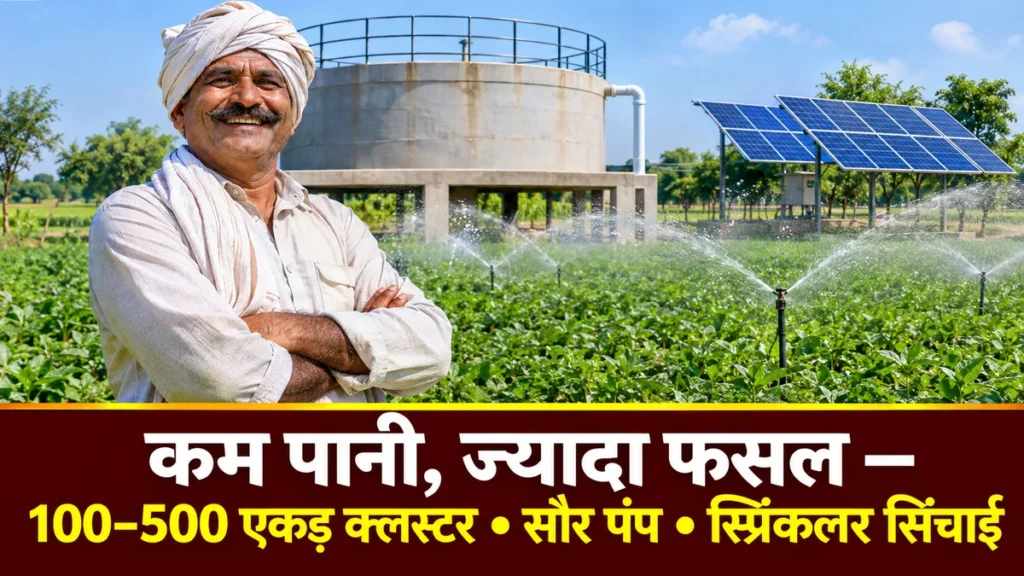
Haryana’s farmers have received big news. Chief Minister Nayab Singh Saini on Thursday, 12 November 2026, announced solar irrigation clusters at the Krishi Sammelan in Bharat Mandapam, New Delhi. Each cluster will have a large water storage tank, and solar-powered pumps will carry water to fields through sprinklers — so more land can be irrigated with less water.
The Chief Minister said cutting the cost of cultivation, securing fair prices for crops and raising farmers’ incomes are the government’s top priorities. The announcement matters because Haryana’s groundwater levels keep falling, and saving irrigation water has become the state’s most urgent farming need.
| Particulars | Details |
|---|---|
| Announcement | Solar irrigation clusters of 100, 200 and 500 acres |
| Water storage | Large tank in each cluster, holding about a month’s water |
| Irrigation method | Solar pumps + sprinkler systems |
| Related announcements | Nearly 2,000 ponds under Amrit Sarovar, canal and drain repair, Renukaji–Kishau–Lakhwar dam agreement |
| Natural farming | Special 2,000-acre cluster in Kurukshetra; natural farming on about 45,000 hectares |
| MSP | Guarantee to procure all crops at MSP reiterated |
| Applications | No application process announced yet — detailed notification awaited |
What is a solar irrigation cluster and how will it work?
The government will form clusters of 100, 200 and 500 acres. Every cluster will have a large water storage tank holding roughly one month’s irrigation water. Solar-powered pumps will move that water to fields through sprinkler systems.
CM Saini said the arrangement will irrigate larger areas with less water and help raise yields. Sprinklers deliver water directly to the crop roots, cutting waste compared with flood irrigation — a far more efficient method for a water-stressed state.
What do farmers gain directly?
The biggest gain is water saving. With stored water in the tank, farmers can water their crops on time even when canal water is unavailable or power supply fails. Running a solar pump also costs far less than a diesel pump.
The second gain is shared access: several farmers will join one cluster, so even smallholders get modern irrigation facilities. The government says this will cut cultivation costs and raise incomes.
What about Amrit Sarovar ponds and canals?
The Chief Minister said work is under way on nearly 2,000 ponds under the Amrit Sarovar scheme. New ponds are being dug and old ones revived to store rainwater and improve groundwater levels.
Canals and drains are also being repaired and strengthened to reduce water wastage. Together with the solar irrigation clusters, this is meant to strengthen Haryana’s irrigation network.
What will the Renukaji, Kishau and Lakhwar dams bring?
The Chief Minister said an agreement involving five states has been reached for the Renukaji, Kishau and Lakhwar dam projects, under the leadership of Union Home Minister Amit Shah. Water from these projects is expected to benefit Haryana, Delhi, Rajasthan and Uttar Pradesh.
He said the government is working on better management of natural water resources so future generations face less risk of water shortage.
What did the CM say on MSP and natural farming?
CM Saini reiterated that Haryana is the first state in the country to guarantee procurement of all crops at the Minimum Support Price (MSP) fixed by the Centre. He said the policy also aims to shift farmers away from water-intensive crops such as paddy.
On natural farming, he said about 1.5 lakh hectares are registered on the state portal and natural farming is currently practised on around 45,000 hectares. An arrangement has been made with farmers in the Morni block to buy naturally grown produce directly from their farms, provided it is grown without chemical fertilisers and pesticides. Panchayat and Agriculture Department land will be given on a 10-year lease for natural farming, and HAFED will procure naturally grown grains in mandis after laboratory testing. A special 2,000-acre natural farming cluster has been announced in Kurukshetra.
Soil testing laboratories at district and block levels are assessing the land of about 40–45 lakh farmers to guide them on fertiliser and pesticide use. He also mentioned the Bhavantar Bharpai Yojana, which protects horticulture farmers against losses from falling market prices, and noted that small and marginal farmers receive Rs 6,000 a year under PM-KISAN.
Do farmers need to apply now?
No — not yet. This is the Chief Minister’s announcement; the detailed notification, eligibility, application process and timeline have not been announced. We will update this story as soon as official information is released. Farmers should beware of fake forms or links and rely only on the Haryana government’s official website and the Agriculture Department.
The detailed notification for this scheme has not yet been officially announced. The information above is based on the Chief Minister’s address at the Krishi Sammelan on 12 November 2026.
Frequently Asked Questions
1. What is a solar irrigation cluster?
It is a group of fields covering 100, 200 or 500 acres, with a large water tank and solar pumps. The tank stores about a month’s water, and sprinklers irrigate the fields.
2. How will farmers benefit?
More land irrigated with less water, savings on diesel costs, and timely water availability are the three big benefits. Small farmers will also get access to modern irrigation.
3. Have applications opened for this scheme?
No. Only the announcement has been made so far. The application process, eligibility and timeline will come with the detailed notification.
4. How many ponds are being worked on under Amrit Sarovar?
According to the Chief Minister, work is under way on nearly 2,000 ponds — new ponds are being built and old ones revived.
5. Is MSP procurement for all crops a new announcement?
No, it is an existing policy that the CM reiterated. Haryana is the first state to guarantee procurement of all crops at MSP.
Official Sources
- Haryana Standard report (12 November 2026)
- National Times Media report (12 November 2026)
- HAREDA Solar Water Pumping Programme (PM-KUSUM, 75% subsidy)