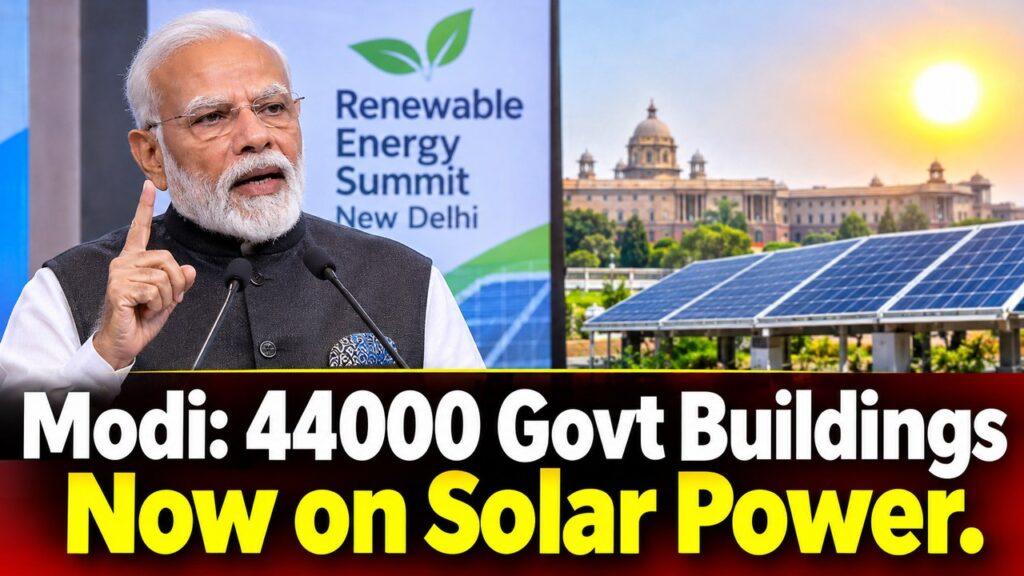
PM Modi at Renewable Energy Summit: 44000 Government Buildings on Solar Saving Rs 700 Crore a Year
Prime Minister Narendra Modi has said that more than 44,000 government buildings across India have been connected to solar energy, generating annual savings of approximately Rs 700 crore. The Prime Minister shared the figures on Monday, 2 November 2026, while inaugurating the Bharat Renewable Energy Summit and Expo 2026 at Bharat Mandapam in New Delhi. The four-day international convention, held under the theme ‘Invest, Innovate, Inspire’, brought together global delegates, clean-technology investors and policy leaders to discuss the future of renewable energy.
Addressing the gathering, the Prime Minister said that over the last twelve years the government has worked systematically to connect industries, farms and households with solar power. He said the government’s ambition extends further, with every government building, school, college, hospital and street-lighting system targeted to come under solar energy. The shift to solar in public institutions not only reduces electricity bills for the exchequer but also cuts dependence on conventional power and demonstrates the government’s own commitment to clean energy before asking citizens to follow.
The Prime Minister also highlighted the rapid progress of the PM Surya Ghar: Muft Bijli Yojana, the central rooftop solar scheme launched in February 2024. Union New and Renewable Energy Minister Pralhad Joshi announced at the summit that total registrations under the scheme have crossed 65 lakh households across the country, and more than 21 lakh households now generate zero electricity bills through their rooftop systems. Under the scheme, eligible households receive direct central subsidies covering up to 40 percent of rooftop solar installation costs, along with the promise of up to 300 units of free electricity per month.
The summit also showcased the PM-KUSUM scheme, under which more than 30 lakh farmers have been provided solar-powered irrigation facilities. The Prime Minister said estimates suggest each farmer can save around Rs 1 lakh annually by using solar pumps instead of diesel or grid-powered alternatives. For farming families, solar irrigation means lower input costs, freedom from erratic power supply and diesel prices, and the ability to irrigate on schedule, which directly supports higher and more reliable crop output.
Looking ahead, the government reconfirmed its target of establishing 500 gigawatts of non-fossil fuel power capacity ahead of the 2030 timeline. The Prime Minister noted that India achieved its Paris Agreement pledge of sourcing 50 percent of installed electricity capacity from non-fossil fuel sources in 2025, five full years ahead of schedule. Production-linked incentive schemes have accelerated gigawatt-scale solar manufacturing facilities across states including Gujarat, Maharashtra and Andhra Pradesh, strengthening domestic capacity. The summit is expected to produce policy recommendations for the next phase of this expansion, as India positions itself as a global leader in affordable, decentralised clean energy.