
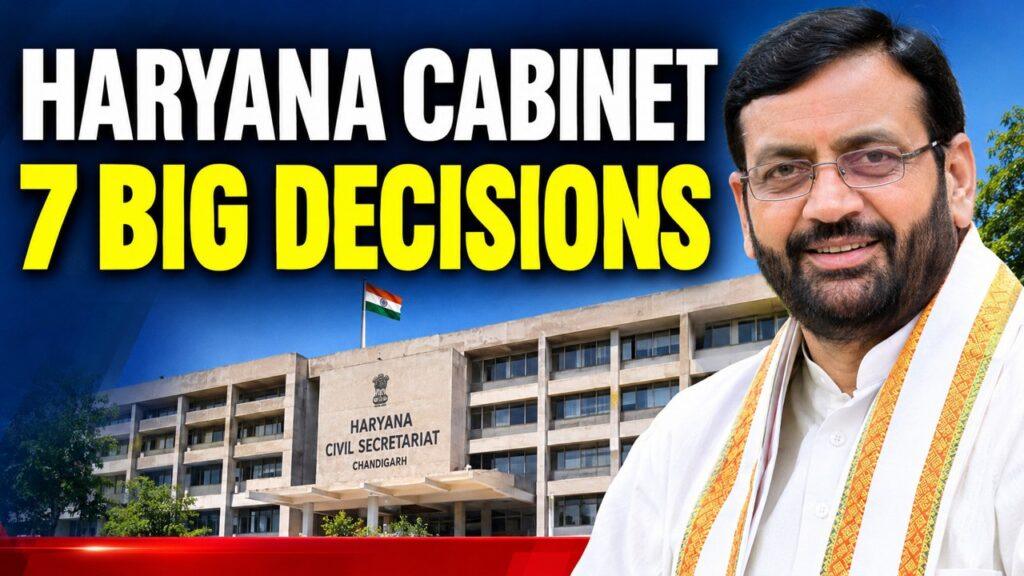
Haryana Cabinet Approves 7 Decisions: Land Pooling Policy 2026, Travel Agents Rules and Special Assembly Session
The Haryana Cabinet on Tuesday approved seven agenda items, including a special session of the state Assembly on 26 November to mark Constitution Day, new rules to regulate travel agents, and a new land pooling policy for planned urban development. The meeting, held in Chandigarh and chaired by Chief Minister Nayab Singh Saini, also cleared an amendment to the state’s transfer of development rights policy.
Officials said the special Assembly session will be convened on 26 November, the day the Constitution was adopted in 1949. Constitution Day is observed every year on that date to recall the adoption of the Constitution and to underline its role in India’s democratic system. The session is expected to focus on the constitutional values and the journey of the republic, with the Cabinet’s approval clearing the way for the formal process of summoning the House.
One of the most important decisions for ordinary families is the Haryana Travel Agents Registration and Regulation Rules, 2026. The rules are aimed at bringing travel agents under a clear registration and regulatory framework, so that people seeking jobs or education abroad are not misled by fraudulent operators. The issue has gained attention because of illegal migration through the so-called donkey route, in which agents charge large sums and send people abroad through unsafe and unlawful channels. By tightening registration and accountability, the government hopes to protect job seekers, improve transparency in overseas recruitment, and make it easier to act against agents who break the rules.
The Cabinet also approved the New Land Pooling Policy, 2026, under which landowners who pool their land for planned development will receive 50 per cent of the developed land in return. Until the developed land is handed over, landowners will receive interim assistance of one lakh rupees per acre per year. The policy is designed to encourage voluntary participation instead of forced acquisition, to unlock land for planned colonies, roads and public facilities, and to give farmers and landowners a direct stake in the value created by development. An amendment to the transfer of development rights policy was also approved, which is expected to make the system more workable for planned growth in urban areas.
Among the other items, the Cabinet cleared amendments relating to the Haryana School Education Rules, 2003, and to the Haryana Shahari Vikas Pradhikaran Employee Welfare Fund Regulations, 2024. Together, the seven decisions cover governance, education, urban development, employee welfare and the protection of people seeking opportunities abroad, reflecting the government’s focus on both planned growth and public safety.
The decisions come at a time when Haryana is pushing ahead with urban expansion around its major cities and trying to curb fraud in overseas recruitment. If implemented effectively, the land pooling policy could speed up planned development while sharing its benefits with landowners, and the travel agents rules could give families a safer way to check whether an agent is genuine before paying large fees. The special session on Constitution Day will also give the Assembly a platform to reaffirm democratic values at a time when debates about the Constitution remain central to public life.