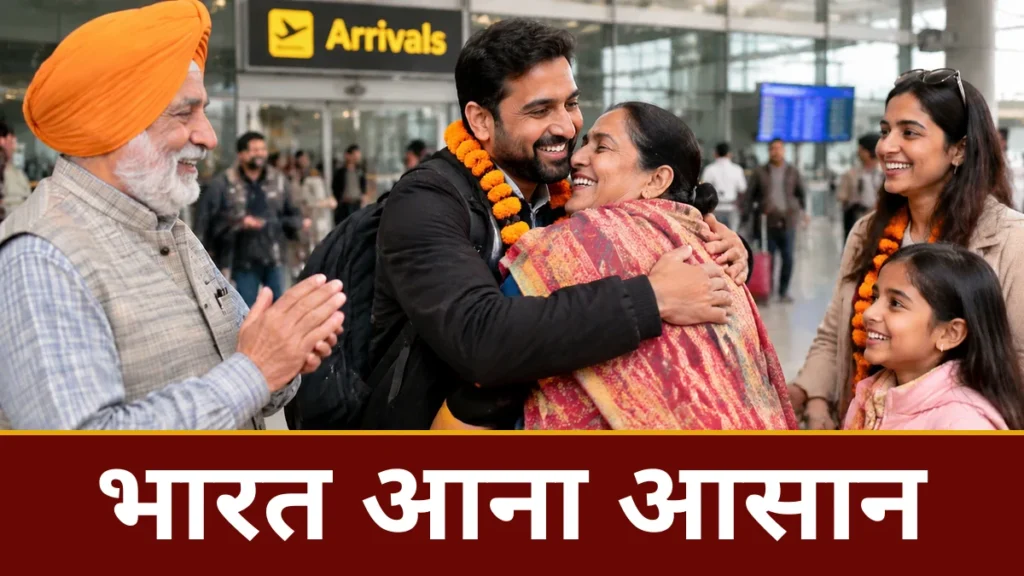
Thumbnail: Viksit Haryana | India visa rules 2026 — categories cut from 13 to 9, announced 11 November 2026
If your parents, children or friends live abroad and visit India — or if you are a foreign student, patient or business traveller planning a trip — your next visa application is about to get much simpler. The Ministry of Home Affairs has cut India’s visa categories from 13 to 9, and the form you fill in is now up to 70% shorter.
The biggest change is one every traveller will notice: the Tourist Visa is gone as a name. It is now the Visitor Visa — and a single trip can now cover a family visit, a business meeting and a medical consultation together. Here is what has changed, who benefits, and when the new system starts.
What has changed? Quick summary
| What | Details |
|---|---|
| Benefit | Fewer visa categories (13 to 9), application forms up to 70% shorter |
| Announced | 11 November 2026, by the Ministry of Home Affairs |
| Changes effective | 27 August 2026; visas under the new system expected by end of 2026 |
| Tourist Visa | Renamed Visitor Visa, split into V-1 (30 days) and V-2 (1, 5 or 10 years) |
| e-Visa | Continues — 13 sub-categories, citizens of 172 countries |
What are the nine new visa categories?
Under the revised framework, India’s nine main visa categories are:
| Category | For whom |
|---|---|
| Business Visa | Business travel |
| Diplomatic Visa | Diplomatic work |
| Work Visa | Employment in India |
| Journalist Visa | Journalists |
| Medical Visa | Treatment in India |
| Official Visa | Government work |
| Student Visa | Study in India |
| Visitor Visa | Tourism, meetings, consultations, cultural programmes |
| Miscellaneous Visa | Other special purposes |
The ministry said it studied the visa systems of developed countries and international standards before making the changes. This is the second round of cuts. In October 2025, the main categories had already been reduced from 22 to 13 and sub-categories from 63 to 49.
Tourist Visa is now Visitor Visa — what can one trip cover?
The Visitor Visa comes in two forms. V-1 is a multiple-entry visa valid for 30 days. It covers tourism as well as short-term activities such as business meetings, medical consultations, wellness retreats, short-duration medical treatment and short-term courses in Indian languages, music, art and craft.
V-2 is for longer visits, with validity of 1, 5 or 10 years. It covers everything permitted under V-1 and also includes mountaineering. A separate six-month multiple-entry visa will be granted for mountaineering expeditions.
The ministry’s point is simple: one visa should cover one trip, even if that trip mixes purposes. Families will no longer need separate visas for separate reasons on the same visit.
Visa forms are up to 70% shorter — what does that mean?
Across all 23 categories and sub-categories, the number of fields in the visa application form has been cut by 65 to 70 per cent, so applicants need to give only the essential information. The e-Visa facility continues through Electronic Travel Authorisation in 13 sub-categories for citizens of 172 countries.
Reports on the ministry’s briefing also mention new sub-categories such as M-1 for medical treatment and M-3 for AYUSH treatment, and S-1 and S-2 for students. The full consolidated list of all 23 sub-categories has not yet been published in full, and this article will be updated when the ministry releases it.
What does it mean for Haryana families?
For Haryana families with relatives living abroad, the change matters at the arrivals gate. A relative can now come on a Visitor Visa and, in a single trip, meet the family, attend a business meeting and take a medical consultation. Students coming from abroad to study in India also get a clearer Student Visa process.
The reform was carried out under Prime Minister Narendra Modi’s leadership and the guidance of Union Home Minister Amit Shah, the ministry said.
When will visas be issued under the new system?
The changes were approved on 27 August 2026. The Home Ministry is updating its IT systems, and visas under the new framework are expected to be issued by the end of 2026. No fixed start date has been announced yet, and this article will be updated when the ministry confirms one.
Frequently Asked Questions
1. When did the new visa rules come into force?
The changes were approved on 27 August 2026 and announced on 11 November 2026. Visas under the new system are expected to be issued by the end of 2026.
2. What is the new name of the Tourist Visa?
It is now the Visitor Visa, split into V-1 (30 days, multiple entry) and V-2 (validity of 1, 5 or 10 years).
3. How much shorter is the visa application form?
The number of fields has been cut by 65 to 70 per cent across all 23 categories and sub-categories.
4. Is the e-Visa still available?
Yes. The e-Visa continues in 13 sub-categories for citizens of 172 countries.
5. Can one Visitor Visa trip cover tourism and a medical consultation?
Yes. That is the point of the change — a single trip can combine tourism with short business meetings, medical consultations, wellness retreats and short cultural courses.
Next Action: Before you apply, check the official India Visa Online portal at indianvisaonline.gov.in for the latest categories and requirements.
Related articles
- National Overseas Scholarship for ST Students: Full Tuition Abroad
- National Overseas Scholarship for SC Students: Full Tuition Plus $15,400 a Year
- Raman-Charpak Fellowship: €1,500 a Month for Research in France
Sources: Ministry of Home Affairs announcement as reported by PTI via New Kerala; Daily Jagran; official visa portal indianvisaonline.gov.in. Hindi version: भारत आना होगा आसान! वीज़ा नियमों में बड़ी कटौती, जानें नया सिस्टम.