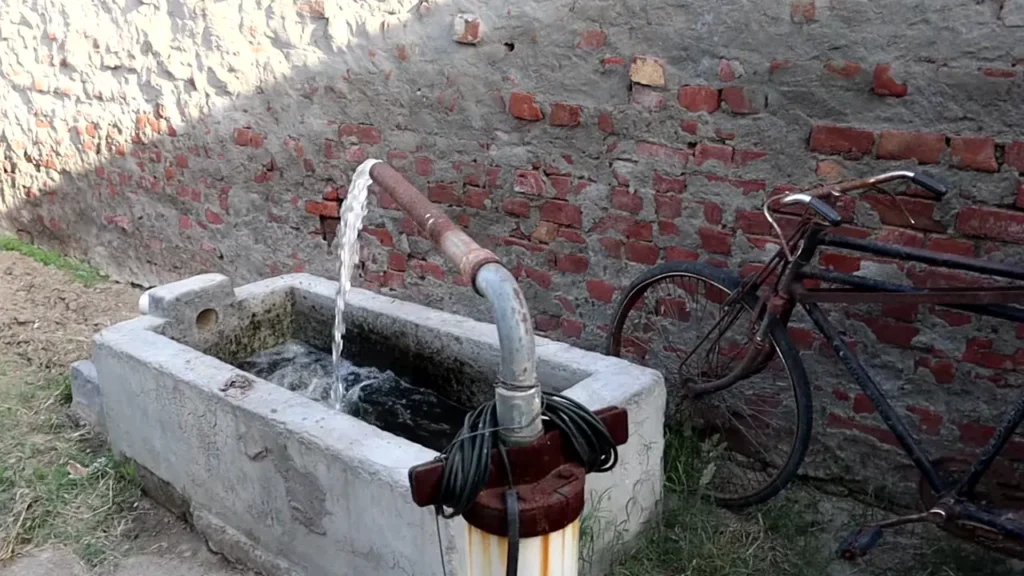
Haryana farmers have received good news. Chief Minister Nayab Singh Saini has directed officials to carry out free scientific testing of water from all tubewells across the state. The entire system will be linked to the Meri Fasal-Mera Byora portal, so farmers can see their sample’s test report and the farming advice based on it online. The decision was taken at a high-level review meeting of the Agriculture and Farmers’ Welfare Department in Chandigarh on Friday, 6 November 2026.
Photo: MaplesyrupSushi / Wikimedia Commons
Chief Minister’s Directions — Key Points
| Point | Detail |
|---|---|
| Decision | Scientific testing of water from all tubewells in Haryana |
| Fee | Free — no charge to farmers |
| Meeting date | Friday, 6 November 2026, Chandigarh |
| Department | Agriculture and Farmers’ Welfare Department, Government of Haryana |
| Where reports will be available | Meri Fasal-Mera Byora portal (fasal.haryana.gov.in), digitally |
| Where to submit samples | Nearest Soil Health Testing Laboratory |
| Helpline | 1800-180-2117 (toll-free) |
What the Water Test Will Check
The Chief Minister directed that tubewell water be tested for carbonates, bicarbonates, calcium, magnesium, sodium, chloride and other essential chemical constituents and water quality indicators. The aim is not merely to hand out a test report, but to build a scientific system of crop selection based on water quality reports.
How to Submit a Sample — Step by Step
Agriculture Minister Shyam Singh Rana explained the correct procedure for collecting a tubewell water sample:
- Run the tubewell continuously for at least 30 minutes before collecting the sample.
- Collect about 500 ml (or 1 litre) of water in a clean plastic bottle.
- Write clearly on the bottle your name, Meri Fasal-Mera Byora (MFMB) ID, village name, Killa/Khasra number, mobile number and the borewell depth (in feet).
- Submit the sample at your nearest Soil Health Testing Laboratory.
- Farmers can submit samples to the nearest laboratory at any time.
For more information, call the toll-free helpline 1800-180-2117 or contact the Deputy Director, Agriculture, in your district.
How the Report Will Help Farmers
The Chief Minister said the government’s objective is not merely to provide water test reports, but to develop a scientific system of crop selection based on water quality reports. Based on the results, farmers will be given clear guidance on which crops are most suitable for their water quality, which crops should be avoided, and which farming practices should be adopted in cases of nutrient deficiencies or specific water-quality conditions. This will help farmers choose the right crop, adopt balanced fertiliser and nutrient management, and improve yields.
Natural Farming Also Discussed in the Same Meeting
In the same meeting, the Chief Minister directed officials to speed up the provisions announced in Budget 2026-27 for promoting natural and organic farming. He asked that the process for the incentive of Rs 10,000 per acre per year to farmers certified by APEDA or adopting natural farming be streamlined so eligible farmers can avail it without difficulty. He also directed that financial assistance of up to Rs 30,000 for the purchase of indigenous cows be effectively implemented, and that natural farming be promoted on nearly 800 acres of land owned by the Agriculture Department. The meeting also discussed promoting Phosphorus Rich Organic Manure (PROM), incentives for higher sugarcane productivity, availability of sugarcane harvesters, tissue culture technology, and subsidies on handheld battery-operated and fuel-operated cotton picking machines.
Existing Soil and Water Testing Network
Speaking at the Agriculture Fair in Hisar on 1 October 2026, the Chief Minister had said that 1.6 crore Soil Health Cards have been issued after testing the soil of farmers’ fields. Seventeen new soil and water testing laboratories have been established in the state, 54 new mini soil testing laboratories have been opened in mandis, and 240 mini soil testing laboratories are already working in schools and colleges. The Har Khet-Swasth Khet portal has also been launched for farmers.
Important Links
| Description | Link |
|---|---|
| Meri Fasal-Mera Byora portal | fasal.haryana.gov.in |
| Haryana Agriculture and Farmers’ Welfare Department | agriharyana.gov.in |
| Helpline (toll-free) | 1800-180-2117 |
Frequently Asked Questions
Q1: Is tubewell water testing free for Haryana farmers, or is there a fee?
A: As per the Chief Minister’s direction, scientific testing of tubewell water will be free. Farmers will not be charged any fee.
Q2: Where should the water sample be submitted?
A: The sample should be submitted at the nearest Soil Health Testing Laboratory. Farmers can submit a sample at any time.
Q3: What details must be written on the sample bottle?
A: Write your name, Meri Fasal-Mera Byora ID, village name, Killa/Khasra number, mobile number and borewell depth (in feet) on the bottle.
Q4: Where will the test report be available?
A: The test report and the related agricultural advisory will be available digitally on the Meri Fasal-Mera Byora portal (fasal.haryana.gov.in).
Q5: How will water testing benefit farmers?
A: The report will show which crops suit the water quality, which crops to avoid, and how to manage fertilisers — helping farmers raise yields and choose crops scientifically.
Note: The exact start date of the free testing system and the number of designated laboratories have not yet been officially announced. Before submitting a sample, please check the latest information with your district Deputy Director (Agriculture) or the helpline 1800-180-2117.
Sources: Chief Minister’s announcement as carried by 5 Dariya News; statement of Agriculture Minister Shyam Singh Rana; Haryana DIPR PRMS press release (1 October 2026).
Also read: Haryana Lado Lakshmi Yojana 13th Instalment: Rs 222 Crore to 10.59 Lakh Women · Haryana Chirayu Extension Scheme 2026: Rs 5 Lakh Free Treatment Cover