
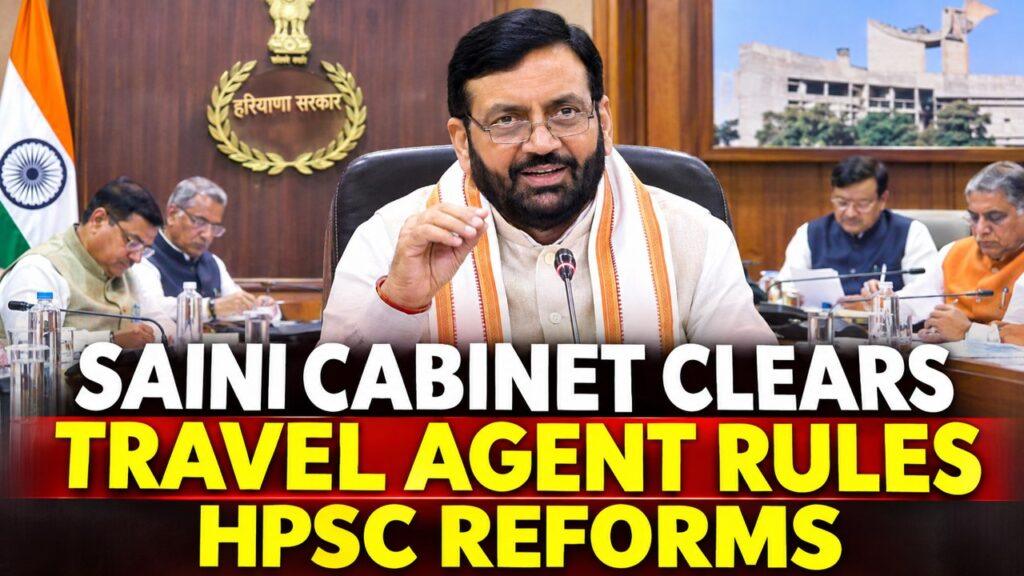
Haryana Cabinet Approves Travel Agent Registration Rules and HPSC Reforms Under CM Saini
The Haryana Cabinet, chaired by Chief Minister Nayab Singh Saini, on Tuesday approved a series of policy and regulatory reforms, including amendments to the Haryana Public Service Commission (HPSC) State Service Group-C Regulations, mandatory registration of travel agents, changes in college cadre service rules, and revisions to the Transferable Development Rights (TDR) policy. The decisions were taken at the meeting of the Council of Ministers in Chandigarh and cover recruitment rules, regulation of overseas travel services, college staffing and urban development. Together, they form part of the state government’s ongoing effort to update service rules and tighten regulation in areas that directly affect citizens.
On the HPSC front, the Cabinet approved amendments to the Haryana Public Service Commission (State Service Group-C) Regulations, 2002, to incorporate newly created posts and to align service provisions with the latest government rules and instructions. Under the revised regulations, the total sanctioned strength of Group-C posts in the Commission will be 85, including 15 newly created positions. These include one Section Officer, three Deputy Superintendents, one Personal Assistant, 25 Assistants, two Senior Scale Stenographers, two Junior Scale Stenographers, six Steno Typists, 13 Drivers, 29 Clerks, one Restorer and two Gestetner Operators. The eligibility criteria have also been revised, so that candidates can now qualify if they have studied either Hindi or Sanskrit at the matriculation level, or Hindi in higher education, replacing the earlier requirement of Hindi up to the matriculation standard. Disciplinary, appeal and service-related provisions have been aligned with the Haryana Civil Services (Punishment and Appeal) Rules, 2016, replacing the reference to the 1987 rules.
The most citizen-facing decision is the approval of the Haryana Registration and Regulation of Travel Agents Rules, 2026, framed under the Haryana Registration and Regulation of Travel Agents Act, 2025. The new rules make registration compulsory for all existing and new travel agents operating in the state. Separate registrations will be required for different service categories, including passport services, tour and travel operations, study visa consultancy and ticketing services. The government said the rules are aimed at protecting youth from fraudulent travel agents, human trafficking, illegal overseas recruitment and risky migration channels. Families in Haryana have in the past lost large sums to agents who promised jobs or study visas abroad and then disappeared, and compulsory registration gives the administration a verified list of agents against which complaints can be checked.
The Cabinet also approved amendments to the Haryana Educational College Cadre (Group-C) Service Rules, 1986, revising qualifications for appointment to the post of Junior Lecture Assistant. For direct recruitment, candidates must have passed 10+2 in the science stream, a change that updates the cadre’s entry qualifications to current academic standards. College laboratories and lecture support depend heavily on these Group-C posts, and the revised rules are intended to ensure that appointees have the science background the work requires. The amendments sit alongside the HPSC changes as part of the same updating of service rules across state institutions.
Alongside these decisions, the Cabinet approved revisions to the Transferable Development Rights policy, which governs how development rights can be transferred when land is used for public purposes. The revised policy framework is part of the state’s urban development toolkit, allowing landowners and developers to work within a clearer set of rules when development moves from one site to another. Taken together, the Cabinet’s decisions show a meeting focused on administration rather than announcements: cleaner recruitment rules, a regulated travel-agent sector, updated college staffing norms and a revised development-rights policy, all approved under the chairmanship of Chief Minister Saini.