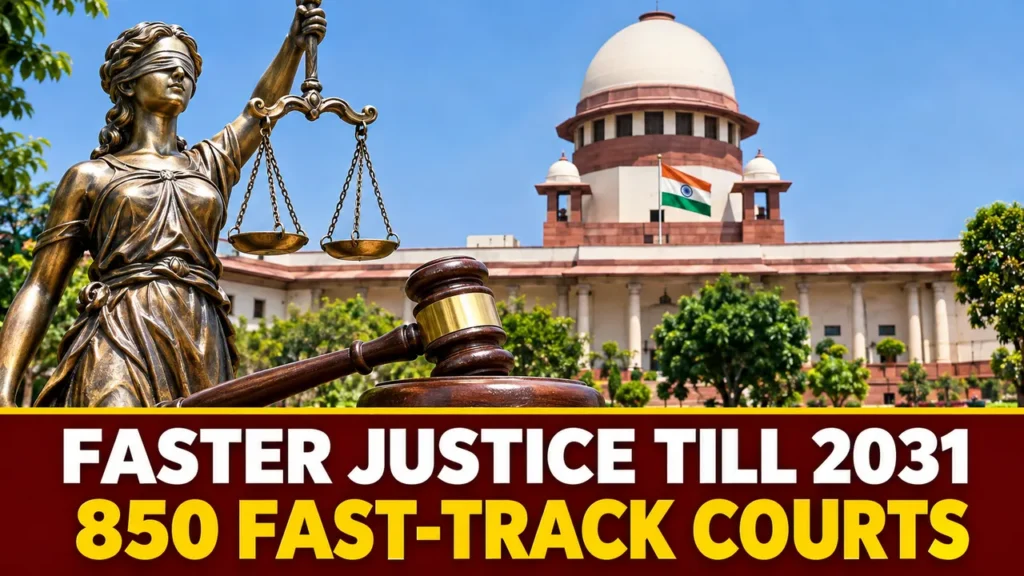
The Union Cabinet chaired by Prime Minister Narendra Modi has approved the continuation of the Fast Track Special Courts scheme for another five years, giving a major push to speedy justice for women and children across the country. The scheme, which covers Fast Track Special Courts including exclusive POCSO courts, will now run from April 1, 2026 to March 31, 2031, with a total financial outlay of Rs 3,788.04 crore. Announcing the decision after the Cabinet meeting on November 4, Information and Broadcasting Minister Ashwini Vaishnaw said the government is committed to ensuring that cases of atrocities against women and children are decided without long delays.
Under the extended scheme, the network of Fast Track Special Courts will grow from the present 779 courts to 850 courts across the participating States and Union Territories. The Central share of Rs 2,353.15 crore will be funded through the Nirbhaya Fund, while the States and Union Territories will contribute Rs 1,434.89 crore. New courts will be allotted to districts on the basis of the pendency of cases, so that the districts with the heaviest backlog get relief first. Each court will have a dedicated judicial officer, a special public prosecutor working full-time for that court, and six support staff, a structure designed to keep trials moving day to day instead of dragging on for years.
The scheme was launched on October 2, 2019, following the Criminal Law (Amendment) Act, 2018 and the directions of the Supreme Court dated July 25, 2019, which called for exclusive special courts in districts with a large number of pending cases. It was initially launched for one year and was later extended up to March 31, 2026. It is currently operational in 29 States and Union Territories, with 779 functional courts, including 399 exclusive POCSO courts. Since its inception, these special courts have disposed of more than 4.02 lakh cases, a record the government cites as proof that dedicated courts, with dedicated prosecutors and staff, deliver faster outcomes than the ordinary trial queue.
Prime Minister Modi welcomed the Cabinet decisions on Wednesday evening, saying they would accelerate justice delivery, strengthen energy security and build domestic capabilities. In his posts, he highlighted the continuation of the Fast Track Special Courts scheme alongside the other decisions taken the same day, including the energy storage and critical minerals schemes. The primary beneficiaries of the scheme are women and children who are victims of offences under the Protection of Children from Sexual Offences (POCSO) Act, 2012, and the scheme’s stated aim is the expeditious trial and disposal of pending cases so that victims do not wait years for a verdict.
The extension matters because delay itself is often the biggest hardship in such cases. By fixing a five-year horizon, assured central funding from the Nirbhaya Fund, and a larger network of 850 courts with full-time prosecutors, the Cabinet has given States a stable framework to plan courtrooms, appointments and support staff well beyond a single financial year. With the scheme now secured till March 2031, the focus shifts to implementation on the ground: filling the new courts, keeping the dedicated prosecutor posts occupied, and bringing down pendency district by district.